By Friday afternoon, plans are already being made. Someone is booking a table, another person is buying tickets for an event, a barber has a full Saturday ahead, a baker is preparing an order, and a taxi driver knows the night might be a long one. Somewhere else, a photographer, DJ, decorator or food vendor is getting ready for their busiest two days of the week.
We tend to think of the weekend as the time when work stops. For thousands of Zambians, it is when work really begins.
Follow the money from Friday evening to Sunday afternoon, and you start to see an economy that is much larger than nights out and Sunday lunch.
What Is Zambia’s Weekend Economy?
It is better understood as all the spending and work that increases when people have time away from their normal weekday routines.
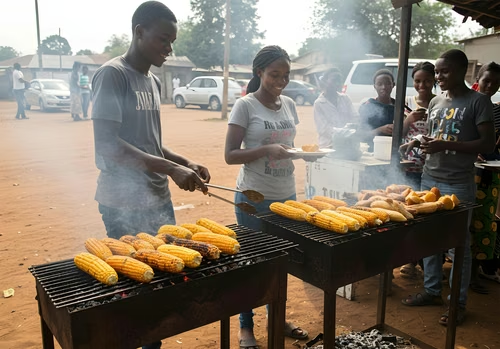
Think restaurants, bars, markets, concerts, weddings, football matches, salons, car washes, lodges, cinemas, takeaway food, taxis, clothing, photography and even the person selling drinks outside an event.

Individually, these may look like small transactions. Collectively, they support workers, businesses and supply chains.
And the sectors most closely connected to leisure are growing. During the first quarter of 2026, Zambia’s arts, entertainment and recreation sector grew by 21.7 per cent, while transportation and storage grew by 9.5 per cent and accommodation and food services by 9.1 per cent. Wholesale and retail trade also grew by 6.7 per cent. These figures cover the entire economy rather than weekends alone, but they show strong activity in industries that benefit heavily from people going out, travelling, eating and spending.
Zambia’s Side Hustle Economy Comes Alive at the Weekend
The weekend economy becomes even more interesting when you look beyond established businesses.
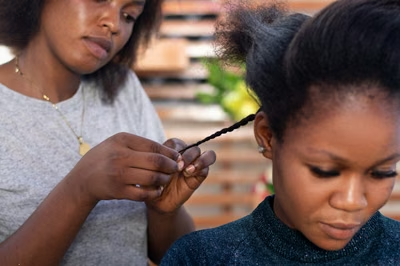
That plate of food ordered through WhatsApp might come from someone's kitchen. Your birthday photographer may work another job from Monday to Friday. The person making cocktails at an event, braiding hair, washing cars or selling clothes online may be earning their most important income on Saturday.
The Zambia Statistics Agency estimated that 74.2 per cent of employed people were in informal employment in 2024. Service and sales work was also the country's largest occupational group, accounting for 30.6 per cent of employed people.
That helps explain why the weekend matters. For someone without a monthly salary, Saturday can be the difference between a good week and a difficult one.
Mobile Money Has Made Weekend Spending Easier
Then there is the phone in your hand.
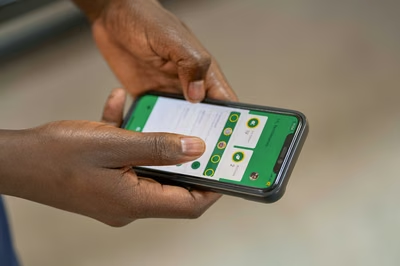
Paying the barber, splitting a restaurant bill, sending money for drinks or paying a vendor no longer always requires cash. Mobile money has made small transactions much easier, particularly for businesses that do not have card machines.
The Bank of Zambia reported that the value of mobile-money transactions increased by 83.4 per cent in 2025, while transaction volumes rose by 65.5 per cent. The Bank said increased merchant acceptance and greater use of person-to-person transfers helped drive that growth.
That matters to the weekend economy because small businesses can now accept payment almost anywhere: at a market stall, from a home kitchen or beside a football pitch.
Restaurants, Events and Tourism Keep the Money Circulating
A weekend outing rarely benefits only one business.
Say you attend a concert. You might buy an outfit before the event, use transport to get there, pay an entrance fee, buy food and drinks and perhaps stop somewhere else afterwards. The organiser has already paid for security, sound, lighting, performers, photographers, cleaners and venue staff.
One person's Saturday night has created income for several other people.
Tourism adds another layer. Zambia recorded about 2.3 million international tourist arrivals in 2025, according to the Ministry of Tourism. Visitors spend on accommodation, restaurants, transport, activities and entertainment, extending the leisure economy beyond residents spending their own weekend money.
The Weekend Economy Is Not Just About Having Fun
There is another side to all this.
A busy restaurant does not automatically mean it is profitable. A sold-out event may still carry high costs. Informal workers may have little protection when business is slow, while vendors can lose an entire day's income to bad weather, transport problems or a cancelled event.
The same flexibility that makes the weekend economy easy to enter can also make income unpredictable.
This is why its growth needs more than customers. Safe transport, reliable electricity, good roads, clean public spaces, security, digital payments and sensible licensing all affect how much money businesses can make — and how comfortable people feel spending it.
Why Zambia’s Weekend Economy Matters
It is easy to dismiss entertainment and leisure spending as money being ‘wasted’. But your restaurant bill becomes someone's wage. Your event ticket helps pay a sound engineer. Your haircut supports a barber. Your weekend away pays lodge workers, drivers, guides and suppliers.
Even the smallest transaction travels.
So the next time Friday arrives and Zambia seems to be switching off, look again. Offices may be closing, but kitchens are getting busy, speakers are being tested, taxis are moving, and traders are setting up.
For much of Zambia’s economy, the weekend is not where the working week ends. It is where business begins.