The “zangena to zero” journey can be over in a breath. In this current economic climate, saving money is important, but for some people, finding ways to make that money generate additional income may also be worth considering.
That is where The K1,000 Manifesto comes in.
Can K1,000 Really Start a Business?
You do not need four walls at the front line of a marketplace, or a five-figure bank balance to start a business. What you need is a strategy for turning your K1,000 into more money, and if you can combine that mindset with a practical skill, the process may become easier.
The trick is to find a product or service that you can sell easily, that you can start cheaply, and that allows you to sell and restock quickly.
Here are five businesses you can start with K1,000, and the numbers behind them.
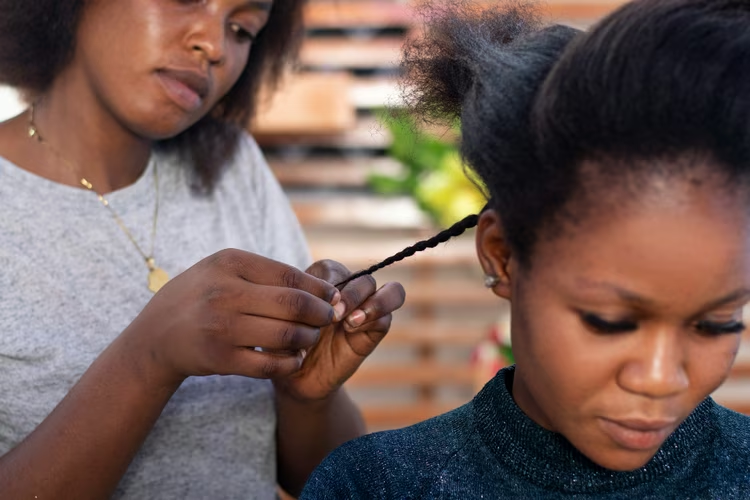
Start a Home-Based or Mobile Hair Braiding Business
Start a small mobile or home-based braiding business. Offer simple styles as you build your skills and slowly build a customer base. With K1,000, you could buy the following products to get started:
- Hair blower — K400
- Shampoo — K60
- Conditioner — K70
- Towels — K100
- Hair spray — K50
- Hair gel — K50
- Combs — K50
- About K230 worth of braiding hair for your first clients, or for resale.
Your first sale could be a simple braid installation at about K150 to K200. For example, five clients in a week paying K180 each would generate K900 in weekly revenue. Over four weeks, that would amount to approximately K3,600 in revenue before expenses.
Depending on your costs, including hair products, braiding hair, transport and electricity, a significant portion of that revenue may be available as profit. Set aside part of your revenue for restocking and business expenses. However, actual earnings will depend on your prices, expenses and the number of clients you serve.
Start a Shoe Cleaning and Laundry Service
A shoe cleaning business can be a relatively low-overhead service because many of the basic cleaning tools can be purchased once and used repeatedly. Profitability, however, will depend on your pricing, customer demand and operating costs. Which, behind all the jargon, simply means it costs significantly less to start it compared to the profit you make from it.
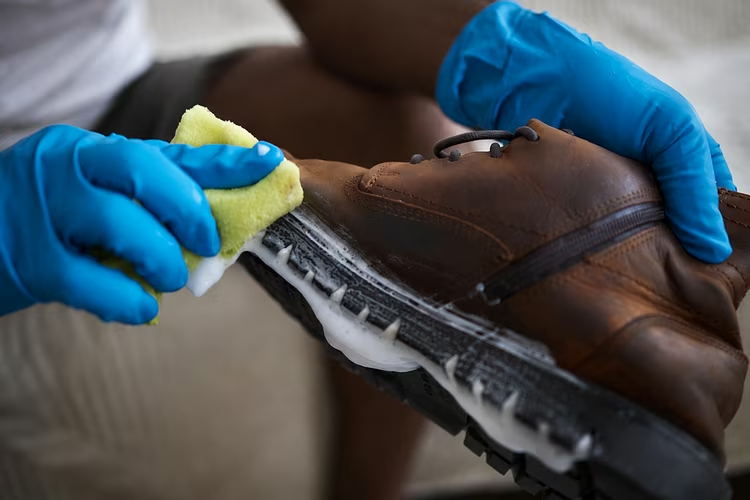
Because most of your clientele will be sneaker lovers, professionals, or students, starting strong with essential equipment and a pickup/delivery model is a good way to launch.
Here are some products you may need, and their approximate costs:
- Multipurpose cleaning concentrate/Dish soap and Laundry detergent mix (K100 – K150): A gentle liquid soap or concentrated shoe cleaner. Starting. For some rubber outsoles and canvas shoes, a mild cleaning solution may be suitable. However, cleaning methods should be adjusted according to the shoe material to avoid damage.
- 3-Piece brush set (K150 – K200): one soft brush, one medium brush and one hard brush.
- Towels (K80 – K120): A 3 - 5-pack of basic microfiber cloths from a local supermarket or wholesale shop.
- Suede brush and eraser set (K100 – K150): A basic suede eraser and crepe brush can help clean suede without using excessive water, which may damage the material.
- Interior disinfectant spray (K50 – K80): A simple antimicrobial/antiseptic aerosol spray to sanitise the inside of shoes.
- Shoe polish (K60 – K100): One neutral or black shoe polish with a small sponge.
- Packaging (K50 – K100): A roll of clear plastic bags and a pad of paper tags/labels to mark client names on shoelaces.
Estimated Total: K690 – K1,000
Sell Fresh Mixed Fruit Cups
Inspired by the ready-to-eat fruit cups sold in many supermarkets, this business involves buying fruit in bulk, chopping it and packaging it in small, clear cups for resale. Sell each fruit cup at K20 to K25.
Fruit prices vary depending on the season, location and supplier. Before starting, compare prices from local markets, supermarkets and wholesale suppliers to calculate how much fruit you can buy within your K1,000 budget.
Start small; the pitfall of this business is mainly spoilage. During hot weather, chilled fruit cups can appeal to students, office workers and commuters looking for a quick and refreshing snack.
Start a Sausage Reselling Business
A business model that has been proven achievable by many university students and neighbourhood parents. Buy sausages in bulk and resell them individually. For example, if a supplier allows you to buy 60 sausages for K600 and you sell each one for K15, you could generate K900 in revenue before deducting costs such as transport, packaging and any spoilage.

The key is rapid stock turnover: sell one batch, recover your K600 stock cost, and immediately reinvest it. The main recurring costs are restocking, transport and packaging. Because sausages are perishable, proper refrigeration, hygiene and safe food handling are essential. Before starting, check local food safety and business requirements that may apply to your operation.
Resell Thrift Clothes and Shoes
With Salaula, strategy and target market are everything. Second-hand clothing resale is a well-established informal and small-business activity in Zambia. However, success depends heavily on the quality of stock, pricing, customer demand and your ability to market your products effectively.
Buy good-quality second-hand clothes from salaula markets at low prices, clean or lightly refurbish them, take attractive photos and resell them through WhatsApp, Facebook, TikTok or directly to customers at a markup.
A K1,000 starting budget could buy approximately eight dresses at K80 each, costing K640 in stock. The remaining K360 could be reserved for washing, transport, packaging, marketing and other operating needs. If each dress sells for K150, selling all eight would generate K1,200 in revenue. Your gross profit on the clothing stock would be K560 before operating expenses.
The same model can be applied to jeans, shirts, jackets, skirts and shoes. Your first sale could happen as soon as you find a desirable piece and list it online. Recurring costs include transport, washing/ironing, packaging and occasional repairs. The biggest risk is buying clothes that look attractive to you but do not sell, so start with small quantities and pay attention to what customers actually ask for.
How to Grow a K1,000 Business
Understand that K1,000 is a starting point, not a magic number. This model could be applied to many different business ideas. The goal is to grow through consistency and discipline. Start small, sell something, keep the numbers, reinvest the profit, and then scale.