What Zambia’s 10-10-5-3-3-1-1-1 Economic Targets Mean
For many Zambians, the first reaction might be curiosity. Is it a code? Coordinates? A secret number known only to a select few? When President Hakainde Hichilema presented the targets at his second-term inauguration at National Heroes Stadium, the sequence left many people wondering what the numbers meant and what they would require Zambia to achieve.
It is, in fact, shorthand for a set of economic targets intended to reshape the scale of Zambia's economy over the next five years.
Ten thousand megawatts of electricity, ten million tonnes of maize, five million tourists, three million tonnes each of copper and soya beans, one million tonnes of wheat, one million tonnes of sugar, and one billion dollars in beef exports. The targets form part of a wider ambition to expand Zambia’s economy substantially over the coming years. The key question is what investment, infrastructure and policy changes will be needed to achieve them.
Why Zambia Needs 10,000 MW of Electricity
Electricity is probably the foundation of most, if not all, these goals. Zambia's experience during the 2024 drought showed how quickly a shortage of power can become an economic problem. Heavy dependence on hydropower left generation vulnerable to low water levels, while mines, businesses, farms and households continued to need electricity. If Zambia wants to produce more copper, irrigate more farmland, process more crops and expand manufacturing, it needs a reliable and sustainable power system capable of supporting that growth.
We can already see signs of a shift. ZESCO's 2025 Integrated Report records the commissioning of the 100 MW Chisamba Phase I solar project, progress on its 100 MW second phase, and additional solar projects including Mansa and other parts of Zambia. The challenge, however, goes beyond adding generating capacity. Electricity must also reach more communities and businesses, while the power system keeps pace with growing and changing demand.
The 10,000 MW target therefore sits at the base of the wider economic ambition. Reaching 10,000 MW will require sustained investment in a more diverse mix of energy sources, alongside the infrastructure needed to deliver electricity reliably.
Can Zambia Produce 10 Million Tonnes of Maize?
Maize, the backbone of Zambia’s agriculture and everyday plate. The 2025/26 Crop Forecasting Survey projects maize production at 4.94 million tonnes, the country's highest recorded harvest. The projected harvest puts Zambia at almost half of its 10-million-tonne target. However, one strong season does not establish that level of production as a permanent baseline. The drought experienced in the 2023/24 farming season is a reminder of how vulnerable agricultural output can be to changing weather conditions.
The government's agricultural plans therefore place considerable emphasis on irrigation, mechanisation, finance, extension services and improved inputs. But producing ten million tonnes is only part of the calculation. The additional maize needs storage, transport, milling and other processing capacity, as well as markets capable of absorbing it. The interesting question is whether higher production can create a larger agricultural value chain rather than simply a larger harvest. Zambia has the land and, in a good season, the productive capacity. The challenge is making that production more consistent and connecting it to the businesses that can turn grain into greater economic value.
What It Will Take to Attract 5 Million Tourists to Zambia
Tourism requires Zambia to sell something very different from maize or copper. The country already has Victoria Falls, national parks, wildlife, rivers, cultural heritage and landscapes that attract visitors from around the world. The difficulty is getting more people to come, persuading them to stay longer and spreading that spending beyond a handful of established destinations.
This is where “Zambia Moves You” becomes more than a slogan. Launched as Zambia’s national brand in March 2026, the campaign is intended to promote the country for tourism, trade and investment. The Ministry of Tourism has linked the campaign to the ambition of attracting more than five million international arrivals by 2031.
The Ministry is also promoting connected tourism circuits, encouraging investment across several destinations rather than concentrating activity around individual attractions.
The Ministry has also reported international arrival figures for the first half of 2026 and projected a higher total for the full year. Reaching five million annual arrivals would require more than marketing alone.
Air connectivity, roads, accommodation, tourism products and visitor experiences all have to expand alongside demand. Tourism development should also extend beyond sightseeing to cultural experiences, Zambian food, stronger digital marketing and greater participation by local communities and businesses in promoting the country.
Zambia’s 3 Million Tonnes of Copper Target
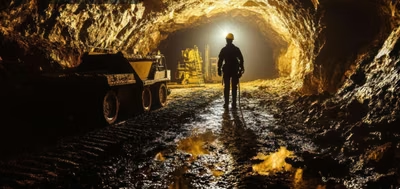
Copper is where the scale of the ambition becomes particularly clear. Zambia’s copper production was reported at 890,346 tonnes in 2025. This would mean that reaching three million tonnes a year would require output to rise to more than three times that level.
Investment is already taking place across the sector, including expansion at major existing mines and the development of new projects. But production at that scale requires more than mining investment. It requires reliable electricity, transport infrastructure, water, skilled workers and the supporting businesses that allow mines to operate efficiently. There is also a wider question about what happens to the additional copper once it has been mined. More production can increase export earnings, but the economic impact will depend partly on how much value Zambia can capture through mining services, processing and industries built around the sector.
Can Zambia Produce 3 Million Tonnes of Soybeans?
Soybeans may receive less attention than copper, but their economic potential extends beyond the farm. They can supply oil processors and animal-feed manufacturers, linking agriculture to poultry, livestock and food production.
The government has identified three million tonnes of soya as one of its agricultural targets alongside maize and wheat.
Getting there, however, requires more than putting additional land under cultivation. Farmers need reliable access to inputs and markets, while processors need enough crushing and storage capacity to handle a much larger crop. The available government data show rising production, but they do not establish a precise pathway from current output to three million tonnes. That makes the target clear, while the scale of investment required to reach it remains a question that needs more detailed sector-specific evidence.
Zambia’s Target to Produce 1 Million Tonnes of Wheat
Wheat presents a different challenge because Zambia imports part of what it consumes. Producing one million tonnes locally could reduce reliance on imports while creating additional activity in irrigation, storage, milling and transport. Reaching the target would require reliable access to water, suitable seed, finance, machinery and infrastructure. How quickly these investments can support production at the required scale remains to be established.
Can Zambia Reach 1 Million Tonnes of Sugar Production?
Sugar is one of the targets where Zambia already has an established industrial base. Zambia Sugar's Nakambala operation has been producing for decades and remains the country's dominant sugar producer. Zambia Sugar produced 372,328 tonnes in the year to August 2025, compared with 425,531 tonnes in the previous year.
Reaching one million tonnes nationally would therefore require substantial expansion beyond recent production levels. The industry's experience also shows why production targets cannot be separated from the conditions surrounding them. Drought affects cane supply, while electricity costs affect processing. Increasing output will require investment in both agricultural production and processing capacity, rather than simply expecting existing operations to produce more. The growth of other sugar producers could also help diversify supply and strengthen competition within the industry.
Zambia’s Ambition to Earn $1 Billion from Beef Exports
Beef may be the most revealing target of all because Zambia is not starting with a billion-dollar export industry and asking it to grow. It is trying to build one.
The first formal export steps have already been taken through certified Animal Disease-Free Compartments, including the 2025 shipment of 55 cattle from Namwala to the Democratic Republic of Congo. For the sector to become a billion-dollar export industry, Zambia needs more than cattle. It needs disease control, veterinary certification, traceability, compliant abattoirs, cold-chain infrastructure and reliable export logistics.
The early progress is significant, but the gap between initial export consignments and annual earnings of US$1 billion remains considerable. Reaching that target would require sustained investment in animal health, export certification, processing capacity and access to reliable international markets.
What Zambia Needs to Turn Its Economic Targets into Growth
The eight targets may appear disconnected at first. Electricity, agriculture, mining, tourism and exports are different sectors, but each depends on infrastructure, investment, skilled workers and reliable markets. Their success will also depend on how effectively these sectors support one another.
More electricity should allow mines and factories to operate. More agricultural production should create demand for storage, processing and transport. More tourists should mean more business for hotels, guides, restaurants and transport operators. More copper could create opportunities and attract international investors. Beef exports require an entire system of veterinary, processing and logistics infrastructure.
That is the real question behind 10-10-5-3-3-1-1-1. The question is not simply whether Zambia can set ambitious targets, but whether it can build the systems needed to turn those targets into sustained economic activity.