A Beginner's Guide to Bonds and Shares
Ba Chanda next door has somehow managed to book a holiday despite earning minimum wage, while Bana Chikondi down the road says she's already planning for retirement. Naturally, you start wondering—how did they do it?
Did they pick extra shifts at work? Open a savings account? Win the lottery? Join a crime syndicate? Or could they have secretly been a billionaire hiding their wealth all along—we will never know! But what we do know is how Ba Chanda and Bana Chikondi could’ve done it: investing in bonds or shares!

What Are Bonds and Shares?
Some might be wondering, what even is that? Well, the Zambian administration borrows money from the people to help fund the country’s budget through something called bonds. When a person purchases a bond, they lend money to the country's administration for a set number of years. Bonds generally pay investors interest every six months (known as coupon payments), while the original amount invested (the principal) is repaid when the bond reaches maturity.
A share represents part ownership in a company. Shareholders may receive dividends if the company declares them, and they may also benefit if the value of their shares increases over time.
Don’t know if this is for you?
I know what many might be thinking as they read this. “Don’t I need at least a ka billion kwacha for this kind of stuff?” Nope! A minimum of K1000 is all one needs to invest in a non-competitive bid government bond. However, should someone have more cash available, they could participate in the competitive bidding, which starts at a minimum of K500,000.

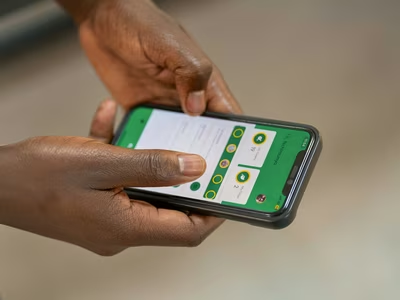
The minimum investment for shares depends on the company's share price and any brokerage fees charged, so some investments can start with just a few kwacha, while others require more. “How difficult is all this?” This can all be done in the comfort of one’s own home, right on their mobile phone! “Where do I even start?” Let’s break it down without further ado:
- To purchase a government bond, one would have to create a Central Securities Depository (CSD) account. To do this, they would need to contact the Bank of Zambia.
Should someone prefer not to manage government bond auctions themselves, licensed brokerage firms in Zambia can handle this for them
- To buy shares, one would have to use the Lusaka Securities Exchange (LuSE) mobile app or work directly with a licensed stockbroker to purchase shares in companies like:
a) Zambia National Commercial Bank.
b) Airtel Networks Zambia.
c) Copperbelt Energy Corporation.
d) Zambia Sugar.
However, keep in mind that this is all general information and opinion intended to be purely educational. Please take the time to correctly research in order to make informed decisions about your money before you invest it.