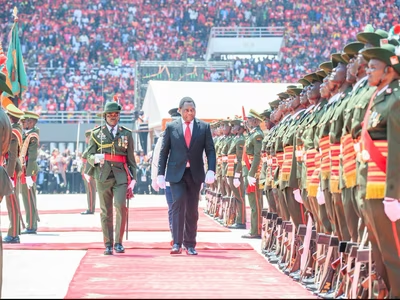
Would you get treatment at a hospital where every doctor, nurse and surgeon was a woman? What if the next Minister of Mines was a woman and the country’s entire mining workforce was female? Would you accept it as simply the way things are, or would the imbalance be impossible to ignore?
Now reverse it.
For most of Zambia’s mining history, operational, technical and decision-making roles were overwhelmingly occupied by men, and few people questioned it. That imbalance has not disappeared. Globally, women are estimated to account for only about 15 per cent of the formal, large-scale mining workforce. Would you say that is simply how things are, or evidence of how slowly one of the world’s oldest industries is changing?
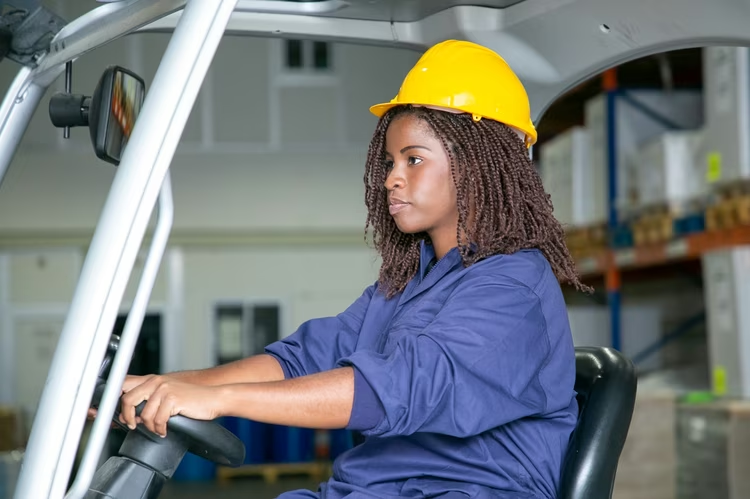
As recently as 30 years ago, it was still rare to find women in fields such as engineering and mining. Those who entered them often found themselves directed towards desk-based or junior roles, while women who reached decision-making positions did so against considerable resistance.
This conversation around women in industry is more than a century in the making. The suffrage movements of the late nineteenth and early twentieth centuries pushed questions of women’s rights and participation into public life. During the Second World War, women entered factories, transport and technical roles in large numbers, only for many to be pushed back into more traditional roles when the war ended.
In Zambia, the reality was not very different. At independence in 1964, every member of the country’s first Cabinet was a man. Women were represented in Parliament, but Zambia would not see its first female full Cabinet minister until 1973, when Dr Mutumba Mainga Bull became Minister of Health.
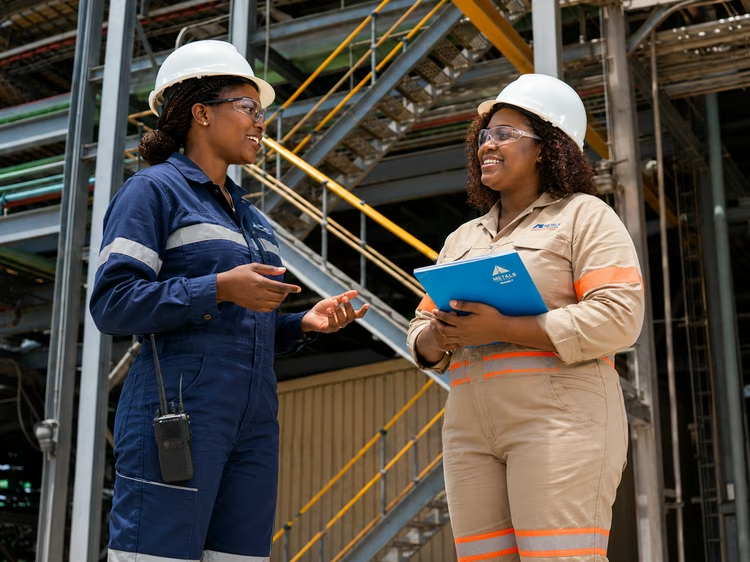
The absence of women from positions of authority was not simply a matter of personal choice. Social expectations, institutional practices and workplaces designed almost entirely around men made it difficult for women to enter, remain and advance in many industries.
However, despite the obstacles, women in Zambia and across the world have continued to enter spaces long dominated by men, make their mark and push industries to reconsider what leadership and technical competence look like.
In Zambia, women accounted for 7.8 per cent of employment in the mining and quarrying industry in 2020. That figure rose to 11.3 per cent in 2023, then fell slightly to 10.3 per cent in 2024. The numbers are moving, but not in a straight line.
One company where the change is increasingly visible is First Quantum Minerals Ltd. In 2025, women made up 12 per cent of First Quantum’s global workforce, up from 11 per cent in 2024, and 17 per cent of employees at supervisor level and above. In August 2025, the company also launched EmpowHER as a pilot in Zambia. By the end of the year, 74 women had participated in mentoring, targeted learning, and career development support to help them progress within the company.
And no, they are not just sitting behind desks. They are working in management, engineering, processing and on-site operations.
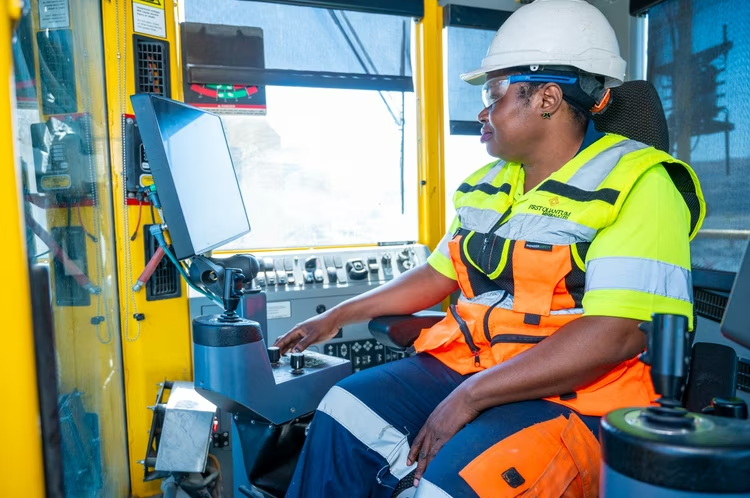
Hellen Chababa operates a rotary blasthole drill rig better known as the Pit Viper. Her journey in the sector began nearly two decades ago, in the mine production department, sharpening drill bits. After four years of continuous learning and determination, Hellen advanced to drill tech operator, a role she held for twelve years. Today, she operates one of the mine's most advanced and powerful drilling machines, playing a critical role in supporting safe and efficient ore extraction.
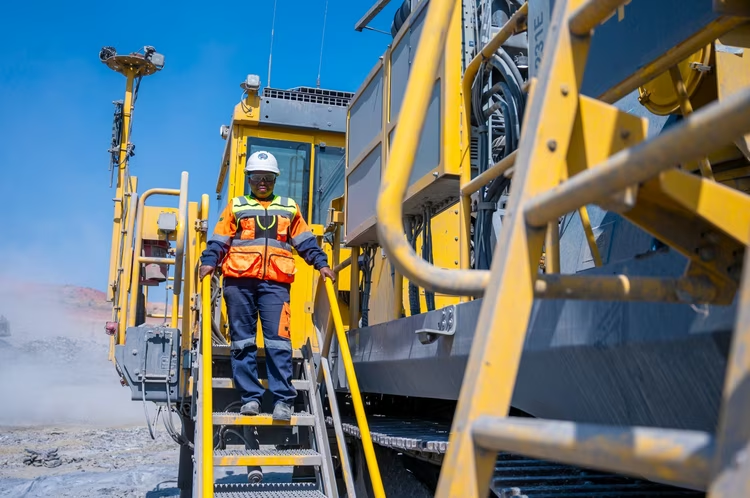
Operating equipment of this scale requires concentration, technical competence and strict adherence to safety procedures. The machines may be intimidating, but the standards against which Hellen is measured are straightforward: production, competence and safety.
In 2019, First Quantum introduced a heavy-equipment operator certification programme in Zambia to improve competency and raise operational standards. Trainees undergo simulator-based instruction covering normal operations, safety procedures and emergency protocols before progressing to practical assessment.
Hellen’s presence in the cab challenges the persistent assumption that women in mining are better suited to administrative or support roles. She is not on the edge of the operation. She is part of the production workforce itself.
Patricia Mankubwa’s career represents another side of the industry. A metallurgical engineer who was nominated for the Mining Personality of the Year award in 2023, Patricia joined First Quantum through its graduate programme in 2015.
She later became the first Zambian and the first woman to serve as technical superintendent at Kansanshi, leading a team of approximately 30 metallurgists, technicians and operatives.
Patricia also played a leading role in the development and operational readiness of the Kansanshi S3 expansion, a US$1.25 billion project that entered commercial production in December 2025. The project added a new 25-million-tonne-per-annum sulphide-processing circuit, substantially increasing Kansanshi’s processing capacity.
But Patricia’s influence has not stopped at balancing equations and overseeing technical systems. She was also at the forefront of pushing for maternity personal protective equipment that would allow pregnant employees to continue working safely and comfortably, as well as pregnancy-safe turnstiles on the premises.
It may appear to be a simple detail, but it exposes a much larger issue. For generations, mine sites were built on the assumption that the workforce would always be male. The equipment, protective clothing and infrastructure reflected that assumption.
Changing it requires more than hiring women. It means adapting the workplace so that they can enter, remain and progress into technical, operational and leadership roles.
It is not yet equal ground, but it is no longer an anomaly to find women operating some of the industry’s largest equipment, meeting production targets or leading technical teams on major projects. Patricia and Hellen’s stories reflect more than personal achievement; they represent the growing opportunities for women in mining and the value of investing in people who are willing to learn, adapt and excel. As more women are trained and trusted to operate equipment, lead teams, and make decisions, they are helping to move mining forward.