Every time you say, “Bakamba, ya 100!” at a filling station, you are seeing the result of a much longer story. That price on the pump board has travelled through international oil markets, exchange rates, transport costs, taxes and regulation before it ever reaches your tank.
And because fuel prices affect almost everything from your daily commute to the price of goods in shops, it helps to know how it all gets there. This is the lowdown on fuel imports and pricing in Zambia.
What determines fuel prices in Zambia?
It starts with the international oil market. Zambia does not produce crude oil, so its petroleum supply depends heavily on imported crude and refined petroleum products, whose prices are influenced by international markets and are generally traded in US dollars.
When international oil prices rise because of geopolitical developments, supply disruptions or increased demand, Zambia can feel the effects because the country has no significant domestic crude-oil production to fall back on.
How the kwacha affects fuel prices
The exchange rate matters too. Since petroleum products are largely traded internationally in US dollars but sold to consumers in kwacha, a weaker kwacha can increase the local-currency cost of imports.
So even if international oil prices remain relatively stable, a weaker kwacha can still put upward pressure on fuel prices.
Why Zambia’s location affects fuel costs
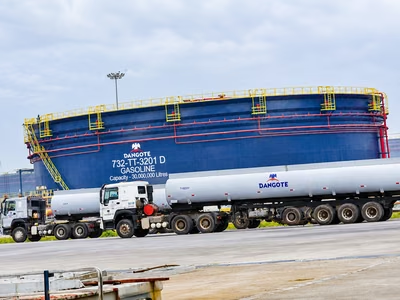
Because Zambia is landlocked, imported fuel has to travel long distances before it reaches filling stations. Depending on the supply route, petroleum products can enter the country through regional ports and transport corridors, including routes through Tanzania, Mozambique and Angola, before being moved inland by pipeline, rail or road.
Each stage of that journey adds transport and logistics costs to the final price. This is one reason the cost of moving fuel around a landlocked country can have a significant effect on what consumers eventually pay.
If only we all travelled by donkey, that would be a whole other situation. Wouldn’t it?
Transport, distribution and fuel margins
Along the way, the businesses involved in bringing fuel to market also need to cover their costs. Oil marketing companies import and distribute petroleum products, while retail dealers operate the individual filling stations where motorists buy their fuel.
Both parts of the supply chain have operating costs and margins that contribute to the final price at the pump. Everybody has to eat, bro.
Fuel prices therefore affect more than motorists. Businesses that rely on transport to move goods, workers and services can also see their operating costs rise when fuel becomes more expensive.
How taxes and government policy affect fuel prices
Government policy adds another layer. Taxes and other fiscal measures affect the final price of petroleum products, and changes to these measures can either increase or reduce pressure on pump prices.
For the September 2026 review, the Energy Regulation Board cited the continued suspension of excise duty and zero-rating of VAT on petroleum products among the measures helping to cushion consumers from higher international prices.
How the ERB helps manage fuel price changes
The Energy Regulation Board also uses its petroleum pricing framework to moderate how changes in international prices and exchange rates are reflected at the pump. This helps prevent every short-term movement in global markets from translating directly into an immediate change for motorists.
The approach is particularly important in a country where international petroleum prices and exchange-rate movements can change the underlying cost of imported fuel.
Why Zambia’s fuel prices stayed unchanged in September 2026
In September 2026, the ERB completed its regular review of domestic petroleum prices and maintained the existing pump prices: petrol at K25.29 per litre, diesel at K26.86, kerosene at K27.02 and Jet A-1 at K28.71.
The review came against a backdrop of upward pressure from movements in international petroleum prices and exchange-rate movements. Geopolitical developments in the Middle East also contributed to uncertainty in global energy markets.
Under normal circumstances, rising international prices and a weaker exchange rate can place upward pressure on domestic pump prices. However, the existing policy measures helped offset some of that pressure.
The continued suspension of excise duty, zero-rating of VAT on petroleum products and the ERB’s pricing framework helped prevent those pressures from translating into an increase at the pump during the September review.
For motorists, that meant fuel prices remained unchanged despite the pressures affecting the cost of petroleum on international markets.
What stable fuel prices mean for businesses and motorists
The stability was also welcomed by industry. The Oil Marketing Companies Association of Zambia said stable prices allowed its members to continue operating, while noting that the outlook for the rest of the year would depend on movements in the kwacha, international crude-oil prices and finished petroleum-product prices.
That matters beyond the filling station. Transport operators, manufacturers, farmers, retailers and other businesses all depend on fuel either directly or indirectly. When fuel prices rise, the increased cost of moving people and goods can eventually affect the prices consumers pay for other products and services.
In short, the number on the pump board reflects several things happening at once. Global oil prices, the strength of the kwacha, the cost of transporting fuel into a landlocked country like ours, and margins for distributors.