The journey reveals that despite expanding human development, critical wildlife corridors still connect the continent's national parks and protected areas.
If you have been following what's trending of late, you would have seen the story of three African wild dog brothers that travelled 4,126 kilometres across the country and into neighbouring nations, which is the longest recorded dispersal for any African mammal. This research shows that wildlife corridors still connect protected areas despite growing human activity, and it offers a glimpse into how endangered species move across the continent.
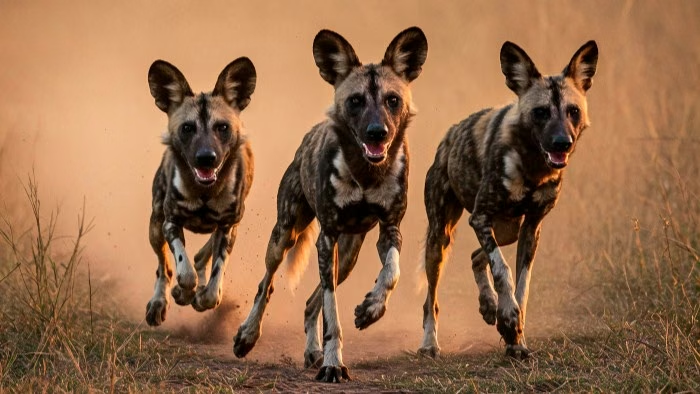
The study tracked 19 groups of wild dogs dispersing across thousands of kilometres of human-dominated landscapes in Zambia and into or close to five neighbouring countries. Among them, the three brothers covered their distance over eight months, repeatedly climbing and descending the Great Rift Valley escarpment while crossing rivers and major roads to skirt cities and lakes. Four groups of 14 dogs that travelled the furthest covered almost 10,000 km.
This extraordinary movement proves that these animals are connecting ecosystems on a massive scale. As farms, roads, and towns fragment wildlife habitat, the connections that sustain species are becoming increasingly fragile and dangerous.
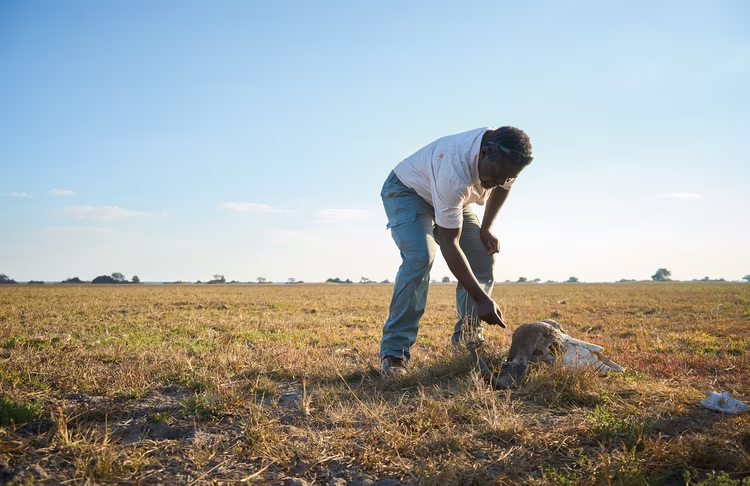
Professor Scott Creel of Montana State University, the paper’s lead author, said that despite their invariably small population sizes and the high risk of mortality in human-dominated landscapes, wild dogs’ enduring capacity to move long distances provides an extraordinary opportunity to conserve a functional meta-population of an endangered large carnivore at the continental scale. Dr Matt Becker, CEO of the Zambian Carnivore Programme, added that rather than relying solely on fenced protected areas, these findings show the value of investing in connected landscapes by supporting habitat, reducing conflict between people and wildlife, and helping communities conserve the areas between national parks that animals depend on.
This is especially relevant for Zambia, where the human population has increased by approximately 50% since 2010, putting immense pressure on wildlife habitats. Bruce Ellender from The Nature Conservancy warned that half of the land in buffer zones has already been converted to agriculture. If this continues unchecked, the opportunity for connectivity between ecosystems would be lost within a decade, which makes this research vital for focusing limited conservation funds on the most important corridors and pathways.
The study’s findings reinforce conservation approaches that focus on conserving the community lands surrounding national parks and the wildlife corridors between them, rather than protecting national parks alone as isolated islands. The government of Zambia has already placed almost 40% of the country under some form of nature conservation designation, but funding to adequately manage these spaces is severely restricted among competing national priorities. As Dr Nyambe Nyambe from the KAZA Secretariat noted, if we conserve and improve these connections spanning the range of national parks and community areas, a lot of species like wild dogs can make the rest happen.
Collectively, dogs that the Zambian Carnivore Programme tracks have now linked all seven ecosystems in Zambia that support resident wild dog populations, with some moving into Mozambique and Malawi. One group from South Luangwa National Park was seen in neighbouring Malawi for the first time in July, which shows that these natural connections still exist and that maintaining continent-wide connectivity remains a realistic conservation goal. The dogs are showing us that connectivity still works, and now we need to do more to protect and strengthen it before these extraordinary journeys become impossible.