“I wish I could work for the mines.”
“There is money in the mines.”
“Once I get into the mines, it's over.”
“I just need one contract with the mines, just one, and I will be set.”
These are the voices you will hear in local conversations surrounding mining in Zambia. Since copper was first struck on the Copperbelt, working for, or doing business with ‘the mine’, has become a local aspiration. From established businesses to individuals, everyone wants to do business with the mines. This begs the question: why is ‘getting into the mines’ such an attractive proposition? The short, uninformed answer you will get on the streets is, ‘The mines pay [well]’. Yes, the mines pay, but what do they pay for? As a global industry estimated at $2.16 trillion, mining does pay, but the real, unspoken motivation lies in probing further into the systems and standards of the businesses that support the mines. What standards, policies and compliances need to be met in the stringent process of doing business with the mines?

In search of reliability, stability and long-term benefits, mines have a long lifespan, often creating bustling business hubs around them. Fuelled by mining growth and expansion, businesses form, towns grow, and individuals and families alike migrate to the area, creating a commercial centre that relies on symbiosis to function. Mines need human capital and equipment; that human capital needs supplies; those supplies and equipment need logistics to reach them; those logistics require road maintenance; and the road maintenance works require heavy machinery, PPE, and essential support requirements to function. As such, a mine cannot exist in isolation. As it grows, so should the people and local businesses alongside, whether through direct or indirect involvement. An inevitable chain of events is set in motion when a new mine breaks ground.
In Zambia, this belief is strong, as evidenced by Statutory Instrument No. 68 of 2025 (SI 68), which came into effect in January 2026. SI 68 requires mining companies to prioritise local companies, with at least 25% of shares owned by Zambians, for goods and services. It also requires mining companies to reserve 20% of procurement budgets for the same, within six months of the regulation’s commencement. In practical terms, this means that Zambian businesses that are registered, compliant, and ready to deliver now have a legal seat at the table that did not previously exist. Although the law does not guarantee a contract, it now guarantees consideration. For prospective suppliers, this distinction matters enormously. Although this recently came into effect, forward-thinking Zambian mining operations have already been employing policies that prioritise local content and encourage capacity building in host communities for decades before it was passed into law.
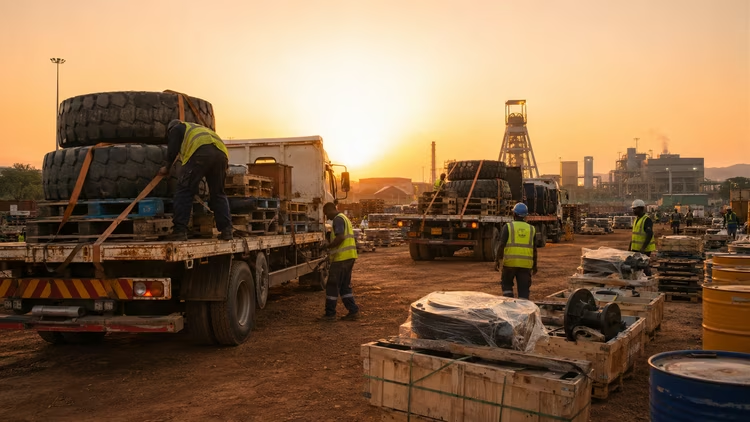
Consider the numbers. In 2024 alone, First Quantum Minerals (First Quantum) spent more than $1.7 billion with Zambian-registered businesses, representing 84% of its total spending on goods and services in the country. To put that into perspective, that figure is equivalent to approximately 6% of Zambia's entire GDP. This is a deliberate and commercially sound strategy that has been at the heart of First Quantum's operations since it first invested in Zambia almost 30 years ago.
Take Mukoleku Security, for example. What began as a small operation with three guards and one bicycle over a decade ago has grown, around the business of mining, into a staff of over 500. Operational discipline, a commitment to safety protocols, and documentation are non-negotiables at any mine. First Quantum, in particular, requires before a supplier ever sees a formal contract. This kind of exponential growth may not have been possible without funding support and training from a mining company that upholds operational discipline and forward-thinking procurement policies. Today, Mukoleku Security is a fully equipped, modernised security force, with plans to expand into the Democratic Republic of Congo, demonstrating resilience and capability beyond a single company contract.
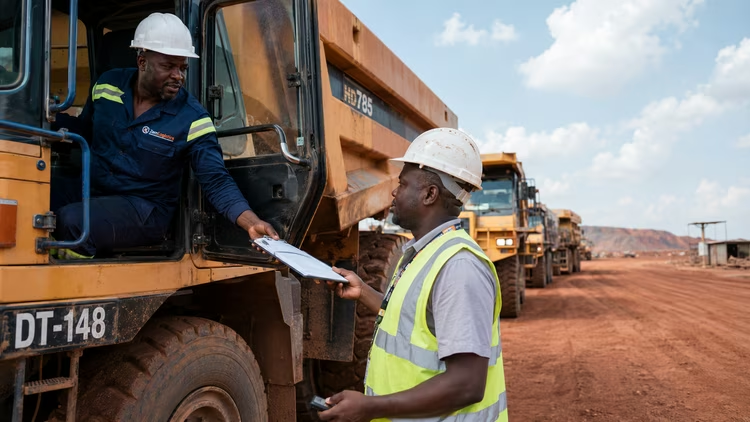
Criticism of the mining industry often cites environmental unsustainability and the commercial booms that disappear at the end of a mine’s life, but Mukoleku Security’s expansion demonstrates that, through strategic formalisation and improved technical capacity, durable and independent business capacity is possible. However, success stories such as this are not without their risks; some businesses fail to expand beyond dependence on a single mine. This leads to over-reliance on a single contract, and when that commodity becomes less favourable or dries up, so does the company’s ability to do business or build capacity in a different sector.
Because of this, the procurement and purchasing processes of each mine matter significantly, as they directly impact the quality of services provided and set the tone for safety expectations, regulatory compliance, reliability, and accountability. For local businesses, working with a large operator that strictly adheres to these requirements by law forces stronger internal systems, and the natural result is a resilient business that can continue to scale regardless of commodity fluctuations.
These deliberate policies, such as sharing value with host communities and enhancing supplier capabilities through training and development to create win-win situations, are why First Quantum has developed a structured approach to procurement and supplier development. Following the implementation of SI 68, First Quantum has expanded its local content scope by outsourcing some internal services, often without changing the scope. This creates a ripple effect, a natural symbiosis, because when one business is empowered, it brings its own business partners, and those business partners bring others into the supply chain. Mineral Link is a wholly Zambian-owned partner of the company, benefiting from First Quantum’s safety and quality assurance training, among other support. Its relationship with the mine began as a support provider with 25 employees and has since transformed into a 200-strong principal contractor responsible for load-and-haul operations at Enterprise. Part of this ripple effect is Mineral Link’s decision to continue partnering with other Zambian businesses, choosing to order machinery locally rather than import it.
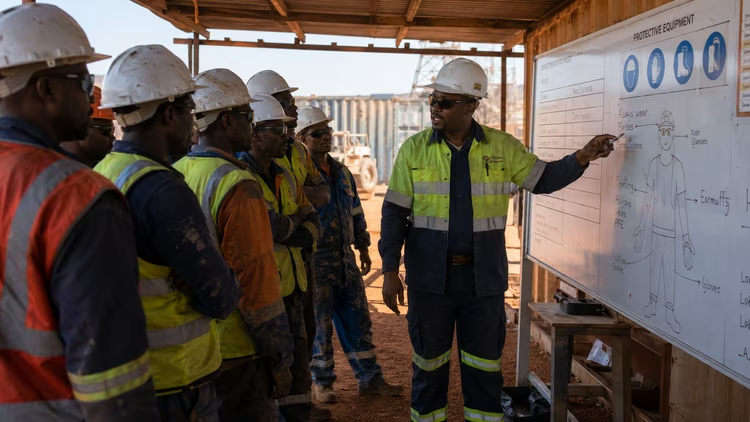
So, what does First Quantum actually look for in a supplier? Beyond registration, the requirements are clear: lawful business practices, safe and fair workplaces, accountability, and zero tolerance for human rights violations. Suppliers are not left to figure out what that looks like on their own. First Quantum provides active training in process management, quality assurance, and safety, making it easier to conduct business for the mines and participate in the benefits the partnership brings. The categories in active demand span a wide range, including lime, silica, haulage, security, signage, spares, ICT, and personal protective equipment. And with Zambia's target of producing three million tonnes of copper a year by 2031, that list of needs will only grow. The Kansanshi S3 Expansion alone engaged over 2,500 Zambians and 535 local companies (during project phase). The pipeline for Zambian businesses is not a promise. It is already in motion.
So, to answer the question, why is working with ‘the mines’ so attractive? Yes, it is because partnering with mines like First Quantum pays in funding, training, national development, and local capacity building. Thanks to these strategic partnerships and to local businesses expanding into the rest of the region, First Quantum’s homegrown Zambian talent is being exported to the rest of the world, whether directly or indirectly, and Zambian skills are building the rest of Africa, beyond a single mine and a single contract.
For Zambian businesses, the opportunity, while real, is not perfunctory, it requires adherence before approaching the table. The businesses that benefit will be those prepared to meet the standards, systems and discipline that mining demands. In this sense, the journey does not begin with a contract. It begins with readiness.