The world wants copper. Zambia has it. But the real opportunity is no longer simply how many tonnes of copper can be extracted, but how much value from that copper Zambia gets to keep.
This goes beyond revenue generation and mining jobs. It reaches into the factories, skills, supply chains, engineering firms and fabricators that can turn extraction into the foundation of a stronger industrial economy. That is the bigger prize; taking advantage of the copper boom and building around it.
The Limits of Extraction
Copper accounts for roughly 60% of Zambia’s foreign-exchange earnings and about 15% of GDP. By any measure, it dominates the national balance sheet. And yet mining employs just 2.3% of the national workforce. This shows that while the sector carries the country, its deeper industrial benefits are too thinly spread.
Too much value leaves before it has had the chance to become local capability. Closing that gap could be Zambia’s next chapter of development.
What that strategy looks like in practice is already visible on the ‘new Copperbelt’, North-western Province. First Quantum Minerals’ Kansanshi mine employs more than 12,000 people, the majority of whom are Zambians, across operations, engineering, maintenance and technical services. When the company built Sentinel, it represented a $2.1 billion infrastructure investment and created around 6,000 jobs. More telling is the S3 expansion at Kansanshi; at peak construction in December 2025, over 2,500 additional Zambian workers and 535 local companies were active on site, creating a market of local capability.
Why This Moment Matters
Global copper demand is rising fast, because of the electrification of everything from transport to industry. In a 2025 report, the International Energy Agency projected demand climbing from 26.7 million tonnes in 2024 to 34.1 million tonnes by 2040.
Zambia produced 890,346 tonnes in 2025 and is targeting 3 million tonnes by 2031, but production ambitions alone should not be the only goal. Zambia’s extraction capacity has been going up, but what is kept is still too small a slice of the pie, resulting in a shallow industrial depth long after the haulage trucks have crossed national lines.
Beyond the Ore
Zambia is already further down the processing chain than its reputation as a raw-material exporter suggests. According to a 2026 IISD assessment, 99% of the country’s copper is smelted or refined into a transportable form domestically, rather than converted into finished manufactured products. With 28 active mining projects and 10 smelters and refineries operating, significant processing is already taking place within the country.
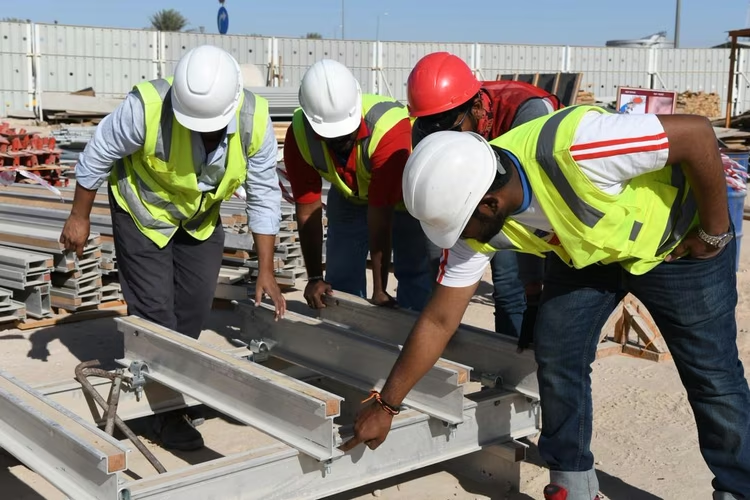
But the current capacity is still not enough. Just 1% of Zambia’s copper exports are finished manufactured products, mainly wire. Plants capable of producing rods, cables, and copper components are operating at only 30 to 50% capacity. Exports of copper rod and cable fell from $189 million in 2013 to $63 million by 2023. It is clear then, that Zambia is not starting from zero. What it needs is more competitive manufacturing, more fabrication and more copper-based products.
And this is where the next layer of value could be built.
Mining as an Industrial Anchor
A major mine generates sustained demand for contractors, engineers, transport providers, laboratories, safety systems, and skilled labour. When this demand flows into capable Zambian firms rather than mainly outward, mining becomes an industrial anchor in its own right.
First Quantum has made local procurement a formal part of its operations. At its Trident operation in the North-Western Province, a business incubation and supplier development programme had engaged more than 550 local suppliers by mid-2025, disbursing close to $400,000 in grants and training, covering business skills, technical capability and access-to-finance support. This support is simultaneously raising the standard. The value lies not only in the support itself but also in helping local firms move up the capability curve and compete for larger, longer-term work.
Since late 2025, Zambia’s local-content mining regulations have required mining and mining-related companies to allocate at least 20% of their annual procurement budgets to local companies that provide core mining goods and services, with a 15% preference margin for qualifying local bids. The regulations make obligatory what companies such as First Quantum had already begun doing by choice, turning mining demand into stronger Zambian businesses that the compete, scale and last.
The Bigger Question
None of this works without reliable power. Zambia’s grid leans heavily on hydropower: clean and cost-effective in good years, fragile in drought years. Reliable energy has the potential to make or break Zambia’s ambitions.
A 100 MW solar project in Chisamba began supplying power to the country in 2025, counting First Quantum as an anchor client for the project, demonstrating how mining-linked investment can support the broader grid and strengthen the infrastructure base needed for industrial growth. A thicker copper economy will need reliable power for mines, smelters, fabricators, industrial parks and the suppliers that surround them.
The National Opportunity
The larger opportunity is practical rather than rhetorical. Zambia does not need to become a major manufacturer overnight. It needs to layer capability where it already has an advantage: refined copper, mine services, supplier networks, regional fabrication and technical skills.
If Zambia gets that mix right, copper could become the base material for an improved economy: one that mines, but also fabricates, services, trains and builds.
The copper boom will reward countries that think beyond the mine. Zambia has the resource. The prize is not how many tonnes we can account for, but how more capability can remain within its borders.