Why Zambia Needed the TAZARA Railway
When Zambia gained independence in October 1964, one major challenge remained: how could a landlocked country move its copper and other essential goods to international markets without depending so heavily on routes controlled by neighbouring governments?
The answer would come in the form of the TAZARA Railway, a line linking Zambia to the port of Dar es Salaam in Tanzania. Built with Chinese support, the railway offered more than a new transport route and became a symbol of economic independence and African solidarity during the Cold War.
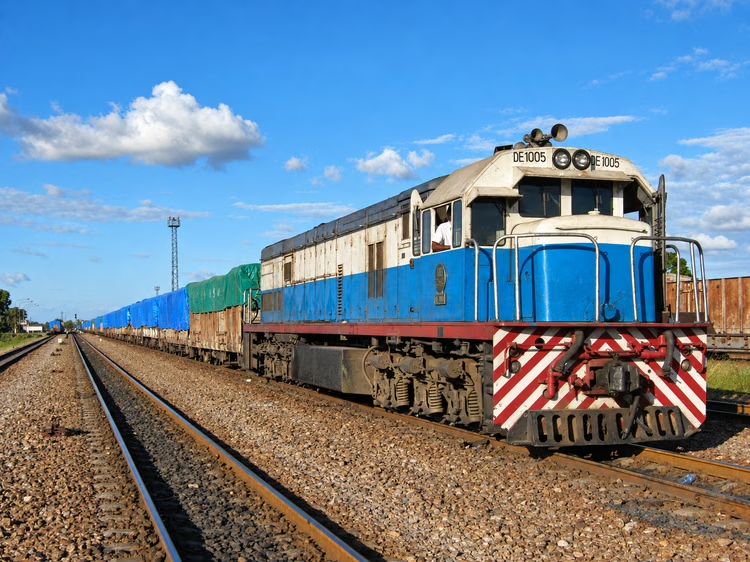
Zambia’s railway infrastructure had been developed during the colonial period as part of a wider Rhodesian network. Zambia’s copper, machinery, fuel and more than half of its imports moved along the railway through Rhodesia and onward toward ports in Mozambique and South Africa, granting the landlocked nation access to sea ports.
However, when Rhodesian Prime Minister Ian Smith’s white-minority government unilaterally declared independence from Britain, an attempt to prevent Britain from imposing majority African rule in Rhodesia, Britain refused to recognise it, and the United Nations subsequently imposed sanctions. This made Zambia’s dependence increasingly uncomfortable and extremely dangerous. Kaunda’s new government was opposing Smith’s government and was supporting the broader African liberation struggle.
It was high time Zambia needed a new railway infrastructure. She looked north. Tanzania under Julius Nyerere was pursuing a strongly anti-colonial foreign policy too.
Tanzania and Zambia came together and drafted the agreement. For Zambia, the solution would be a railway running eastward, connecting her to Dar es Salaam and giving her an independent route to the Indian Ocean. For Tanzania, the benefit would be a railway connecting her to Zambia, bringing transit freight, railway revenue and greater economic activity.
TAZARA Funding: Why China Stepped In
Now, the two African countries needed to source funding in the middle of the Cold War.
The Cold War was a broad global rivalry between the U.S.-led and Soviet-led blocs, and the then-growing Communist China, involving ideology, diplomacy, military power, economics and influence in Africa and in many other arenas. Despite this economic competition, the TAZARA project funding faced numerous rejections, including from the World Bank and the Soviet Union, as it was considered economically unviable.
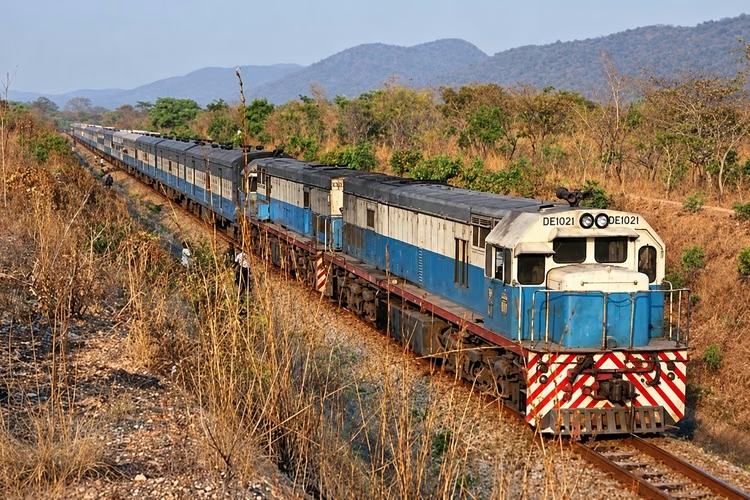
It was then that Tanzania and Zambia turned to China.
For China, the project was going to demonstrate that Beijing could undertake enormous infrastructure projects in Africa and cultivate relationships with newly independent states. China agreed. In September 1967, the three governments signed an agreement in Beijing, with the growing world power subsequently providing an interest-free loan of 988 million yuan that would see the railway become a reality in six years' time.
How China Helped Build the TAZARA Railway
Construction began in October 1970, from both African countries. Workers moved outward from Dar es Salaam in Tanzania and from Kapiri Mposhi in Zambia, with the two sides ultimately destined to meet.
At its peak, the project involved roughly 38,000 Tanzanian and Zambian workers and 13,500 Chinese technical and engineering personnel at the same time. One of the most difficult stretches was the 158-kilometre section between Mlimba and Makambako in Tanzania. Engineers excavated approximately 20 million cubic metres of earth, constructed 46 bridges, bored 18 tunnels and built 362 culverts. Across the completed 1,860-kilometre railway, approximately 89 million cubic metres of earth and rock were moved, while 320 bridges, 22 tunnels and 2,225 culverts were constructed.
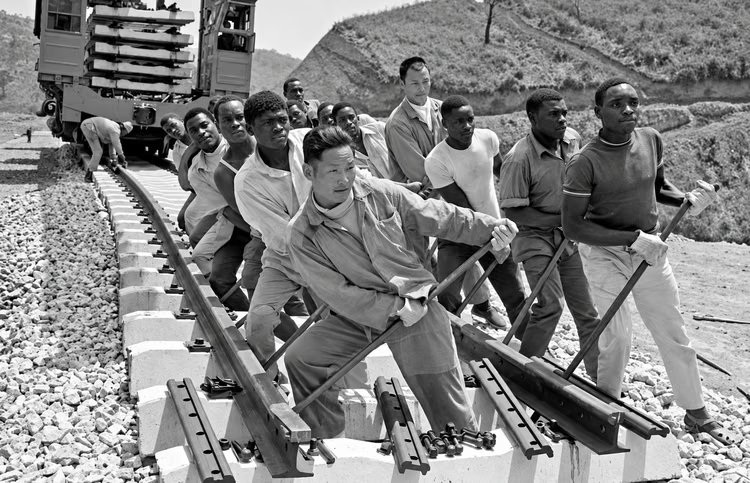
By August 1973, the track had crossed from Tanzania at Tunduma into Zambia at Nakonde. The railway pushed through the Zambian countryside of Mpika and Serenje. By June 1975, the line had reached Kapiri Mposhi, two years ahead of the original schedule.
Trial operations followed. The completed railway was formally handed over to the governments of Tanzania and Zambia in July 1976. Politically, the railway came to be known as the Uhuru Railway, to mean a railway of freedom.
Why the TAZARA Railway Declined
Operationally, TAZARA’s original design capacity of 2.5 million tonnes per annum in each direction was far greater than the railway would eventually achieve in ordinary operation. The railway’s actual performance remained considerably below that potential, with its historical peak at about 1.27 million tonnes in 1977–78.
This performance below potential paved the way for its gradual fall. With underinvestment, maintenance problems including shortages of spare parts, equipment and technical capacity, operational inefficiencies and changing trade patterns, the railway gradually lost capacity and competitiveness. The tracks aged, locomotives and rolling stock deteriorated, reliability suffered, and freight shifted towards roads. And eventually, the railway that had once represented economic independence struggled to carry enough cargo to sustain itself.
TAZARA’s $1.4 Billion Rehabilitation Plan
Half a decade after TAZARA was built to answer a political problem, it faces conversion into a commercially viable railway.
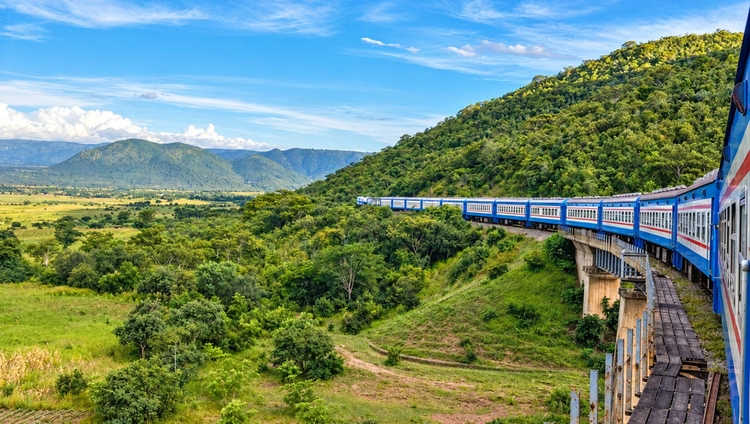
In September 2024, Zambia, Tanzania and China signed an initial framework for rehabilitating the railway. Then, on 29 September 2025, the three governments signed a 31-year concession agreement with China Civil Engineering Construction Corporation (CCECC) worth about US$1.4 billion to revitalise TAZARA. Unlike in 1976, when TAZARA was principally about political independence and an alternative route, this 2026 rehabilitation plan is much more about trade, logistics, investment and commercial viability.
Can TAZARA Become a Major Regional Trade Corridor Again?
Today, Zambia remains landlocked and remains one of the world’s significant copper-producing countries. The broader region is also increasingly important for minerals needed by modern industries. With the TAZARA becoming part of a larger rail-and-port logistics corridor, the Zambian government projects freight volumes rising from roughly 400,000 tonnes annually to 2.4 million tonnes within two years of full operation, and eventually exceeding three million tonnes. The railway will become economically competitive enough to justify the enormous landscape and infrastructure it occupies.