He crossed countries, built a following among people displaced by war, crossed the Zambezi during a solar eclipse and left behind Ngoni communities spread across southern and central Africa. Zwangendaba's story sounds almost too dramatic to be history, yet his migration remains one of the most remarkable journeys in the region's past.

His story begins during the upheavals of the early 19th century, when warfare and political change sent communities across southern Africa searching for somewhere safer to settle. Among them was the Jere clan, led by Zwangendaba, a leader whose answer to chaos was, remarkably, to keep moving.
The Mfecane and Zwangendaba's Great Migration
The upheaval began in the early 19th century, during a period of warfare, political consolidation and migration in southern Africa that became known as the Mfecane, or Difaqane. The rise and expansion of the Zulu kingdom under Shaka played an important part in this upheaval, although historians continue to debate its wider causes and consequences. Sent entire nations dashing for the horizon. Running away from the impending destruction to be dealt.
Among those caught up in the upheaval was the Jere clan, led by Zwangendaba. What followed was one of the most remarkable migrations in southern African history: over the following decades, Zwangendaba led his followers northwards through what are now parts of Mozambique, Zimbabwe, Zambia, Malawi and Tanzania, gathering other groups into the community that became associated with the Ngoni. This little not-so-little excursion lasted about two decades and never really ended, even after he did.
Zwangendaba and the Ngoni Migration
As Zwangendaba's followers moved northwards, they spent time in present-day Mozambique and came into contact with Soshangane, another powerful leader whose followers were themselves part of the upheavals of the period. The alliance did not last. Two ambitious leaders, one expanding territory and plenty of room for disagreement: somebody was eventually going to have to go. Zwangendaba chose "north" over "negotiate." Flee over paying a fee, if you catch my drift.
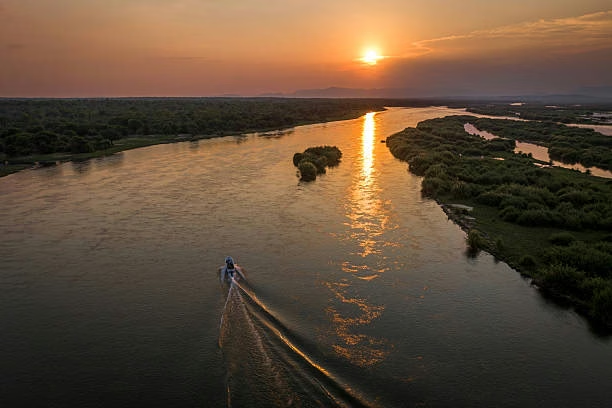
He pushed into Zimbabwe next, ran into the Ndebele, also fleeing Shaka and also not thrilled to see him, and kept walking anyway, picking up new subjects the way a rolling snowball picks up snow. By the time Zwangendaba's followers reached the Zambezi, the community associated with the Ngoni had become more than a single original clan. It was a mobile political and military society that had incorporated people from different communities encountered during the migration.
The Zambezi Crossing Under a Solar Eclipse
Then came the flex, the Ngoni never let anyone forget. One of the most famous episodes in the migration came when Zwangendaba's followers crossed the Zambezi during a solar eclipse in the 1830s. The event became an important part of Ngoni historical memory, and the unusual coincidence of a major migration crossing with an eclipse helped give the episode an almost legendary quality, as if the sky itself had signed off on the itinerary. For a people fluent in omens, you could not ask for better marketing. Centuries later, this crossing is still the headline event of Ngoni identity, the moment the running became a founding myth.
Naturally, a man with this much forward momentum couldn't just retire. By the late 1840s, Zwangendaba's migration had reached present-day Tanzania, where his followers came into conflict with the Fipa people. In 1848, Zwangendaba died near the area now associated with the Zambia–Tanzania border, bringing an end to the life of a leader whose movement had carried his followers across a remarkable stretch of southern and central Africa. This particular battle didn't go his way. Picture a box-office-style slow-motion moment. Zwangendaba took a poisoned arrow, his warriors retreated, and near Tongola Hill, herbal medicine did not do what it was supposed to and brought his life to an end.
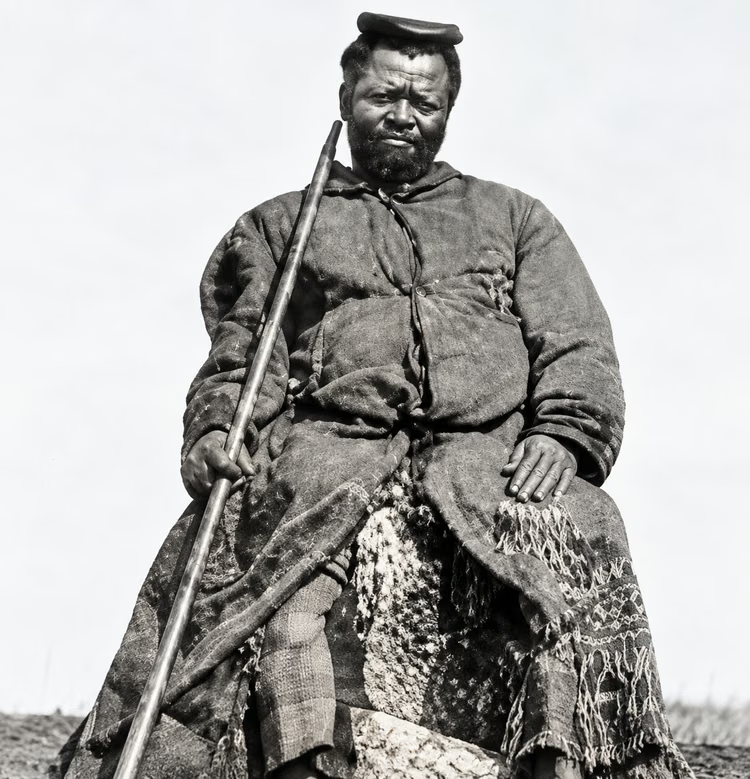
The great wanderer finally stopped moving, permanently, in the hills near modern Nakonde, right on the Zambia–Tanzania border, as if even death couldn't get him to commit to one country. His grave was marked with stones and logs and has since mellowed into a modest circular cairn, historically humble for a man who once out-walked an empire, outwalked a painful fate. A painful fate that inevitably caught up to him.
How Zwangendaba's Ngoni Kingdoms Spread
Zwangendaba's death did not bring the Ngoni story to an end. Instead, disputes over succession and leadership contributed to the movement's fragmentation. Different groups followed different leaders, eventually establishing Ngoni communities and kingdoms across territories that are now part of Zambia, Malawi and Tanzania. His sons and generals splintered off toward Malawi, southern Tanzania, and back into eastern Zambia, each founding their own Ngoni kingdoms. Today, Ngoni communities are found across several countries, with different groups tracing their histories and traditions back to Zwangendaba's migration.
Proof that even in death, Zwangendaba's story continued through the people, kingdoms and traditions that grew from his migration.
Zwangendaba's Grave and the 2026 Commemoration
For nearly two centuries, Zwangendaba's grave sat quietly, minding its own business, tended by Chieftainess Waitwika, who deserves acknowledgement. Then 2026 rolled around, and someone in the Muchinga Provincial administration had a very good idea: turn the site into an annual pilgrimage and a genuine cultural-tourism destination. The inaugural commemoration under this new arrangement happened in Nakonde on 18 February 2026, complete with a symbolic re-enactment of the 1835 Zambezi crossing, led by Paramount Chief Mpezeni IV. Because if your ancestor crossed a river under a solar eclipse, you re-enact it; you don't just post about it, but if you want to, please do; we need the PR.
There is something almost perfectly contradictory about Zwangendaba's legacy. He spent much of his life moving, while two centuries later we are the ones doing the travelling, gathering once a year to remember him at the place where, at last, he stayed.
Perhaps that is the fitting end to the story: Zwangendaba never held still, but his history did.