Ask most people, including many Zambians, whether Zambia has a "philosophy," and you will likely get a pause, then a shrug toward folklore: proverbs from grandmothers, masked dancers at a harvest festival, a chief's court where elders argue over cattle. Interesting, certainly. Worth preserving, probably. But philosophy in the sense of a rigorous, examined, evolving body of thought feels like it belongs somewhere else.
That instinct is worth questioning rather than accepting. The question of whether African and, by extension, a specific nation like Zambia, has produced philosophy proper, rather than merely a folkloric residue of belief, has been one of the most contested questions in twentieth-century African intellectual history. It is not a question Zambia has to answer from scratch. But it is one Zambian thought has barely begun to answer for itself, in its own name, rather than under the broader banner of "Africa”.
This piece does not claim to settle that question. It claims something more modest and, I think, more honest: that Zambia that a traceable, coherent body of pre-colonial and enduring thought recognizable through the ideas it repeatedly posits about personhood, community, time, and the moral order and that this body of thought deserves to be examined with the same seriousness applied to any other tradition, while also being honest about the work still needed for it to stand as a fully articulated philosophy rather than a rich but under-systematized inheritance.
The trap of the wrong question
Before asking "does Zambia have a philosophy," it helps to know that African philosophers have already fought a bitter, decades-long war over what counts as an answer. In the 1970s, the Beninese philosopher Paulin Hountondji coined a deliberately unflattering term, "ethnophilosophy". For a genre of writing, epitomised by works like Placide Tempels' Bantu Philosophy, that presented the collective worldview of an ethnic group as though it were a philosophical system. For Hountondji, this move was suspect precisely because it treated philosophy as inherently a communal, custom-dictated affair rather than the individual, critical, argumentative discourse he believed philosophy properly was.
This matters for Zambia because it is exactly the trap most casual discussions of "African wisdom" fall into: assembling proverbs and calling the assembly a philosophy. If that is all this article did list Bemba sayings and call it a day it would deserve the same critique.
But the debate did not end there, and its second half is more useful to us than its first. Later scholarship has argued that ethnophilosophy's critics depended on unrealistic assumptions about how philosophy makes progress, and that a body of collective, orally transmitted thought can still be philosophy if it is treated as raw material for critical engagement rather than a finished product. Oruka himself, having criticised ethnophilosophy, went on to develop "sage philosophy". The practice of finding individual elders within oral communities capable of genuine critical reflection on the communal worldview, distinguishing folk sages who merely transmit wisdom from philosophic sages who interrogate it. That distinction is the right tool for a Zambian inquiry: the question is not whether proverbs exist, but whether there were, and are, minds using them as premises for reasoning rather than as decoration.
What the evidence actually shows
Judged by that stricter standard, Zambia's case is stronger than the folklore label suggests, for three overlapping reasons: the coherence of its proverbial logic, the metaphysical work done by its ceremonies, and the existence of institutionalised spaces for dialectic.
Proverbs as compressed argument, not decoration: Zambian proverb collections. Nyambe Sumbwa's cross-linguistic compilation spans. Bemba, Kaonde, Lozi, Luyana, Luvale, Nyanja, and Chitonga. Are not simply moral one-liners. Many encode a recognisable epistemology. The Bemba saying Ukutangila tekufika, "the first may not necessarily arrive first," is a claim about the relationship between initial advantage and eventual outcome that could sit comfortably next to Aesop's tortoise and hare as a piece of practical reasoning about causality and effort. The Tonga proverb Aabantu taatiki musinza roughly translates to " soup is not spilt where many people are gathered. Encodes a specific epistemic claim: that distributed judgment reduces error, an idea not far from what a modern theorist might call the "wisdom of crowds." These are not isolated cleverness; collectors report the Tonga alone possess several hundred such proverbs, each attached to a specific domain of life, suggesting a systematised, not incidental, body of applied reasoning.

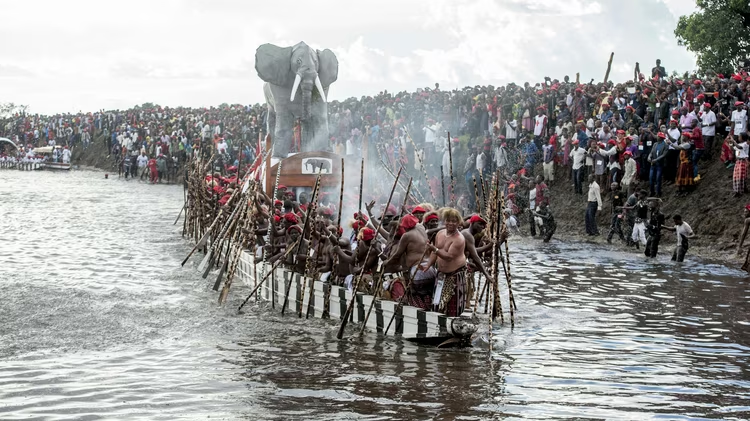
Ceremony as cosmological argument: Consider the Kuomboka, the Lozi migration ceremony. The word itself means "to get out of water," and on its surface it looks like pure spectacle: an annual procession of the Litunga, the Lozi king, from the flooded Barotse plains to higher ground aboard the royal Nalikwanda barge. But look at what the ceremony asserts. It stages, publicly and annually, a claim about the relationship between sovereignty, the natural order, and the community's survival. That legitimate authority is precisely the capacity to read the environment correctly and move the people in time with it. The Ngoni Nc'wala similarly stages a claim about the source of abundance: the chief ritually tastes the first harvest before the community may eat, tying the material fact of the harvest to ancestral continuity going back to a specific historical migration. Among the Chewa, the Nyau society's masked Gule Wamkulu performances, recognised as UNESCO intangible heritage, encode an entire metaphysics of ancestral presence and moral instruction beneath a spectacle that outsiders often read as mere costume and drumming. These ceremonies are not illustrations of belief; they are the belief's argument, restaged so that each generation can inspect its logic.
Institutional spaces for dialectic: Perhaps the most philosophically interesting Zambian institution is the insaka, the traditional gathering space, often literally a roofed, open-sided structure, where elders and community members debated, adjudicated disputes, and transmitted knowledge orally across generations. A designated site where competing claims about right conduct, precedent, and consequence were tested against each other in front of witnesses. A tradition with no textual archive can still have had its Socratic moments; they simply happened at the insaka and were never transcribed.
Where Zambia's tradition converges with, and diverges from, wider African thought
John Mbiti, writing as a Kenyan theologian rather than a Zambian, nonetheless gave the wider region its most quoted formulation of communal personhood: I am because we are, and since we are, therefore I am, capturing the idea that individual identity is constituted through, not before, relationship. Zambian custom supplies its own local instances of the same claim: inheritance, marriage, and dispute resolution have traditionally run through the extended family and chieftaincy rather than the isolated individual, but it is worth noting a genuine scholarly tension here rather than smoothing it over. Recent critics of Mbiti's axiom have argued about whether it implies the community simply outweighs the individual, or whether, as some now argue, it describes a reciprocal formation in which neither term has strict priority. Zambian practice, with its strong lineage systems alongside individual praise names, personal totems, and the recognised authority of the sage or nkuulwe, arguably sits closer to the reciprocal reading than the crude "collective over individual" caricature that critics of communitarianism often attack.
Mbiti's account of African time as cyclical, ancestor-inflected, and oriented toward a present continually replenished by the past also maps onto Zambian cosmology's treatment of Lesa (the Bemba and wider term for the Supreme Being) and the ancestral spirits who mediate between the living and the divine. But this is precisely where the tradition's Zambian specificity gets flattened if we are not careful. A Lozi, a Tonga, and a Bemba cosmology are not identical systems wearing different vocabulary. They differ in how directly the divine is thought to intervene, in the structure of chieftainship's relation to the spirit world, and in how death and ancestorhood are ritually processed. A serious Zambian philosophy has to resist the temptation to melt seven or more distinct ethno-philosophical systems into one undifferentiated "Zambian worldview," even while noting the family resemblances between them.
What still has to be built
This is not a small gap, and closing it will not happen through nostalgia. It requires universities and scholars willing to treat the insaka's oral method as a legitimate philosophical genre worth translating into argument rather than only into ethnography; it requires distinguishing, ceremony by ceremony and proverb by proverb, description from claim, and claim from justification; and it requires Zambian thinkers willing to disagree publicly with each other about what Bemba, Lozi, Tonga, and Nyanja cosmology actually implies, the way Hountondji disagreed with Tempels, not the way a folklorist disagrees with another folklorist about which version of a story is more authentic.
The honest verdict
So does Zambia have a distinct philosophy that has emerged through time? The fairest answer is that it has the tradition, the coherent, recurring, arguable ideas about personhood, time, authority, and the sacred, but not yet the discipline that would let outsiders, and Zambians themselves, engage it as philosophy rather than heritage. That is not a dismissal. The material was always philosophical. What it needed was philosophers willing to treat it that way, in public, in writing, in disagreement with one another. Zambia's task now is not to invent a philosophy from nothing, but to finally write down the argument its own traditions have been having with themselves for centuries.