Long before Wall Street raised its walls, while paper money was rewriting the rules of exchange elsewhere, this hill above the Zambezi was part of a trade network that stretched from Central Africa to the Indian Ocean, connecting copper ingots and ivory to glass beads, textiles and ceramics moving through Indian Ocean trade networks. Medieval Zambia was not peripheral to the world economy. It was woven into it.
Long ago, when the world was still young, the Creator planted the trees across the African plains. Each tree was given a special gift.
The tall palm admired its graceful height. The acacia loved its leaves. The fig tree spread wide shade for travellers and animals.
But the baobab was never satisfied.
The baobab complained constantly.
“Why is my trunk so thick?” it grumbled.
“Why are my branches so short?”
“Why don’t I have flowers like the flame tree, or fruit like the mango?”
The Creator listened patiently and gave the baobab chance after chance. The tree was moved near rivers, then onto hills, then into fertile valleys. Still, it complained.
The baobab envied every other tree.
“I should be taller.”
“I should be prettier.”
“I deserve leaves.”
At last, the Creator grew tired of hearing the endless complaints.
“One day,” the Creator said, “you will learn that every living thing has its purpose.”
In frustration, the Creator seized the baobab, yanked it from the earth, and thrust it back into the ground upside down.
Its roots twisted into the sky like tangled branches.
And that, people say, is why the baobab looks as though it was planted upside down.
From then on, the baobab became a lesson in humility. Though strange-looking, it turned out to be the most useful tree of all, storing water in its giant trunk and providing fruit, medicine, shelter, and shade for people and animals across Africa.
So the tree that once complained the most became known as the “Tree of Life”.
This is what happens when you merge onto the T2 in search of the history of trade:
The hot asphalt snakes upward past the leaning mobile money booths and the sludge of vehicles and people: people pushing wheelbarrows and people pushing themselves.
Then the hills open. The road exhales. You are free.
This is the trip you must take to break out of the diorama of modern trade and find what existed before the stalls, trucks and trains. Trees of all sizes wave as you swoosh by, bringing your first geography lessons to mind. Zambia is a savannah and a savannah is a mixed woodland-grassland. Escaping modern trade takes more than you thought. The filling station breaks your reverie.
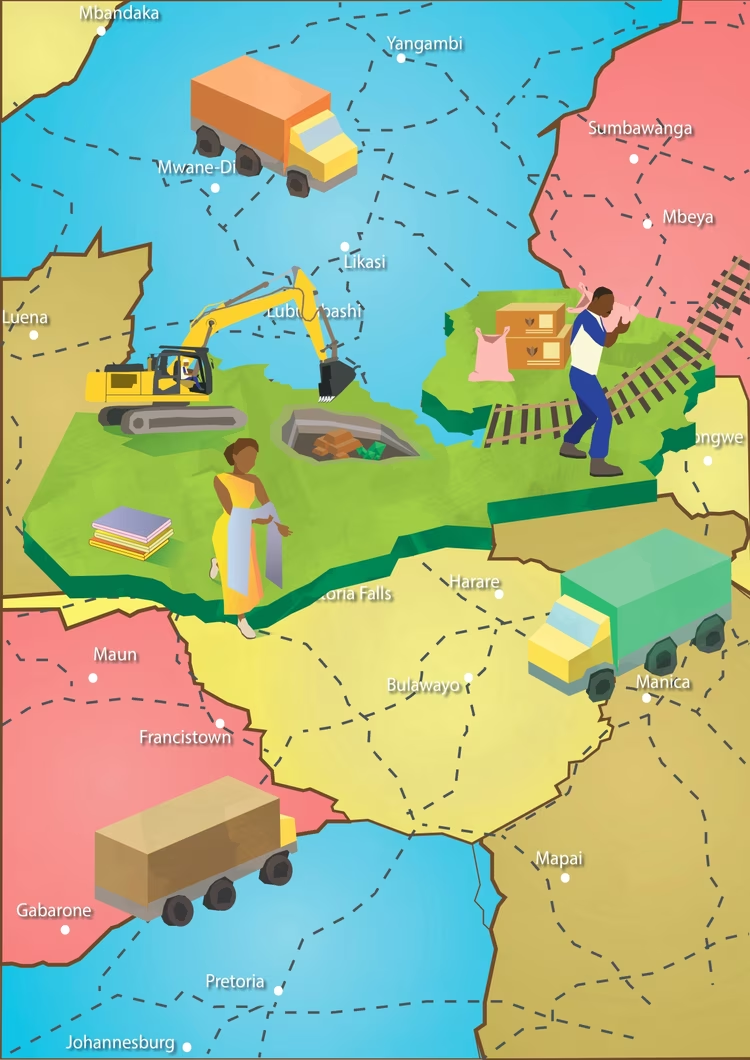
You fill up your tank with nine hundred and eighty kwacha, paid in clean, new notes. Being three ten-kwacha notes short makes you chuckle. The silent dance of payment happens once more at the Shimabala Toll Plaza, where an orange-pink note is the only way to let you through.
This is what it takes to find Ng’ombe Ilede.
The road to the ancient trade centre runs backwards through time. G-Unit sags on the boys and faded Hey Mama skirts hang on the little girls. They still walk kilometres to school. Billboards disappear from the skyline and home shops offer roadside wisdom above their doors: tondolo musuma… waulesi asadye… chalo bantu…
Your phone darts in and out of reception, turning into a useless brick in your pocket as you rely on goodwill for directions. You trade your best smile for a finger aimed the right way.
What Does Trade Mean?
On the surface, trade is secure and positive. It is not about money; it is about value. Value is subject to human discretion, so anything can be traded. This has helped human civilisations achieve and sustain ecosystem equilibrium. The socialist face of trade strives for fairness, while the survivalist face of trade shakes hands with power and war.
“No one knows what it means, but it’s provocative… it gets the people going!” — Will Ferrell, Blades of Glory.
Trade gets the people in economics going; it is a big word that touches everything in existence.
Money Money Money
There are only two other things with as many nicknames as money does; one is the devil and the other you cannot say without a strike from the editor.
In Tang dynasty China, merchants used early paper instruments known as “flying money” to transfer value across distances. By the eleventh century, the Song dynasty had developed paper money into a more recognisable medium of exchange, expanding the possibilities for trade.
“All these pieces of paper are issued with as much solemnity and authority as if they were of pure gold or silver.” — The Travels of Marco Polo.
Before paper, traders relied on complex barter, trust, and record-keeping systems to ensure their livestock, grain, precious metals, and commodities maintained value through arduous modes of exchange. Paper money opened a new world of possibilities for merchants, states and systems of exchange. The fact that paper, with the right authority and insignia, could become a cow or a bar of gold was revolutionary. The genius still stands today.
Cows Make the World Go Round
Money is only funny in a rich man’s world. You remember this as the kilometres rise and the fuel gauge drops. Present-day Ng’ombe Ilede would never work as a modern trade centre. It is 150 km from the city centre, much further than the airport, and there is no matcha there.
The closest thing to a salted caramel latte is the ingredients: sugar cane lining the road, salt on your skin in the hot weather and herds of cattle crossing slowly to remind you whose town you’re in. You wonder what it is like for a farmer to sit back while their money eats grass and crosses trunk roads with only a young boy with a whip to protect it. Your own stockbroker has a cow in the logo, and the girl who sends updates is savvy—you wonder if she has a whip. In lobola discussions, the uncles still demand cows; the past is present.
Baobab Street
Wall Street started as a defensive wall built in 1653 by the Dutch colony of New Amsterdam to keep out British forces and local threats. The wall fell in 1699 but trade rose, and over the following centuries, New York grew to rival and eventually surpass London as the world’s most powerful financial centre. The stock there does not need a whip. Wall Street is more than a physical location, and you do not have to visit it to feel its power.
“The Magnificent Seven stocks—Apple, Microsoft, Amazon, Alphabet, Meta, Nvidia and Tesla—are dominant tech companies whose size and innovation mean they can heavily influence overall market direction and investor sentiment.” — Saxo Group.
Ng’ombe Ilede is humbled. All the signs pointing to her are faded, and you rely on the nod of a man napping in a wheelbarrow to turn the right way. The history books speak of “The Sleeping Cow”, a site with findings dating from the seventh to the sixteenth centuries, with its most prominent period as a trade centre generally placed between the thirteenth and fifteenth centuries. It was positioned near crossings of the great Zambezi River where traders, metallurgists, herders and travellers converged long before colonial borders carved the continent apart.
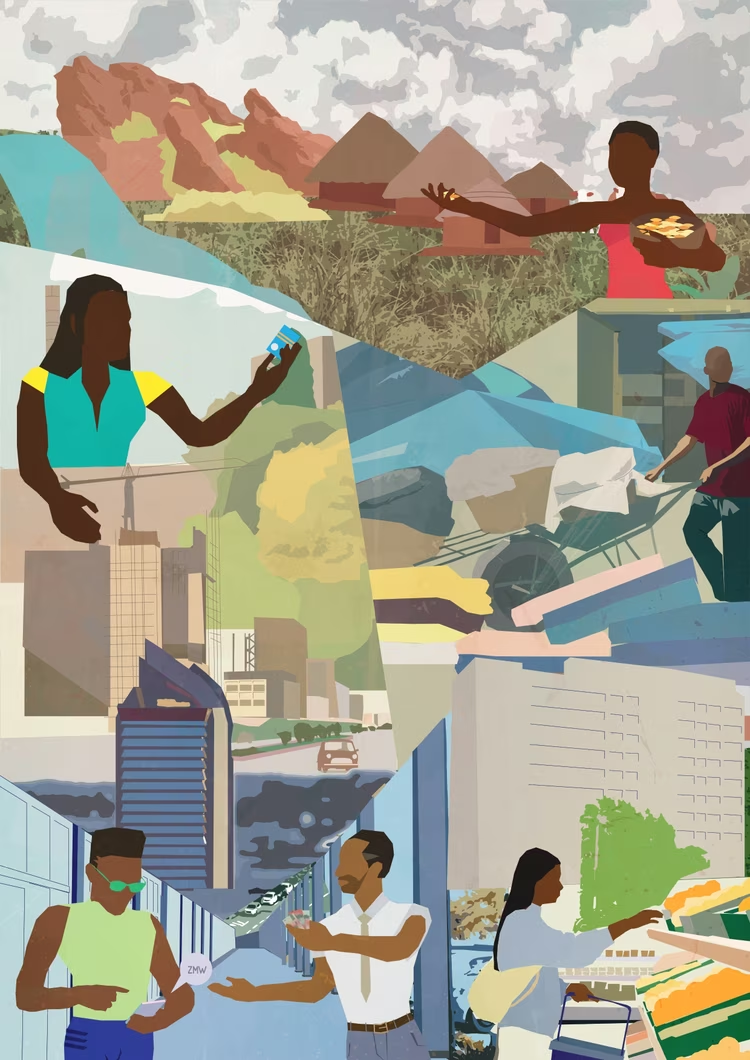
After the site was uncovered in 1960 during government construction work, it was first excavated by J.H. Chaplin, with further excavations carried out by Brian Fagan in 1961 and 1962. What emerged was evidence of a sophisticated part of the continental and transoceanic economy, connected to the Katanga copper belts, the Kingdom of Mwenemutapa and the vast Indian Ocean trade network stretching towards Arabia, Persia, India and China.
Gold moved south from inland kingdoms; copper ingots and finely worked ornaments travelled from Central African furnaces; ivory, animal skins, beads, iron tools and salt crossed rivers and savannahs in caravans that often moved by foot, guided by seasoned knowledge and alliances.
In return came glass beads from India, cloth from Asia, ceramics from China, and later imported textiles that became woven into African identity itself. Trade here was not simple barter. River crossings controlled movement and caravan routes linked inland Africa to Swahili coastal cities such as Kilwa Kisiwani and Sofala, which channelled wealth from Great Zimbabwe.
The metallurgy alone tells a deeper story about technical knowledge and human ingenuity. The people connected to Ng’ombe Ilede understood how to mine ore and transform raw earth into metal strong enough for tools, weapons, jewellery and trade currency. Every copper bracelet and iron spear excavated at Ng’ombe Ilede represents centuries of inherited knowledge: a bead from India, buried beside locally smelted metal in Zambia, becomes proof that medieval Africa was connected, inventive and integral to the making of the early world economy.
The public record still feels thin on detail. Ng’ombe Ilede sits on a platform after a dip in the valley. The path to her is lined with stark, wide baobab trees that tell of the ages. Shiny goats with taut pregnant bellies graze in the marshlands left behind by the receding Zambezi. The view makes you want to paint.
How Do You Want to Be Remembered?
The Natural Heritage Conservation Commission has done its best to preserve the natural landscape, and a friendly, knowledgeable Mr Manyonga is Ng’ombe Ilede’s custodian. He paints the picture of a different time when the mighty Zambezi connected traders to the Indian Ocean. It was a time before Northern Rhodesia and Zambia—before the place became a history lesson.
Manyonga’s eyes light up even when he tells the story for the eighth time that day. There are more mysteries than answers about the powerful communities that traded here and sustained systems of exchange built on trust, value and regulation, not unlike the principles that still underpin financial markets today.
Nobody knows who the people were, what gods they worshipped, or who they loved, but trade always leaves evidence.
Today’s vibrant chitenge carries its own trade history: Dutch-imitated Indonesian batik designs, European factories, West African ports, and Central and Southern African adoption, where once-exported textiles were embraced, renamed and transformed into a powerful African cultural identity. In the future, they will dig us up and find chitenge with our remains.
“This hill was a village around 850 AD, and some of the bodies are richly decorated. Archaeologists recovered beads, copper, ivory, gold and other luxuries obtained from traders travelling up the Zambezi Valley. These were great people. They were buried with wealth,” Manyonga says.
The record of livestock, grain and infant burials, along with the varying burial styles, hints at a community living in Lusitu long before the Tonga people. Life at Ng’ombe Ilede exhibits a splendour and sophistication that is rarely attributed to pre-colonial Bantu life. The materials found indicate culture, language and innovation that add a new layer to the timeline of human trade.
In 2016, a new body was discovered. Named Muntu Ulede, the remains of a woman, possibly in her 30s at the time of her death, were found adorned in wealth and placed in a way that suggests she may have held status within the community. Nobody is here to remember. This discovery points to the possibility of more bodies, more untold stories under the baobab tree. Ng’ombe Ilede took the form of a sleeping cow after it collapsed, but kept living. It still lives as a reminder of an era when trade in Zambia was great, expansive and unfathomable.
The rise and fall of civilisation point to the cyclical nature of human life and to the futility of our fight against time.
You realise a few things:
Everything is meaningless until we give it meaning.
We are only the authorities of the present moment.
Time humbles us all.
You drive back home on the T2, still chasing, never finding.