Why Zambians Feel They’re Paying More for Less
Following a direct call from the Minister of Commerce, Trade, and Industry, numerous Zambian companies have reduced the prices of their goods. But before consumers have even had the chance to fully express their relief, many have continued voicing a different kind of disappointment: not with the price itself, but with the steadily decreasing amount of product they seem to be getting for it.
Whether in a packet of biscuits or washing powder, in a sack of rice or mealie meal, or in a tube of lotion or toothpaste, consumers feel they are getting a few biscuits to munch on, less nshima to cook and ultimately less bang for their buck. The technical term for this is "shrinkflation."

What is Shrinkflation?
Shrinkflation is essentially a hidden form of inflation. When a company’s profit margins come under pressure due to rising costs, or when it is trying to maintain its share of the market, which could be threatened if higher prices scare customers away, it may choose not to increase prices, which consumers would easily notice. Instead, it reduces the amount of product it provides.
In this way, the company survives or maintains its profits and feels little to no burden as the production environment around it changes; those costs and losses are instead offloaded onto the consumer. So if you’ve been absent-mindedly reaching for the last few potato chips at the end of a packet that used to be there but suddenly aren’t, it isn’t all in your head.
How to Spot Skrinkflation
One of the easiest ways to notice shrinkflation is to pay attention when a product suddenly looks different. A brighter packet or differently shaped bottle may seem like simple marketing, but sometimes the real change is not the design but the size.
It also helps to look beyond the price tag and check the unit price on the shelf, the cost per gram, per litre or per kilogram. In a supermarket, where brands of mealie meal, rice, sugar, or washing powder sit side by side, that number can reveal to you which product offers better value. The same goes for the net weight printed on the back of the packet.
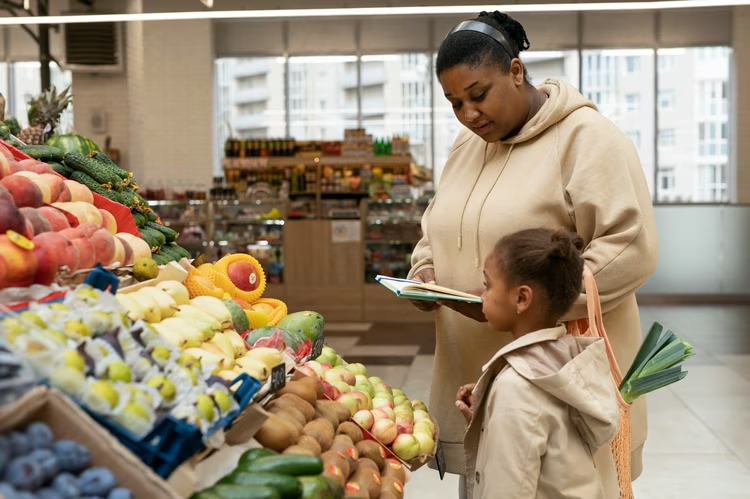
For those of us trying to stretch our kwacha a little further, switching brands can sometimes help. A store brand may offer more for the same price, or another manufacturer may not yet have reduced its quantities. Knowing the usual size of the products you buy and paying attention when that changes is one of the few ways to guard against paying the same price for less.
As of January 2026, the cost of living for a family of five in Lusaka increased from ZMW 11,327.98 the previous month to ZMW 11,365.09, according to the Jesuit Centre for Theological Reflection. While it is still too early to determine what impact the recently announced price cuts will have on the overall cost of living, the broader trend has, for a long time, been clear: prices rise, while many salaries remain largely unchanged.
With this in mind, it becomes even more important to ensure that where money is spent, it delivers real value. In an environment where household budgets are already stretched, getting what you believe you are paying for, in quantity as well as price, is no small matter.