The word “virus” has tended to cause public discomfort since 2020. Outbreak stories once felt geographically distant to many Zambians; global crises once felt distant to many Zambians, usually in countries we watched through headlines. That distance narrowed quickly during COVID-19. Today, even a small cluster of cases somewhere else in the world can circulate online within hours, often stripped of context entirely.
Why Hantavirus Is Suddenly Trending Online
The virus itself is not new. Scientists have studied hantaviruses for decades, particularly in parts of Asia and the Americas where rodent-borne infections are more prominent. That is partly why hantavirus has unsettled people so quickly online. The name sounds unfamiliar enough to feel threatening, and unfamiliar things tend to attract speculation. Within hours of the recent headlines, clips began circulating across TikTok, Facebook, X, and WhatsApp, many of them dramatic, some completely detached from verified information. By the time most people encounter a health story online, it has usually already been filtered through bias or someone’s attempt to go viral.
In Zambia, where election-year conversations already carry an increased sense of suspicion, health stories rarely remain purely medical for long. People begin connecting dots almost immediately. Questions emerge around government transparency, international agencies, donor interests, and whether the public is once again being prepared for restrictions or panic. Some of those reactions come from genuine concern. Much of it comes from the memory of COVID-19 itself and how it quickly changed our lives forever.
What Is Hantavirus & How Does It Spread?
"Hantavirus" refers to a family of viruses carried mainly by rodents. Humans typically become infected after exposure to contaminated rodent urine, droppings, or saliva, particularly in enclosed or poorly ventilated spaces where particles can become airborne during cleaning. Scientists have identified different hantavirus strains in different regions of the world, often linked to specific rodent species that act as natural reservoirs.
The illness caused by hantaviruses can be severe. In the Americas, certain strains can lead to hantavirus pulmonary syndrome, a condition that affects the lungs and may progress rapidly. In Europe and parts of Asia, other strains are associated with hemorrhagic fever with renal syndrome, which primarily affects the kidneys and blood vessels. Mortality rates vary depending on the strain and the speed at which supportive medical care is provided.
The primary risk with hantavirus remains environmental exposure linked to rodents, with the exception of the Andes virus, which is the only type of hantavirus that is known to spread person-to-person. This spread is usually limited to people who have close contact with the ill person.
Why Outbreak Anxiety Spreads So Quickly Online
Outbreak psychology tends to follow familiar patterns. Uncertainty can create demand for explanation, and in that vacuum, people often gravitate toward the narrative that feels emotionally convincing before they gravitate toward the one supported by evidence. During election years, those dynamics become even more pronounced because institutions themselves are already under scrutiny.
In Zambia, scepticism toward public messaging stems from economic pressure, political polarisation, uneven trust in leadership, and broader global shifts in how people consume information. Social media has accelerated all of it. A single TikTok carrying unverified claims can move faster than an official health statement, particularly when the unofficial version sounds more dramatic or emotionally satisfying.
What complicates matters further is that dismissing public anxiety outright tends to deepen mistrust. People do not respond well to having their concerns dismissed outright. A more effective approach acknowledges why fears exist while remaining disciplined about evidence. There is room to say that people are uneasy without presenting speculation as fact. That balance is where many outbreak discussions begin to collapse.
The practical reality for Zambia
At the moment, there is no verified widespread hantavirus outbreak in Zambia. Still, rodent exposure is not strange to us. In both urban and rural settings, many households encounter rodents around food storage areas (especially grain), drainage systems, markets, and poorly sealed housing. During colder months or periods of food scarcity, rodent movement indoors often increases.

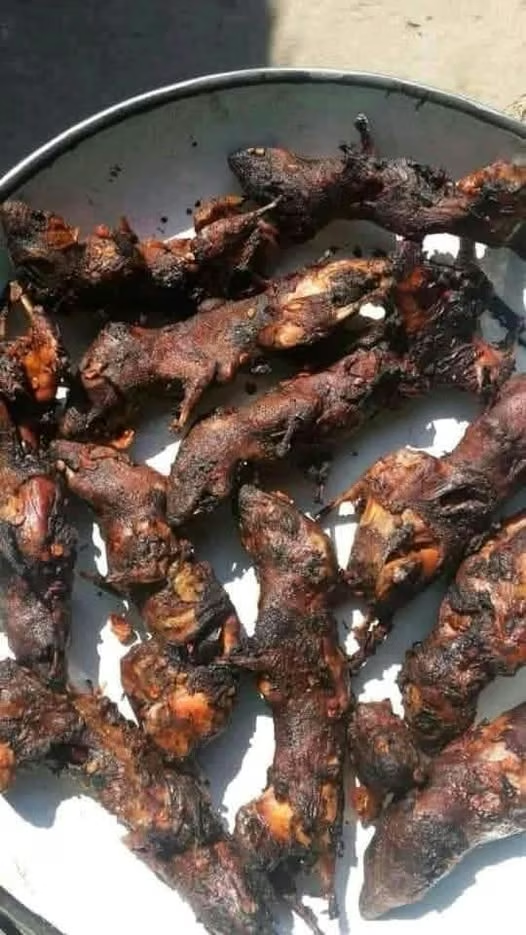
This is where public health messaging sometimes loses people. Advice imported directly from Western public health campaigns can sound disconnected from ordinary living conditions. Telling families to avoid rodent exposure in overcrowded settlements or farming communities completely does not sound practical because, in many cases, it isn’t. In some communities across Southern Africa, certain small wild animals, including some rodent species, have historically formed part of local diets, which means public health messaging should also consider cultural context.
Ventilating enclosed areas before cleaning, avoiding dry sweeping of rodent droppings, using disinfectant during cleanup, storing food properly, and reducing indoor nesting spaces are all interventions supported by established public health guidance that aren’t new to us in regard to rodent management.
The danger of overstating certainty
One of the lasting lessons from recent global outbreaks is how quickly public confidence weakens when institutions appear either evasive or overly absolute. Scientific understanding evolves through evidence, and during emerging health events, some uncertainty is inevitable. Most people tolerate uncertainty better than they tolerate contradiction disguised as certainty.
That is why careful language matters. Saying “this is what we currently know” often carries more credibility than presenting provisional findings as the final truth. Responsible reporting also requires discipline around what remains unverified. Claims about engineered origins, political orchestration, or hidden agendas may circulate widely online, but repetition alone does not transform speculation into evidence.
Right now, the evidence around hantavirus remains relatively clear. It is a serious rodent-borne illness that scientists have studied for decades. Certain strains can cause severe disease in humans, particularly after exposure to contaminated environments. Current evidence does not suggest easy or widespread human-to-human transmission for most hantaviruses. In a climate already saturated with fear, political tension, and online misinformation, calm public communication may matter just as much as the science itself.