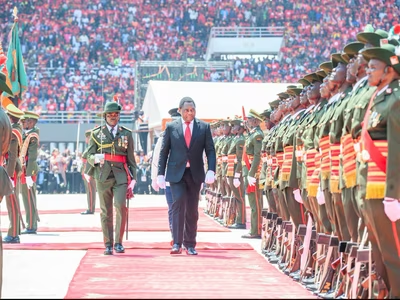
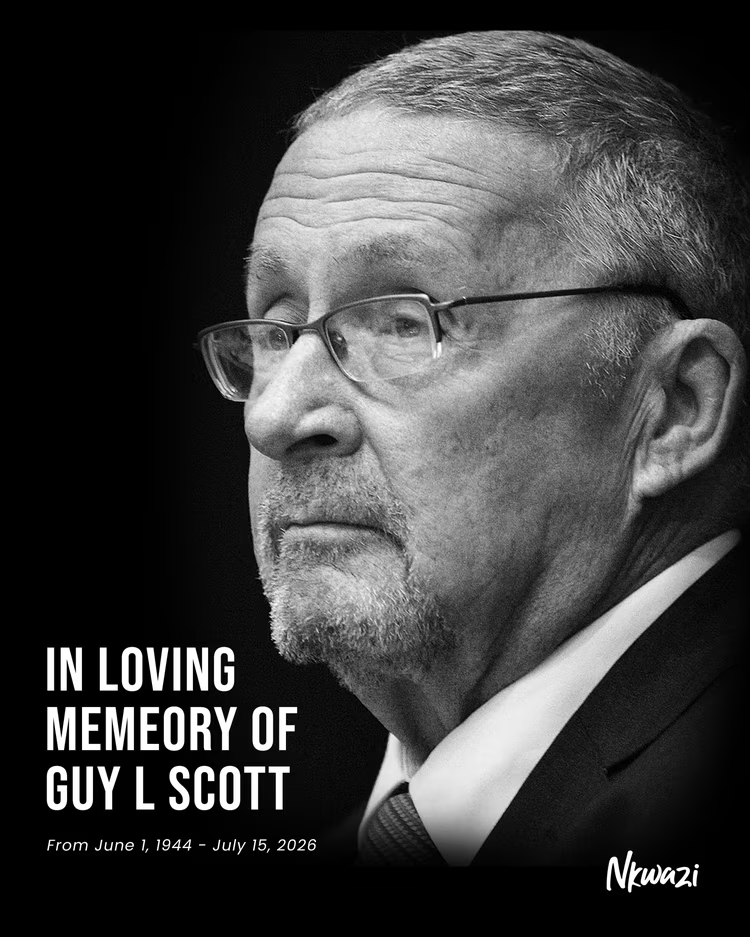
It was Wednesday, the 15th of July 2026, when the news broke that Guy Lindsay Scott had passed away. He was 82. The government declared five days of national mourning, and President Hakainde Hichilema accorded him a state funeral. But if you've been paying attention to Zambian politics for the past thirty years, you already knew there was more to him than an asterisk in the history books.
The Roots of a Zambian Original
Born in Livingstone on 1 June 1944, Guy Scott was Zambian through and through, even if his complexion told a different story to the casual observer. His father, Alec, had emigrated from Scotland in 1927 to work as a doctor on the railways, and his mother, Grace, followed from England in 1940.
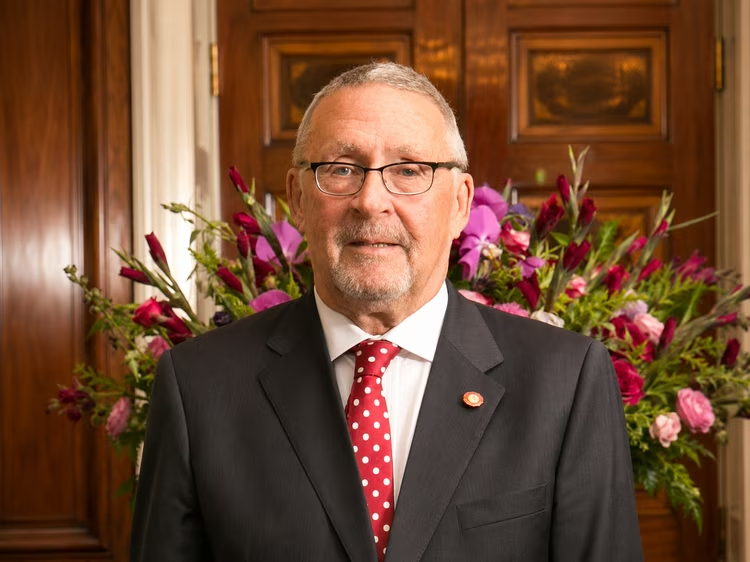
Do you remember the headline: the white Zambian who became acting president for ninety days, who often joked about his distant connection to David Livingstone, quipping that he was related to the great explorer “only in the Bemba sense,” a typically irreverent way of acknowledging his family’s colonial history while planting his flag firmly in Zambian identity.
He was educated at Peterhouse in Southern Rhodesia (now Zimbabwe), because, as he once put it, the Southern Rhodesians had decided that Northern Rhodesia was “too hot for white people to think”. He studied economics at Cambridge in the early 1960s, returned home, and took a job as a planner in the Ministry of Finance. By most accounts, he was the kind of young man you'd expect: clever, methodical, quietly ambitious. He returned to Zambia at the dawn of multi-party democracy in 1990, and the rest, as they say, is history.
The Farmer Who Refused to Be a Mascot
Before he was a politician, Guy Scott was a farmer and a bloody good one at that. His business, Walkover Estates, specialised in exporting fresh produce like wheat and strawberries to London supermarkets via overnight flights.
When he entered politics in 1991, winning the Mpika Central parliamentary seat under the Movement for Multi-Party Democracy, he brought that same pragmatic, earth-bound sensibility with him. As Minister of Agriculture, Food and Fisheries, he was credited with managing the devastating drought of 1992, the “drought of the century”, to avert a national famine. He pushed commercial farming and spoke candidly about food security.
The Alliance with “King Cobra”
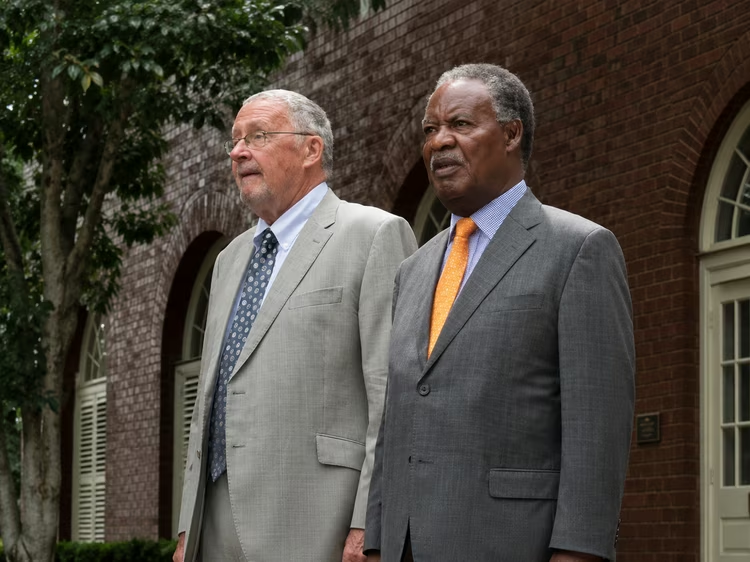
Guy Scott’s political career reached its zenith through his unlikely partnership with Michael Sata, the man they called “King Cobra”. Scott joined Sata’s Patriotic Front in 2001 and became his vice-president in 2011, the first white Zambian to hold that office since Independence.
In his memoir, Adventures in Zambian Politics: A Story in Black and White, Scott took readers inside the presidential bedroom where he found Sata very sick and bedridden, with the nation, including Scott himself as Vice President, kept in the dark. It was a raw, unflinching account of a friendship tested by the brutal realities of power.
The 90 Days That Made History
When Sata died in office on 28 October 2014, Guy Scott became acting president. It was a moment of profound historical significance: he was the first white head of state in mainland Africa since F.W. de Klerk left office in 1994. He saw himself as a caretaker, a man tasked with guiding the nation through mourning and overseeing a constitutional transition.
And yet, the constitution had other plans. A clause requiring the president to be a “third-generation” Zambian, inserted to prevent Kenneth Kaunda from running again, barred Scott from contesting the presidency because neither of his parents was born in Zambia. He understood his limits. He was content with what he had.
The Man Behind the Myth
In his later years, he lived with Parkinson’s disease and dementia and spoke openly about it. He argued that neurological illness should not carry the stigma of witchcraft or spiritual explanation. The sharp mind that had graduated from Cambridge and researched robotics at Oxford began to fade. But even then, he remained at Trotover Farm, surrounded by his wife Charlotte and his family, a stubborn reminder of a Zambia that was willing to look beyond race and embrace competence, character, and a healthy dose of mischief.
A Rest Well Deserved
Guy Scott gave many years of his life to public service. He stepped in to lead the nation at a difficult moment and guided Zambia through that transition with a steady hand and a commitment to constitutional order. But he was more than a politician. He was a farmer, an economist, a writer, a husband, a father, and a friend. He was a man who believed that Zambia had moved from a post-colonial to a cosmopolitan condition, and he staked his entire career on that belief.
He was a white Zambian who loved Zambia so completely that the fact of his whiteness became almost irrelevant to his story because he offered a demonstration that citizenship could be real, that it could transcend the categories the colonisers had carved into our minds.
Now, he is gone. And Zambia is poorer for it. But as we mourn, let us also remember the man who spoke his mind regardless of the consequences, and who proved, against all odds, that a white Zambian could stand at the highest office in the land and be accepted not in spite of his colour, but because of his character.
Rest well, Guy. You earned it.