What if the next promising Zambian business is not another boutique, bar or general shop?
For entrepreneurs looking beyond the rinsed and recycled business ideas, Zambia’s latest economic figures point towards something more interesting. In the first quarter of 2026, the economy grew by 7.7 per cent year-on-year, with particularly strong growth in specific areas.
That does not mean every business in these sectors will succeed. It does, however, show where economic activity is currently increasing.
Here are ten opportunities worth considering in 2026.
Small-scale agro-processing
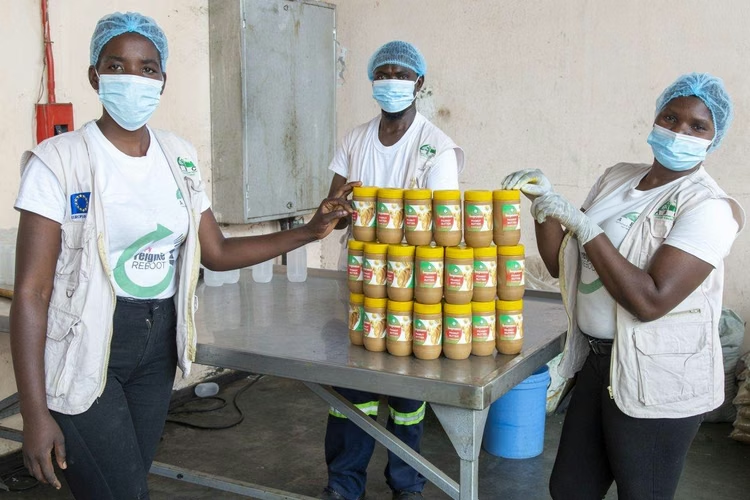
Instead of simply growing crops, make money further along the agricultural value chain. Think dried vegetables, peanut butter, tomato products, grain milling or packaged traditional foods.
Entry level: Roughly K20,000–K100,000, depending on equipment and scale.
Customers: Supermarkets, restaurants, schools, households and wholesalers.
Regulatory requirement: Business registration, tax registration and relevant food-safety and local-authority approvals.
Agriculture grew by 21.4 per cent in Q1 2026, making value addition an opportunity worth watching.
Produce aggregation and cold-chain logistics
Farmers do not only need buyers; they need someone to move produce from farms to markets before it spoils. A small operation could begin by aggregating vegetables, fruit, dairy or meat and supplying urban retailers and restaurants.
Entry level: K50,000–K250,000 for a small vehicle, crates, storage and basic cold-chain equipment.
Customers: Farmers, supermarkets, restaurants, hotels and food processors.
Regulatory requirement: Business and tax registration, transport requirements and food-handling compliance where applicable.
This fits into two expanding areas: agriculture and transportation and storage, which grew by 9.5 per cent in Q1.
Last-mile delivery and logistics
E-commerce, restaurants and small retailers increasingly need reliable delivery. Rather than competing with large courier companies, a small business could specialise in a particular town, route or customer group.
Entry level: K15,000–K80,000 using motorcycles, bicycles or an existing vehicle.
Customers: Online sellers, restaurants, pharmacies, offices and households.
Regulatory requirement: Business and tax registration, appropriate vehicle documentation and insurance.
Transport and storage's 9.5 per cent Q1 growth suggests that the movement of goods remains an active part of the economy.
Digital services for small businesses
Many businesses have social-media pages but still struggle with websites, online payments, bookkeeping, advertising, data management and basic cybersecurity. A small digital-services agency can sell these skills without requiring a large physical shop.

Entry level: K5,000–K30,000 for a laptop, internet, software and marketing.
Customers: SMEs, professionals, restaurants, schools and start-ups.
Regulatory requirement: PACRA and ZRA registration, with additional requirements depending on the service.
Information and communication grew by 11 per cent in Q1 2026, one of the fastest-growing sectors recorded by ZamStats.
Solar installation and maintenance
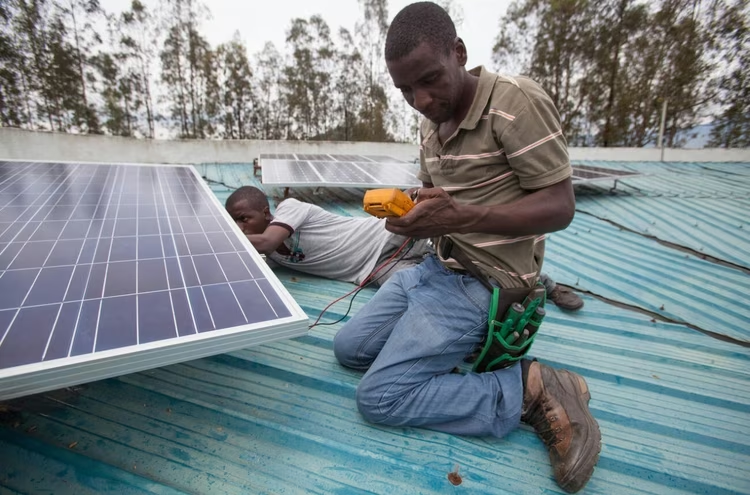
For businesses and households dealing with unreliable power, solar is increasingly more than an environmental choice; it is a business-continuity tool. Entrepreneurs can specialise in installation, maintenance, battery systems and energy-efficiency solutions.
Entry level: K30,000–K150,000 for tools, training, stock and working capital.
Customers: Homes, farms, shops, schools and small businesses.
Regulatory requirement: Relevant Energy Regulation Board requirements and technical standards. ERB specifically regulates the manufacture, supply, installation and maintenance of renewable-energy generating equipment.
Tourism transport and experience services
Tourism does not always require building a lodge. Entrepreneurs can provide airport transfers, guided day trips, cultural experiences, photography tours, cycling experiences or specialised transport around major attractions.
Entry level: K50,000–K300,000 depending on whether a vehicle is required.
Customers: Domestic and international tourists, hotels and travel agencies.
Regulatory requirement: Tourism licensing and, where applicable, vehicle, insurance and guide requirements.
Accommodation and food services grew by 9.1 per cent in Q1 2026, while arts, entertainment and recreation grew by 21.7 per cent.
Specialised food services
Forget trying to become the next generic takeaway. There is room for businesses focused on a specific need: corporate lunches, healthy meals, school catering, event catering, meal preparation or delivery to offices.
Entry level: K15,000–K100,000.
Customers: Offices, schools, events, households and restaurants.
Regulatory requirement: Local-authority permits, health certification and food-safety compliance. Zambia's Food Safety Act requires businesses requiring health clearance to undergo inspection.
Mining-supply businesses
Mining creates opportunities beyond owning a mine. Small companies can supply PPE, industrial consumables, cleaning services, fabrication, transport, electrical components, maintenance or specialised technical services.
Entry level: K50,000–K500,000+, depending on the product or service.
Customers: Mines and their contractors.
Regulatory requirement: Business and tax registration, relevant technical licences and compliance with individual mining companies' supplier requirements.
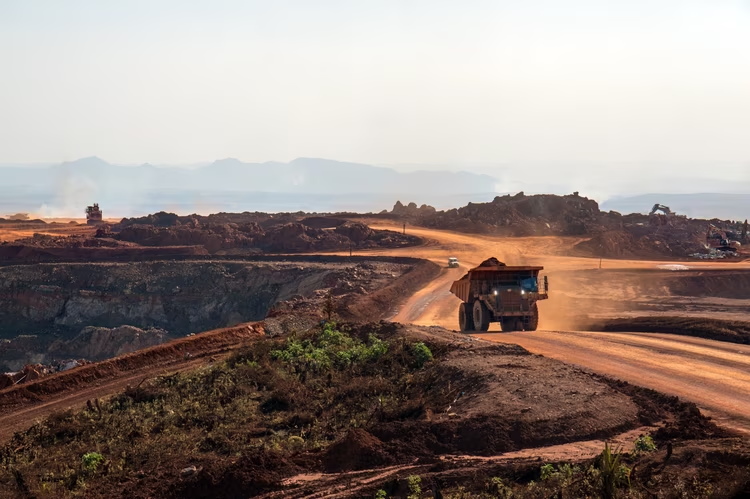
There is evidence of active local-supplier development: Mopani announced in July 2026 that it planned to onboard 60 new local companies, while its programme had already generated more than K20 million in orders for participating businesses during January–June.
Agricultural equipment repair and maintenance
As farming becomes more mechanised, equipment downtime becomes expensive. Repair businesses specialising in irrigation pumps, tractors, generators, solar systems and other agricultural machinery can serve farmers without needing to own farms themselves.
Entry level: K30,000–K150,000 for tools, diagnostic equipment, spare parts and transport.
Customers: Commercial farmers, cooperatives, agro-dealers and smallholders.
Regulatory requirement: Business registration and any technical or safety requirements applicable to the equipment being serviced.
Creative and digital entertainment services
The growth of arts, entertainment and recreation creates space for businesses around events, content production, photography, videography, podcasting, live entertainment, gaming and digital media.
Entry level: K10,000–K100,000 depending on equipment and scale.
Customers: Individuals, brands, event organisers, artists and institutions.
Regulatory requirement: Business registration, tax compliance and intellectual-property permissions where applicable.
The opportunity is in solving a problem
The strongest business idea is not necessarily the one with the smallest start-up cost. It is the one that solves a problem people are already willing to pay to have solved.
Zambia's Q1 figures provide a useful map. The challenge for entrepreneurs is turning that broad economic activity into a specific service.
Growth potential is not a guarantee of profit. But in 2026, entrepreneurs may find more interesting opportunities by following where Zambia's economy is moving rather than simply following what everyone else is selling.