There's a particular sound that the Lusaka Securities Exchange makes when something substantive happens. It's not loud. It's a small brass bell, the kind you'd expect at an old school assembly, not a stock market. But on the afternoon of 16th June, when that bell rang for Airtel Networks Zambia Plc, it marked something that Zambia's capital markets had seen only three times before in its 33 years of existence.
Airtel Zambia had just crossed the US$1 billion market capitalisation mark.
Market capitalisation is not cash in the bank. It is the market value of a publicly listed company, calculated by multiplying its share price by the number of shares in issue. Still, on a market like the LuSE, crossing US$1 billion is no small feat.
To put that in context: there are around twenty listed companies on the LuSE. Only four have ever broken the billion-dollar mark by market value. Copperbelt Energy Corporation got there first. Then ZCCM Investments Holdings. Then Zambia Sugar. And now, a telecoms company that most Zambians know better for its airtime sold at almost every kantemba nationwide than for its share price.
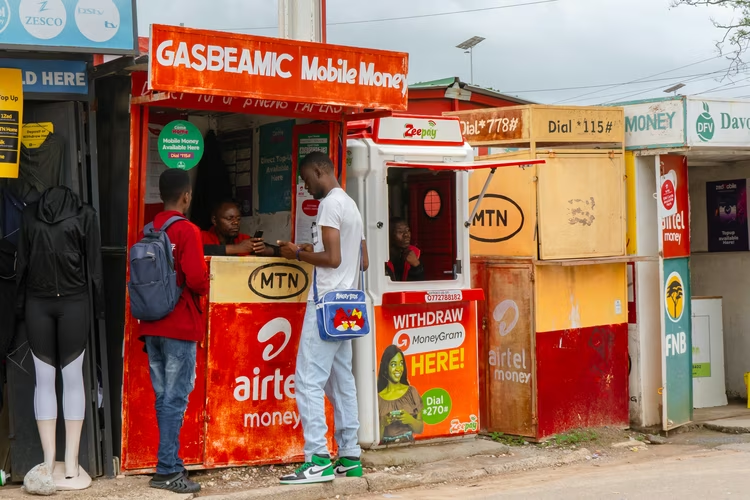
That contrast is part of why this milestone has people talking. Airtel isn't an abstract institutional name that lives only in financial pages. It's the network that buzzes in your pocket when a mobile money transfer lands, the SIM card swapped at a roadside stall, the small data bundle bought for the day because that is often how connectivity is managed in Zambia. Watching something that ordinary crosses the US$ 1 billion threshold on a Zambian stock exchange has a different kind of resonance than watching a mining or energy firm do it.
The company figures put Airtel's share price at around K43-K46 two years ago, compared with K175 today. The exact starting number varies slightly between company statements, but the direction doesn't: more than fourfold growth either way. Some of that is genuine business performance, a customer base that's grown past 12.5 million, with data users now making up nearly two-thirds of that base, a sign of the long, slow shift from voice calls to data that's been reshaping telecoms across the continent. Some of it, by the exchange's own admission, is currency maths: a stronger kwacha against the dollar has lifted the dollar-denominated value of every Zambian stock, including Airtel. This isn't a story about a company minting money out of nowhere. It's a story about a business riding a genuine growth curve at the same moment the macroeconomic winds happened to be blowing the right way.

Over the past year, Airtel poured more than US$107 million into network infrastructure: 406 new 4G and 5G sites, much of it aimed at pushing population coverage from 91.6% toward a 95% target. Some of that investment will support the development of network infrastructure in major cities such as Lusaka, Kitwe, and Ndola. The rest is funding rural towers that won't generate headlines but will put some villages on the network for the first time.
While not part of the LuSE listing, Airtel Money, the mobile financial arm of the wider Airtel business, helps illustrate how deeply the Airtel name is embedded in everyday life. Across Airtel Africa’s markets, the mobile money business grew its user base by more than a fifth this past year, crossing 54 million customers across the continent. In Zambia, where a large share of the population still doesn't have a bank account, its importance is obvious. For many people, the Airtel Money agent at the local town market is their bank.
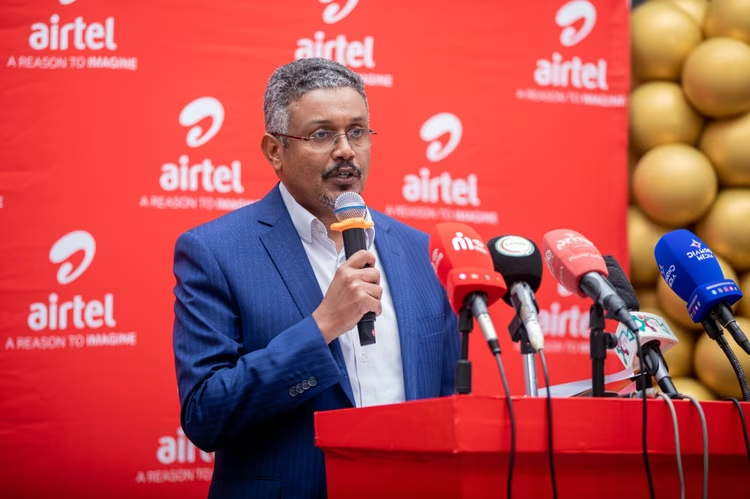
Board Chairperson Lynda Mataka described the milestone as something built collectively, by customers, staff, shareholders, and partners, rather than handed down from above. Managing Director Hussam Baday struck a similar note, pointing to the trust of everyday users as the real foundation under the number. Ceremonial language can sound predictable, but a telecoms company's valuation is, ultimately, just a tally of how many people keep choosing to use it.
Dr Brilliant Habeenzu, Permanent Secretary in the Ministry of Technology and Science, framed it more broadly still, as a signal about Zambia's investment climate generally and not just one company's fortunes. A billion-dollar valuation on a relatively small, still-maturing exchange tends to get noticed by people well beyond Zambia's borders. Capital markets pay attention to one another. A fourth billion-dollar company on the LuSE is a different pitch to a foreign investor than a market with only three.
What happens next is the more interesting question than the bell itself. Across Airtel's African operations more broadly, data revenue overtook voice revenue for the first time this year, a sign of where the next phase of growth is likely to come from. The company is betting that its next few million customers will look less like phone users and more like digital ones, and the infrastructure spend, the mobile money push, and the rural coverage expansion are all aimed at that bet paying off.
For now, though, the bell has rung, the milestone is logged, and Airtel sits alongside CEC, ZCCM-IH, and Zambia Sugar as the fourth Zambian company to be worth more than a billion American dollars on paper. It's a strange kind of fame for a company best known for SIM cards and data sold at kantembas nationwide, rather than for its stock price.