What Happens When a Belief System Becomes a Crime?
When two Zambians were sentenced under a colonial-era Witchcraft Act in 2025, many saw it as an unusual court case. Others saw a clash between modern law and indigenous belief systems that has never truly been resolved.
These practices once served as instruments of remembrance rooted in traditions, customs and ways of life. They helped shape the rich cultural diversity of Africa and fostered connections that often extended beyond modern political borders. A oneness which is being lost to so much of which is our own doing and the doing of those that oppress and condemn.
The colonial power’s scourge into Africa bore so many perspectives on what Africa is. African nation-states played into the realities conjured by biased and prejudicial thought and attitude. Some scholars argue that colonial influence operated not only politically and economically, but also through religion and cultural transformation. Taking it far back, as colonial messengers brought forth a new idea and sense of spirituality and philosophical life. These ‘civilised’ and ‘unbarbaric’ spiritual beliefs were evangelised throughout the lands of the native and indigenous people. Forcefully altering the nature of the African being at its core.
What Zambia's Witchcraft Act Actually Says
The Witchcraft Act, Chapter 90 of the Laws of Zambia, outlines practising witchcraft as pretending to exercise any kind of supernatural power, witchcraft, sorcery, or enchantment calculated to cause fear, to annoy, or harm. It is punishable by three years in prison if caught. The language of the Act reflects legal concepts inherited from the colonial era, prompting ongoing debate about whether such laws remain appropriate in modern Zambia. How much do we still live within the colonial constraints imposed on us. To pretend to exercise supernatural power is to frame every accused person as dishonest. Someone performing a deception, nothing short of a magician. NOT seen as a practitioner acting within a comprehensible, challenged belief system that has lived concurrently with human life for as long as there has been human life itself. Let it not be known only as something inherently African, but with the knowledge that many cultures have diverse spiritual beliefs.
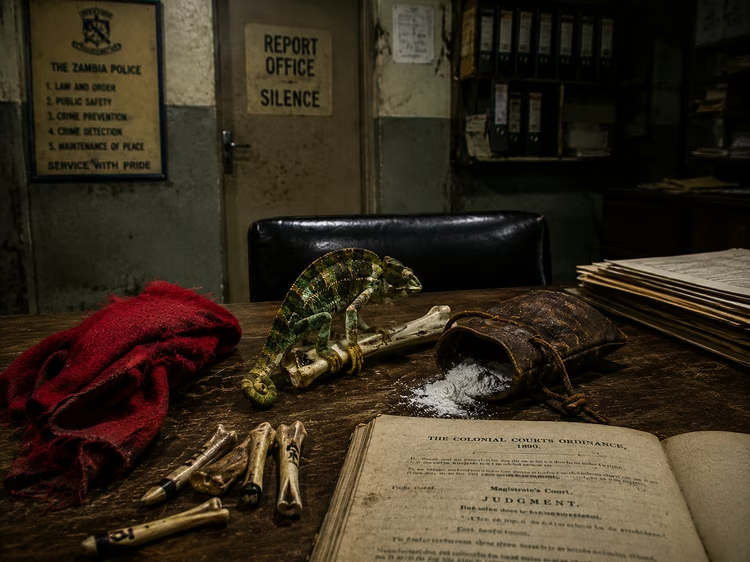
As recent as the year 2025, this epistemological and quite violent war rose once more. Two men are sentenced to two years with hard labour for being judged to have attempted to assassinate the current Zambian president, Hakainde Hichilema. Under the Witchcraft Act of 1914, they were convicted on counts of professing witchcraft and possessing charms, mystical objects. How can it be that we express the colonial bias? Of which we perpetuate by allowing those rules to hold value. Reported ‘charms’ were found to be a red cloth, a live chameleon, an animal’s tail and an unknown white powder. The makings of great mystical calamity, labelled dangerous by the same laws that were put in place to oppress the people who struggled to achieve the sense of freedom we live in today. Not surprisingly, the case soon gained national and international attention. But still the same questions are directed towards the law enacted, its validity and viability.
Does the Law Understand What It Prohibits?
This case is one of a kind, a wake-up call to some. A case which somewhat of a spectacle amongst it all. Aside from the political propaganda, the fundamental question of this all is, does the Witchcraft Act know what it forbids?
The ordeal is the product of a specific colonial logic. Colonialism needs to put a stop to indigenous beliefs, whether or not knowing that what has taken root in an unfamiliar land has any value and reality to it. That is close to the starting point of all colonial bias and prejudice. Tearing down what stands unfamiliarly to build up something familial. It was the first case of recorded political paranoia in recent times to be coherent with this thinking. Which sparks moral, ethical, cultural and philosophical debate.
It is originally outlined in the act of 1914 that witchcraft is the throwing of bones, the charms and any other means by which this ‘superstition’ is carried out. Be it sorcery or witchcraft. Colonial authorities responded by regulating and criminalising practices they regarded as superstition or threats to public order. A fabrication of the mind and one that lacks any grounding. A contradiction recognised as law in that it warrants criminal punishment and treatment, simultaneously classifying it as fantasy, mere pretence. It can not do both. In that contradiction, therein lies the truth.

The evidence in that trial was ironically put to the test. The accused are said to have demonstrated just how the chameleon, red cloth and unrecognisable white powder could consequently work to alter life itself. A court packed to its capacity watched on. You understand that practitioners and believers watched on as the very beliefs they hold were put to the sword, envisioning how they themselves could be persecuted if they were found to be a believer. Many look to traditional healing for their ailments; these very beliefs can be the basis of their hopes. To call these beliefs mere pretence takes away that hope, let alone having to be punished for it.
The Epistemological Legacy of Colonial Rule
Colonialism not only takes land and labour, but it also begins a systematic epistemological war. A war on what is accepted as knowledge, what counts as real and rational. African spiritual beliefs and practices are a part of that war. It was understood that cosmological frameworks are not peripheral to African social and cultural life; they organise it. And their disruption disorganised the sense of self, community authority, collective meaning and moral order.
Awareness has now been brought to how the systems they left still delegitimise African knowledge systems, and colonial rule reserved for itself a monopoly on what kinds of causation are legally accepted and recognisable. Science and Christianity were left and could explain illness, misfortunes and death, but African Cosmology and belief systems could not, at least not legally or in any court, even.
Fanon, Césaire and the Question of Cultural Alienation
African thinkers like Aimé Césaire and Frantz Fanon saw how colonialism was not a civilising mission but a destructive one that sought domination and control through the perpetual construction of the image of the colonised as primitive and savage, thus justifying laws like those that are still valid today, years on.
Frantz Fanon’s black skin, published in 1952, mirrors this dilemma. It is about what colonial domination does to the inner life of the colonised, and the way it installs a split consciousness in adopting foreign ways of life and abandoning one's own. Alienation from one’s own cultural inheritance and tradition.
It is known only to the originators of such law what truly it is meant to do. The degree of standard of proof required in any common-law court varies depending on how the allegation is made. Which begs the question, who do these laws serve?
Nonetheless, many Zambians believe and engage with Zambian Cosmology, as well as still organise their lives and communities in accordance with it. These beliefs and practices still hold essential cultural significance and are held dearly.