Traditions, languages, and cultural rhythms reveal a continent shaped not by fixed lines, but by continuity and adaptation.
“Wait, your number is different from mine.”
“Really? What’s yours?”
“I am a stroke ten. Stroke one.”
“Oh yeah. I am a sixteen stroke one.”
This is our code of citizenship.
In Zambia, the National Registration Card (NRC) does more than identify; it locates. The first set of numbers is personal, but the second set marks our district of origin. My friend and I shared a desk in high school, ate in the same dining hall and walked the same streets. But when he turned sixteen, his father took him to a district office in Kabwe to register, and when my turn came, my mother took me to Lusaka. We have the same card with a stiff green-grey photograph, but our origins are not the same.
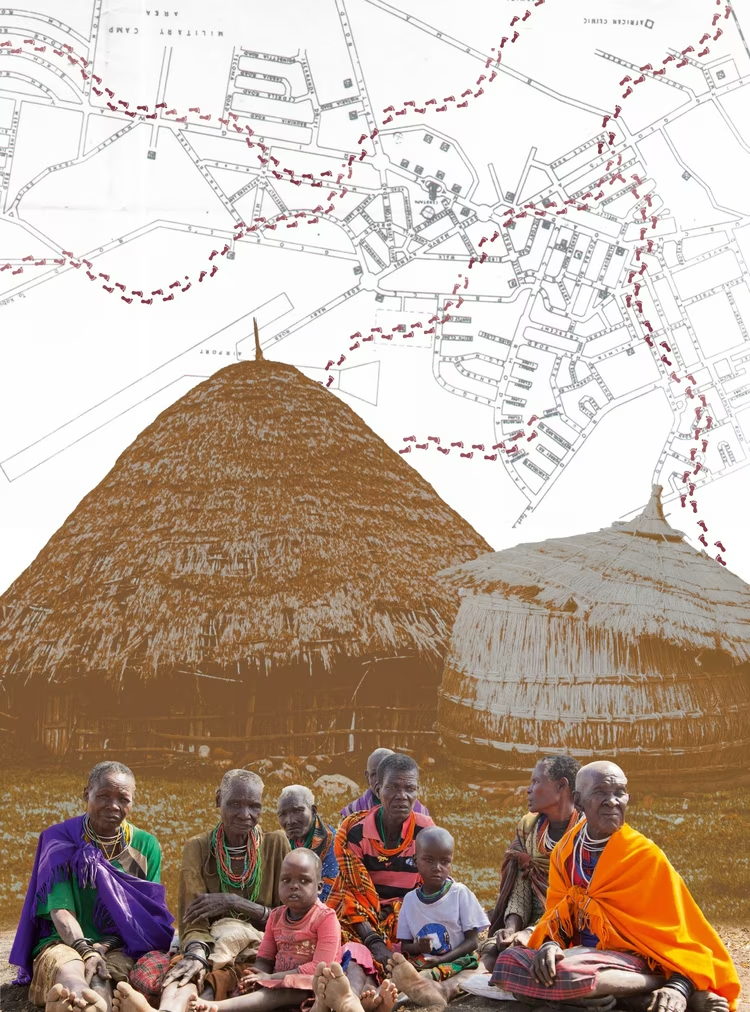
Lusaka myopia closes off the mind to other realities. Realities where full lives exist outside the path set out by the capital city. As a child, I thought all trains ran at 17 hours, just because I always heard the choo-choo after school.
My parents were /46/1 and /61/1. Two districts. Two geographies. Two genealogies colliding in a pre-Internet Zambia with no algorithms to engineer romance. They met at the office in Lusaka. How did a /46 meet a /61 and find enough in common to build a family?
The answer begins with the original.
000001/11/1 - The First Stroke
The very first National Registration Card was issued to Kenneth Kaunda in 1965. Northern Rhodesia was no more. Zambia was coming into form, and 11 marked Lusaka District. The final 1 marked nationality and the bureaucratic poetry of unity: One Zambia, One Nation.
Under Kaunda’s philosophy of Humanism, unity was not just a slogan but a policy. National Youth Service programs of the 70s sent young people across provinces. Civil duty, multilingual education, and inter-tribal relations reflected the unity and industry in our coat of arms. The NRC, for all its unifying ambition, also revealed something deeper: our history was interwoven. The first architects of this region were not colonial cartographers. They were migratory communities.
“African societies were dynamic and capable of change, innovation and adaptation long before their contact with Europe.” Ogot, Africa from the Sixteenth to the Eighteenth Century (UNESCO General History of Africa, Vol. V, 1992)
The Bantu migrations are often described in school textbooks as an abstract, primitive push in search of land with no beauty or reason. However, historians such as Jan Vansina and Bethwell Allan Ogot have shown that Bantu migrations were not chaotic in nature. They were structured, technological, and socially sophisticated processes unfolding over centuries. Kuomboka, when the Lozi king moves from floodplains to higher ground, is a choreography born of ecological intelligence. Ncwala among the Ngoni marks harvest cycles and migration tied to collective survival. Yes, there was conquest, but there was also innovation, education and a rhythm with nature. Their movements show a deep understanding of terrain, distance, geographic precision, and an adaptation that ensured their crops and livestock remained productive enough to sustain generations.
When some people look at the map of Zambia, they see a butterfly, but I see two palms, open and inviting. Before she was known as a land of war-fleeing people, Zambia was magnetic and abundant with potential.
Beginning around 1000 BCE, Bantu-speaking communities gradually moved from West-Central Africa into the eastern and southern regions of the land. They carried iron-working technologies, agricultural systems, livestock practices, and intricate kinship models. Their movement was not displacement, nor leisure; it was a kinetic philosophy.
In African Religions and Philosophy (1969), anthropologist John Mbiti explores travel and movement, and emphasises that in many African cosmologies, the community includes the living, the dead, and the unborn. Migration, then, was not rupture but continuity. A village did not vanish when it moved; it replicated itself.
Trace a line on the map from the Congo Basin through Zambia and into northern Namibia, and another from Zambia through Zimbabwe into Zululand, and you will find language echoes of this invisible trail. The linguist Malcolm Guthrie classified Bantu languages into zones not by modern borders but by structural kinship. Noun classes repeat. Grammatical rhythms mirror each other. Words for cattle, home, ancestor, and child resonate across geography.
Language is a fossil record of migration. But what if there is more?
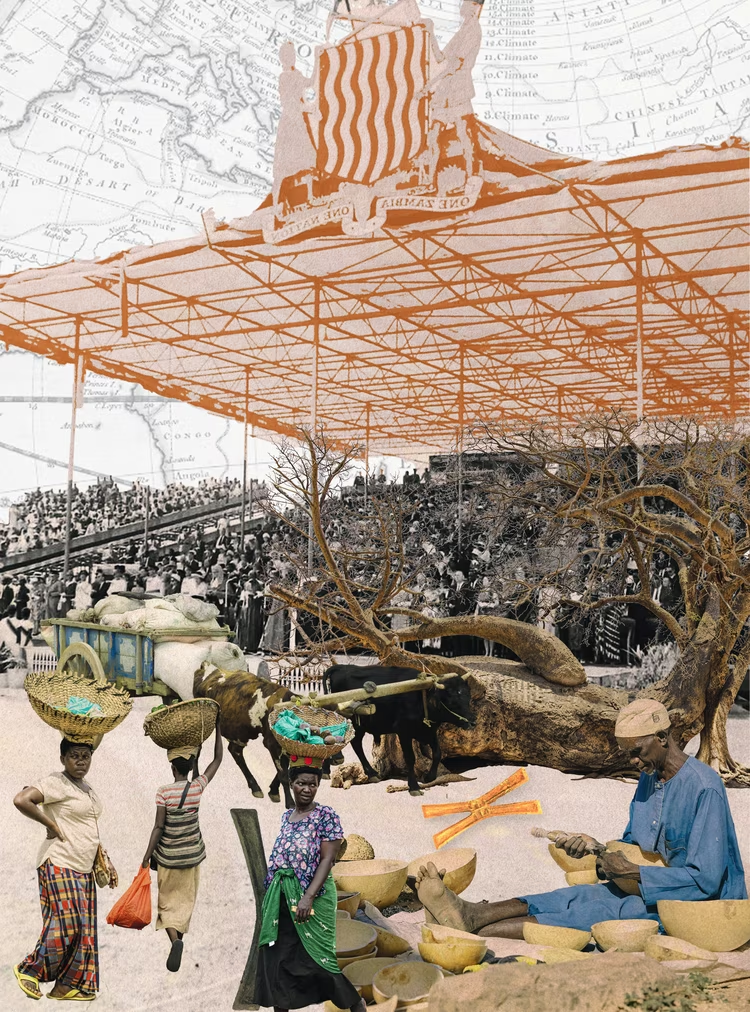
The Second Stroke
“Umwana ushenda atasha ba nyina ukwipika” — Bemba Proverb.
[Translation: A child that never travels thinks his mother is the best cook.]
The Berlin Conference of 1884 was held before Kenneth Kaunda took his first breath. Before the concept of Zambia, they divided the continent into shapes that suited their ambitions. They accounted for African mineral resources but not for Africa’s songs, drinks, stories, hobbies, and kinship. Our fluid borders froze. African identity is fundamentally circulatory rather than territorial. Long before passports, kinship flowed with purpose across what are now borders.
The Scramble for Africa was only possible because the people of the continent were dehumanised and commodified. There is a hidden irony in the idea of the ‘effective occupation’ of Africa. Today, many Zambians have mixed origins. Our blood is a record of when Europe touched our continent. Our food and fashion show how Arabs brought us spices, and how the Dutch colonised Indonesia and converted batik into our chitenge. The maize from the Americas and the British bread and tea culture are now our staples.
Northern Zambia borders the Nyamwezi people of present-day Tanzania, an 18th-century community known for travelling by moonlight. These moon caravanners are described as expert navigators and agriculturalists who moved with precision across East and Central Africa, evolving their language and skills as they adapted. They are a spotlight on African leadership before conquest, and Nyamwezi rulers like Mirambo contended with Arab-Swahili traders, German colonisers, and later British colonial rulers.
African communities like the Nyamwezi show a flair for movement that one could call tourism, diplomacy and exploration. Whatever it was, it was definitely beyond the tourism of safari brochures.
Modern-day Zambians are not known for travel. Aside from assumptions about our timid nature, the green Zambian passport cannot wander as freely as the navy-blue passport of England. African nations are frozen in contradictory geographical maps that do not reflect their identities. In the border towns, green NRC holders often speak a little French, a little Arabic, a little German, and a little Portuguese because language never forgets.
But time is not a healer; it is a judge.
The Last
As a /10/1, Lusaka is all I have ever known. I stomp around the city without Google Maps, I haggle no matter the price, and I feel everything but fear. As a child, travelling north to my paternal grandparents and south to my maternal grandmother, I felt only fear. Good behaviour on the holiday trip was compulsory. Our father forced us into leather jackets and never let us open the windows. We would arrive, so sweaty that our skin was smooth, but so relieved to be free on the loamy, well-swept soil of our grandparents' land. My grandparents could not speak English, but for us, they tried. Love is more effective than Duolingo. Ruth, my maternal grandmother, was ‘properly’ educated by the missionaries of the 1930s and went on endless rants about William Shakespeare. She saw me. Without the fog of discipline, grandparents have the generational advantage of seeing mischief as creativity, curiosity as intelligence, and hard-headedness as leadership. They also have a closer memory of our true origins and the gift of foresight. They know where we are going because they know where we are from.
Today, my grandparents and my father are all dead. I am happy to report that I travel with the windows down and I do not own a leather jacket. My car is one of the thousands cruising by. I feel where old colonial roads meet new dual carriageways. Abercorn is now Mbala, Broken Hill is Kabwe, but some parts of Mansa still say Fort Rosebery, some parts of Chililabombwe still whisper Bancroft. Whenever I can, I stop to drink water out of a gourd and sit in the cool of a hut. I wonder if the opposite is true: are there any parts of Britain, Europe or the Arab world that still carry the scars of The Scramble?
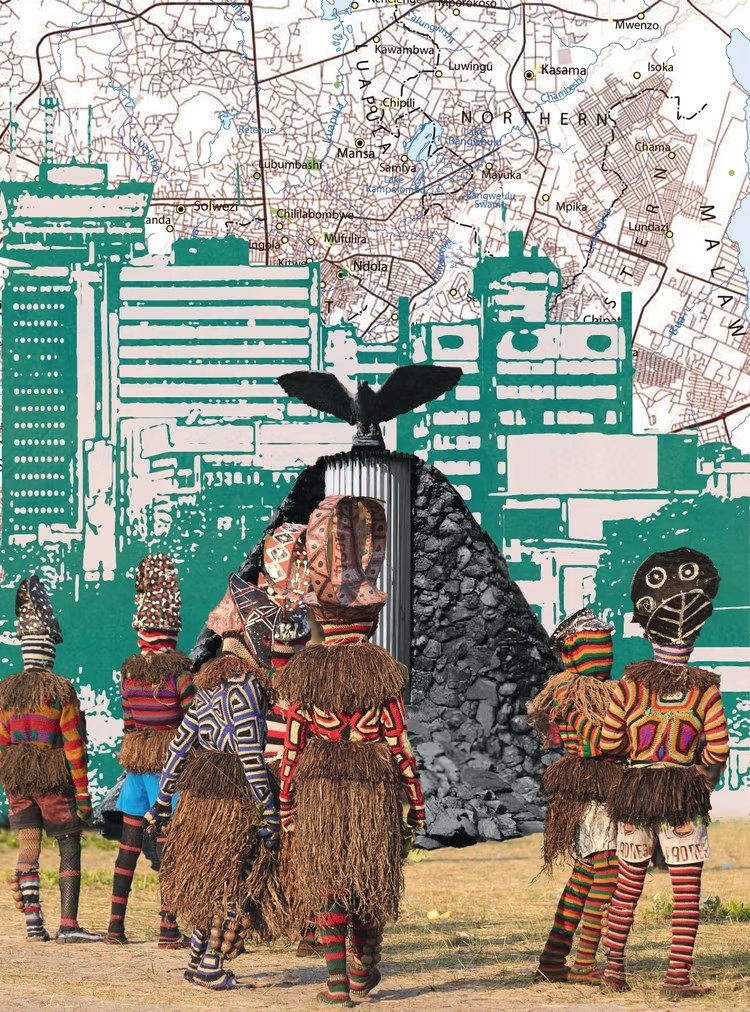
Travel is true isolation. It forces us to decide what to carry and what to leave behind. Our ancestors knew this. I am a practical packer; I only carry what I need. In the long hours of travel, I find the luxury of spending time on small talk, movies, and books I never have the attention span for. This is the same luxury I imagine turned my ancestors into songwriters and storytellers. I read Hamlet to build my own conclusions. In the anonymity of being one in a crowd, I discover that I am only extroverted around my loved ones. I eat only once, I wear grey and fade into the background as I watch the world. To travel is to find the true self.
Outside of my beloved home, Lusaka, I find fear. Fear of not having enough, fear of getting scammed, fear of going the wrong direction. Google Maps stays open. I recite my details over and over in case I lose my papers. Presenting my paperwork simplifies me to /10/1. I am not what I do or who I have become; I am where I am from. Travel builds empathy for everyone who has migrated out of need, not want.
I am embarrassed that I have seen Dubai, yet I have not seen the source of the Zambezi. As war looms over our world, those are the facts that give rise to regret. The impermanence of our global identity makes every travel choice an important one. Some people have made homes of the places they were when COVID-19 struck. If the world ended, is this where I would want to be?
I am not ready for the end of the world. On paper, I am /10/1. Lusaka. One nation. But the roads I have travelled, the languages I have heard, and the migrations that carried my ancestors here suggest something else entirely. A number can mark where you began. It cannot contain where you are going.
There is so much of this world to see. But above it all, I want to do it because of what it will reveal about me. People are the places they have been, and right now, you can taste the Zambezi on my skin.