2025 was a year characterised by uncertainty across many global capital markets. Interestingly, that was not the case for the Lusaka Stock Exchange (LuSE), which emerged as one of Africa’s standout performers. By mid-2025, the LuSE All Share Index (LASI), which tracks LuSE’s overall market performance, had risen by more than 50 per cent, building on the previous year’s trajectory, when the exchange ranked amongst Africa’s top five stock market performers in 2024. To put the growth into context, since January 2024, as of the time of writing, the LASI has increased from 10,828.18 points to 25,308.72 points, representing a 133.73 per cent increase.
This historic performance occurred against the backdrop of several significant milestones. The market recorded two companies valued at over USD 1 billion each, alongside a record-high market capitalisation exceeding K217 billion. As a result, the exchange attracted intense interest from both local and international investors. This 2025 performance has not just set the tone for 2026 and beyond; it has fundamentally marked a turning point for the LuSE, solidifying its reputation as a viable, high-growth investment destination in sub-Saharan Africa.
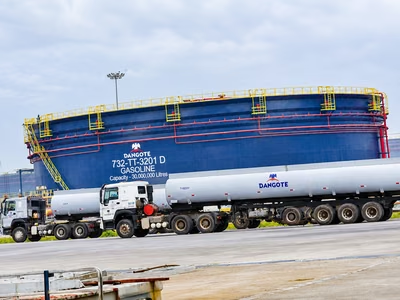
Several underlying factors contributed to this success. Key drivers included strong performance in the mining sector, favourable commodity prices, and surging energy demand in the Copperbelt provinces of Zambia and the Democratic Republic of Congo (DRC). Furthermore, bold economic reforms have boosted confidence, aided by easing inflation and a relatively stable exchange rate. As Zambia leverages its unique role in the regional and global investment landscape, it is critical to examine not only how the LuSE arrived at this favourable position but also what it signals for the country’s economic future.
Market Performance and Momentum
LuSE’s 2025 performance can only be described as stellar. This is reflected in the price appreciation of several stocks, resulting in the LASI closing at 25,242.39 points, a 25 per cent increase since the second quarter of 2025. This performance was primarily driven by price gains in CEC (+14%), ZNCO (+12%), ZSUG (+41%) and BATZ (+153%). Year-on-year movements have followed a similar pattern, indicating sustained performance, primarily driven by the financial performance of these listed entities.
What stood out most significantly for the LuSE, which has often played catch-up to larger markets such as South Africa, Nigeria and Egypt, was the consistency of its rise. This sustained momentum suggests that something significant, or something deeper than routine market cycles, is driving this performance, even if it has not been visible to all observers.
What is Fuelling the Performance?
Several converging factors have driven the LuSE’s landmark run, each one revealing a broader narrative of Zambia’s evolving economic landscape.
Copper has been at the centre of this momentum. Rising demand for the metal, driven primarily by renewable energy and electric vehicle manufacturing, has improved prospects for companies across the mining value chain. This global trend has, in turn, boosted investor confidence and driven higher valuations for companies heavily exposed to the sector and related sectors.
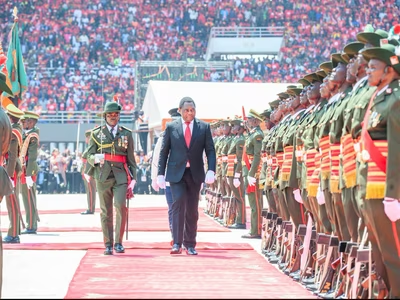
The government’s commitment to economic reforms and bolstering monetary stability has also played a significant role. The Bank of Zambia is navigating inflation deftly by adopting a “fix-on-the-go” approach despite persistent pressures, which is providing a more predictable macroeconomic environment. A combination of fiscal discipline, transparency and regular investor and public discourse has yielded a clear perception of stability for institutional investors.
The rise in public awareness and financial literacy around the stock market has triggered a significant surge in retail investor demand. This increase, coupled with heightened participation from domestic institutional players, including insurance companies, pension funds and asset managers, has improved the exchange’s liquidity. Following the restructuring of Zambia’s debt and the subsequent rating upgrade from Selective Default (SD) to CCC+ by S&P Global Ratings, and the deliberate, widely publicised mining sector expansion plans, foreign investors have begun a steady yet cautious return. Consequently, the LuSE has become increasingly difficult to ignore for frontier-market funds seeking high-growth diversification.
Risks Beneath the Rise
It is a given that every boom has its inherent risks. Following its stratospheric rise, the LuSE would do well to remain wary of turbulence in its various forms. The most apparent risk is market concentration, as a large proportion of market performance is driven by a small set of top-performing stocks, primarily in the mining sector and ancillary sectors. The risk lies in the possibility that a severe shock or adverse development in one or two key companies or sectors could disproportionately skew the entire index (LASI), leading to sharp, exaggerated market volatility.
Another risk lies in exchange rate fluctuations. The Kwacha is not immune to volatility, which is always a key consideration for potential foreign investors. While 2025 has been a relatively stable year for the Kwacha, supported by positive macroeconomic developments, the currency remains exposed to global commodity cycles. Any sharp weakening of the currency could translate into diluted returns for foreign investors when they repatriate their profits, a factor that could potentially deter future international capital inflows.
These risks, coupled with potential inflationary pressure and commodity dependence, could become a ‘poisoned chalice’ if not handled with the utmost caution. Even with effective management, inflation remains above target, and rising prices could erode real investor returns. Copper remains Zambia’s economic lifeblood, and this deep dependence on the mineral means that Zambia’s fortunes rise and fall on the ebbs and flows of this commodity. Any slowdown in global demand would send shockwaves that would critically impact corporate earnings.
What Comes Next?
Having established the LuSE as the de facto poster child of the African exchange landscape, the critical question remains: What next? With an elevated ability to attract investment due to clarity in policy, commitment to reform and well-targeted sector growth, the LuSE’s future looks bright. To maintain and solidify this position, the LuSE must focus on diversification and expansion across several key areas.
The LuSE needs new, attractive listings to broaden its market depth, which is currently dominated by energy and mining heavyweights. To achieve this, it will be essential to clearly demonstrate to companies the benefits of going public. Bolstering the LuSE Alternative Market (LuSE-Alt) will enable small and medium-sized enterprises to participate in the listing process, which has traditionally excluded them. This strategy, combined with the provision of tailored financial instruments, could prove to be the missing key that unlocks unbridled growth for this critical sector.
Clarity, transparency and sustained fiscal discipline, along with definitive regulatory guidelines, are imperative for preventing volatility and maintaining foreign investor engagement. The LuSE must work to encourage broader retail and institutional participation whilst aggressively driving public education programmes and advocating for strengthened investor protection frameworks.
LuSE’s phenomenal rise in 2025 must be seen as more than just a smile-inducing financial headline; it should be viewed as a fundamental shift in Zambia’s economic landscape. This performance attests to rising investor confidence and highlights the tangible impact of deliberate national reforms.
The signals are clear: Zambia is capable of attracting capital, offering competitive returns and supporting broader economic development. If Zambia can successfully harness and ride this momentum, the LuSE may well be on track to become one of Africa’s most dynamic and essential financial platforms for many years to come. Here’s to diversification, expansion, transparency and continued market deepening. Here’s to the future.