Who Was Chirupula?
In the early history of colonial Zambia, few figures straddled two worlds as dramatically as John Edward Stephenson, better known across the Copperbelt as Chirupula.
To European settlers, he was an embarrassment, a man who had abandoned the conventions of empire. To many Africans, he was a chief, a pathfinder and at times a mystic figure who moved with unusual ease between the visible and invisible realms.
Born around 1874 in Northumberland, England, Stephenson arrived in southern Africa in the 1890s, part of the wave of fortune seekers drawn by the empire and mineral wealth.
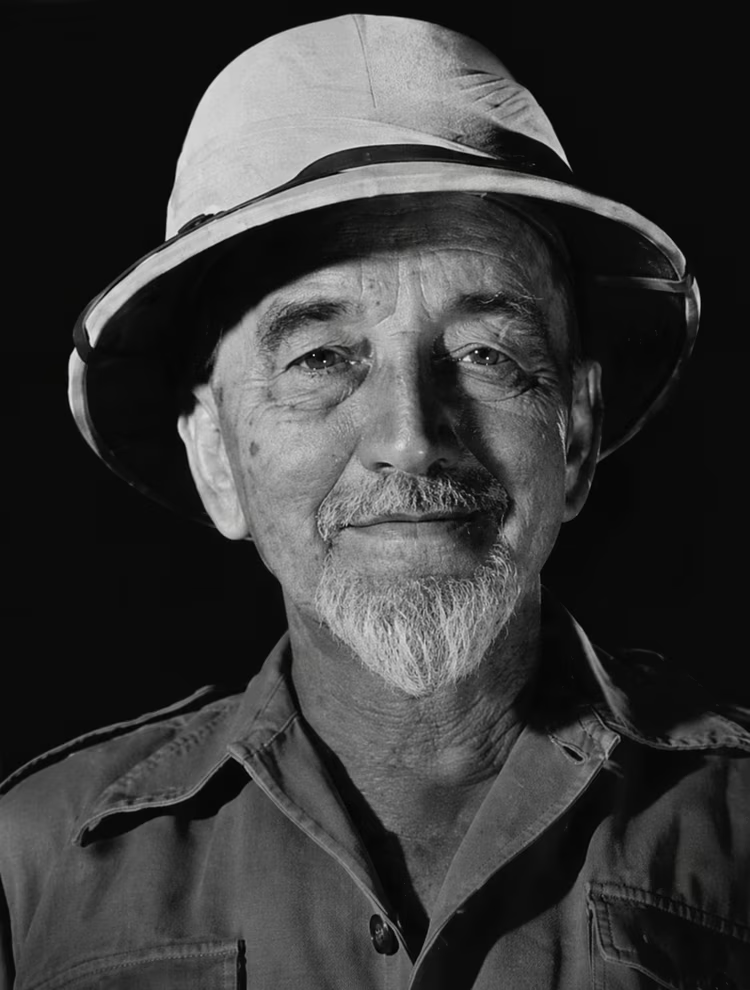
He first worked as a telegraph operator in Kimberley before illness, and restlessness pushed him northward. By 1898, he was in Bulawayo and soon after joined expeditions moving into what was then Northern Rhodesia under the banner of the British South Africa Company.
He would later be credited with founding the boma that grew into Ndola on July 18 1904, making it one of the earliest colonial administrative centres in the territory.
From that modest outpost near the Kafubu River, Ndola evolved into a trading hub and later a municipality, eventually receiving a coat of arms from the Royal College of Arms in London in 1952 and city status in 1967. Yet even as the town formalised its British identity, its founder was moving in a different direction.
How Illness Changed His Life Forever
Stephenson’s transformation began during an illness. Stricken with malaria while travelling north, he was nursed back to health in an African village. The experience left a lasting mark. In later years, he would reflect that it was in that hut, surrounded by women who cared for him without expectation, that his loyalties subtly shifted.
According to local accounts, he married his first wife, Loti, a Ngoni woman whom he is said to have rescued from exploitation. What may have begun as an arrangement of protection became a lasting union.
In time, he married other African women, among them Mwape Chiwali and members of Lamba royalty. Historical accounts suggest he fathered nine children through his marriages.
In the rigid racial hierarchies of colonial society, such choices were scandalous. He became the black sheep among colonial settlers.
Among Africans, he was absorbed into kinship networks and given the name Chirupula, loosely translated as smiter.
He served as a Native Administrator and tax collector, travelling widely through Lala and Lamba territories. Unlike many officials, he spoke local languages fluently and cultivated close relationships with chiefs.
Local stories even describe a pet baboon that supposedly smoked a pipe and sat like a man among gatherings, adding to the aura that surrounded him.
Over time, he left formal colonial service and established his own enterprises, but his authority among Africans remained.
The Legend of the Sanguni River Snake
It was this unusual standing that drew him into one of the Copperbelt’s most enduring legends, the saga of the Luanshya River snake known as Sanguni or Funkwe.
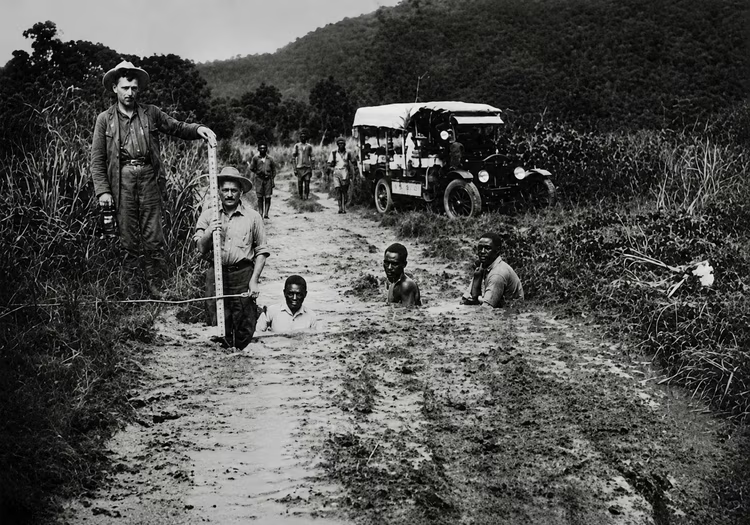
When work began at the Roan Antelope Mine in the late 1920s, death stalked the workforce. Malaria, blackwater fever and pneumonia cut down miners in alarming numbers. Swamps along the Luanshya River bred mosquitoes, and living conditions were harsh.
According to Lamba oral tradition, the explanation lay beneath the waters. They spoke of Sanguni, a monstrous serpent with a humanlike head and a body fused from a snake and a fish.
It was said to swim through the Luanshya River into mine shafts, causing flooding, cave-ins and disease. Each accident or illness was counted as another victim claimed by the spirit.
Fear spread rapidly. Workers deserted. Recruitment faltered. The mine’s reputation darkened. Managers understood that malaria was the principal killer, yet medical campaigns took time.
Draining swamps and improving sanitation required money and planning. In the meantime, confidence had to be restored.
The Ritual That Was Said to Drive Away the Serpent
In 1928 and again in 1930, Stephenson was called upon. By then widely known as John E Chirupula Stephenson, he organised Lamba elders to conduct a ritual exorcism at the river.
A thatched cone-shaped shrine was erected near the site where a miner had drowned. Accounts of the ceremony describe offerings, including white ritual items such as white flour, a white rooster, a white handkerchief, and white beads. Elders offered prayers and performed ceremonies asking the serpent to depart.
When the ritual concluded, they proclaimed that Sanguni had relocated and would trouble the mine no more. The symbolism was powerful. Confidence returned gradually. Recruitment resumed.
Meanwhile, the mine intensified malaria control and drained the swamps. Mortality rates fell in subsequent years as ecological conditions improved.
Myth, Malaria, and Mining Reality
Sceptics then and now argue that the ceremony was theatre, tolerated by management as a cheap way to quell fear while scientific measures addressed the true causes of death.
Others see it as a pragmatic merging of belief systems in a frontier society where modern medicine and traditional cosmology collided.
What is certain is that the episode entered Copperbelt lore. Some local interpretations connect the eagle-and-serpent imagery in Luanshya's coat of arms to the Sanguni legend, although the symbolism has been explained in different ways over the years.
Freemasonry, Spirituality, and the Mystery of Chirupula
Stephenson’s own beliefs add another layer of intrigue. He was a Freemason and reportedly fascinated by esoteric ideas.
Friends described him as highly superstitious, attuned to omens and the unseen. To some, he embodied the contradictions of empire, a British pioneer who embraced African spirituality even as he represented colonial authority.
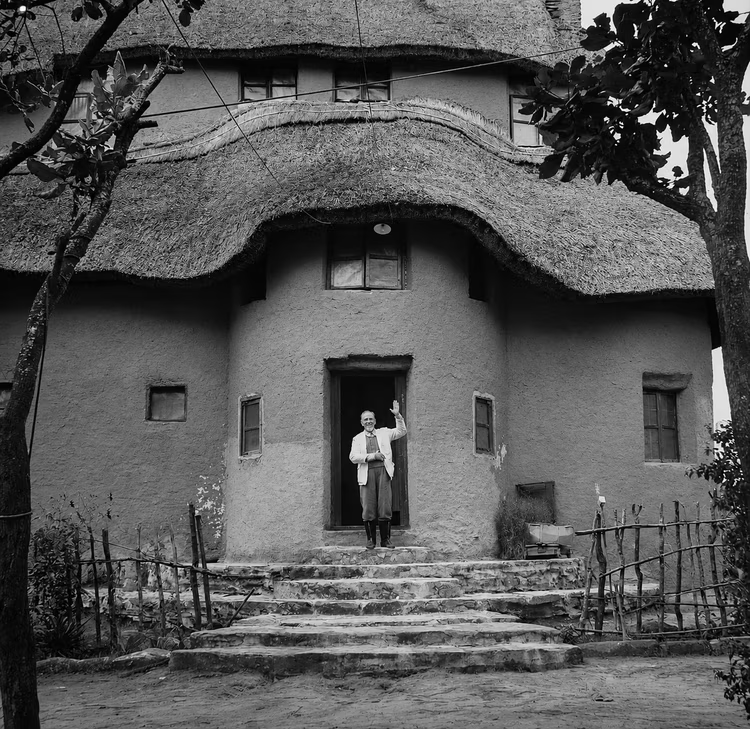
He lived in a thatched cottage that became a local landmark. Long after he died in 1957, family members spoke of strange occurrences there.
Family stories recount unexplained sounds and shadows around the property after his death. Whether these were the inventions of youthful imagination or the persistence of a legend, they reinforced the mystique surrounding Chirupula.
Hero, Mystic, or Colonial Intermediary?
His life forces uncomfortable questions about identity and power. Was he a romantic who rejected the racial dogmas of his peers, or a colonial intermediary who understood that influence required cultural fluency?
Did he truly believe he had driven away a river spirit, or did he recognise the psychological necessity of ritual in stabilising a fragile workforce?
In the end, John Stephenson Chirupula defies simple categorisation. He founded a town that became a pillar of the Copperbelt economy.
He married across racial lines and built a large African family in an era that condemned such unions. He stood at the crossroads of science and myth during the formative years of industrial mining.
And in the collective memory of Luanshya and Ndola, he remains the jungle pathfinder who dared to cross boundaries others feared.
The legend of Sanguni still circulates among the Lamba, even as historians point to malaria and poor sanitation as the real culprits behind early mining deaths.
That duality mirrors Stephenson’s own life, poised between rational administration and esoteric ritual. In that tension lies the enduring fascination with a man who, in trying to master the frontier, allowed the frontier to remake him.