In the towns of the Copperbelt in colonial Zambia, the most dangerous thing was a rumour. Whispers travelled faster through markets, beer halls and churchyards, feeding on fear and suspicion. And the most feared rumour of all had a name: Bamunyama, also known as Bakabulangeti, Ba Kamupila and Bakapulikoni- Capricorn.
These names carried the weight of an entire society's anxieties, fear of colonialism, of the educated elite, and of the stranger within.
Who Were the Bamunyama?
The word Bamunyama evoked images of vampire men who captured unsuspecting victims, drained their blood and disposed of their bodies in secret chambers.
In Ndola, rumours swirled around Arthur Davison Children’s Hospital, nicknamed Yengwe by locals after the colonial official Arthur Davison, whose name Africans transformed into Yengwenyama.
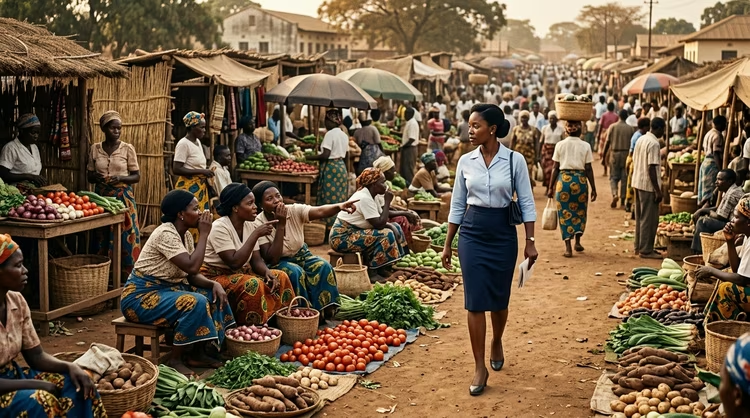
According to popular lore, the hospital harboured a hidden room where kidnapped Africans were marked with a wand and prepared for slaughter. This detail spawned another label, Ba Kamupila, named after the wand supposedly used to mark those selected for slaughter.
The fear was not confined to the faceless vampire. Suspicion extended to real, living individuals.
Who Were Bakapulikoni?
Africans who socialised with whites, wore suits, spoke fluent English or held clerical positions in the colonial administration were branded Bakapulikoni. The term is derived from the Capricorn Africa Society, a multiracial body founded in 1949 that advocated gradual civic rights and cooperation between races.
To many ordinary Africans struggling under colonial rule, such associations appeared suspect. The educated elite were accused of colluding with colonialists and, in the fevered imagination of the time, of participating in sinister blood rituals.
The Capricorn Africa Society itself had complex aims. Established by figures such as David Stirling, it called for equal rights for all civilised people and promoted a restricted franchise that would gradually expand African participation.
In Northern Rhodesia, its members later formed the Constitution Party in 1957, seeking to advance Capricornist ideals. Prominent Africans and Europeans joined, including liberal minded settlers and African professionals. Yet as nationalist movements gained momentum, the society’s moderate stance appeared increasingly out of step.
African members drifted toward more militant organisations, such as the United National Independence Party (UNIP), and the society eventually dissolved in 1961. In the popular imagination, however, Bakapulikoni endured not as constitutional reformers but as shadowy collaborators.
The Bakabulangeti Myth
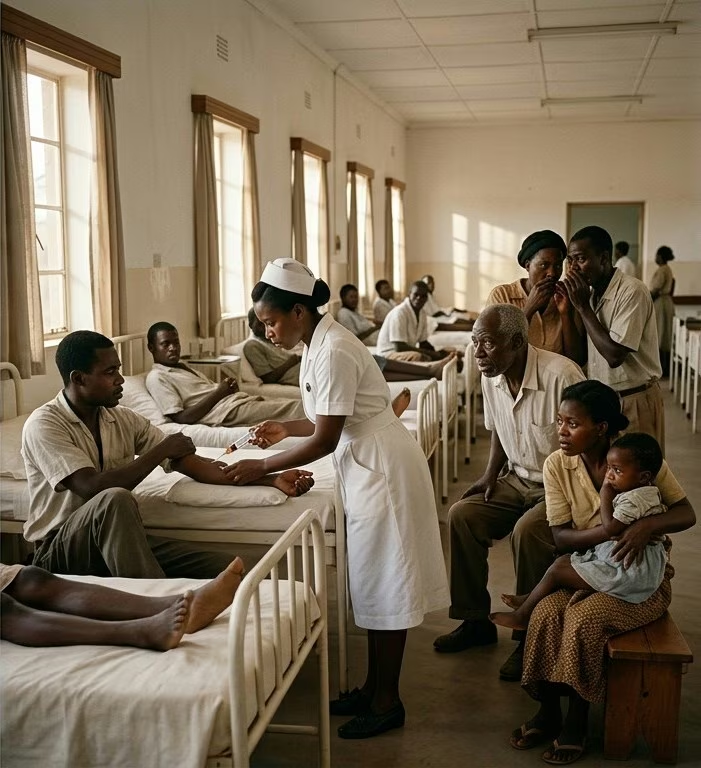
The myth also took on ethnic dimensions. Sotho migrants, who often draped themselves in blanket-like garments, were labelled Bakabulangeti. The blanket became a symbol of concealment. In the charged atmosphere of urban migration and labour competition, difference bred suspicion.
A man wrapped in a blanket at dusk could easily be cast as a vampire in waiting. Xenophobia fused with folklore, and ordinary attire became incriminating evidence.
These legends flourished in a period marked by rapid urbanisation and social dislocation. The Copperbelt towns were expanding, drawing young men from rural areas into wage labour and regimented compounds.
Traditional structures of authority weakened, while colonial institutions remained alien and mistrusted. Hospitals, in particular, inspired anxiety. To communities unfamiliar with biomedical procedures, blood transfusions and surgical instruments could appear ominous. The image of a secret hospital room where blood was siphoned from Africans reflected both ignorance and deep-seated fears of exploitation.
The Social Cost of the Myth
These accusations were not harmless gossip. Being branded a munyama could invite mob justice. In communities where literacy levels were low, and rumours carried authority, suspicion sometimes spelt death.
The myth operated as a social weapon, deployed against outsiders, rivals or those perceived as too close to colonial power. It was easier to believe in vampires than to confront the structural inequalities of the colonial system.
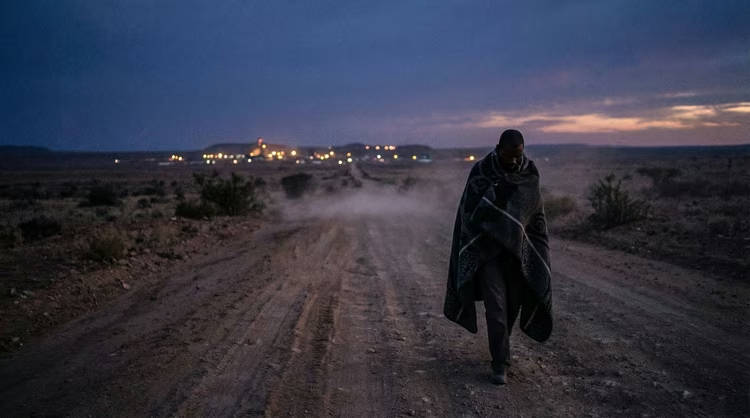
Zambian literature captured these tensions with striking clarity. The renowned Bemba writer Stephen Mpashi fictionalised the hysteria in his novel Uwauma Nafyala.
In one memorable scene, two medical personnel, Kabanki and George, become targets of Bamunyama's accusations. They are accosted by a suspicious duo convinced of their vampiric intentions.
The confrontation escalates until one of the accused kills his assailant in self-defence. Mpashi’s narrative lays bare the destructive power of rumour, showing how fear can turn neighbour against neighbour and transform healers into hunted prey.
Music also entered the fray. The celebrated broadcaster and folk musician Alick Nkhata composed a song debunking the Bamunyama rumours. Through melody and satire, he sought to calm public hysteria and remind listeners of the folly of believing every whispered tale.
His intervention underscores how deeply embedded the myth had become in popular consciousness. That a musician felt the need to fight a rumour with a melody tells you how deep the fear had taken root.
The Bamunyama legend survived because it was never just one thing. It began as a chilling story of cannibals linked to a colonial hospital and a feared official. It then expanded to encompass educated Africans accused of fraternising with whites. Later, it attached itself to migrant communities distinguished by dress or language.
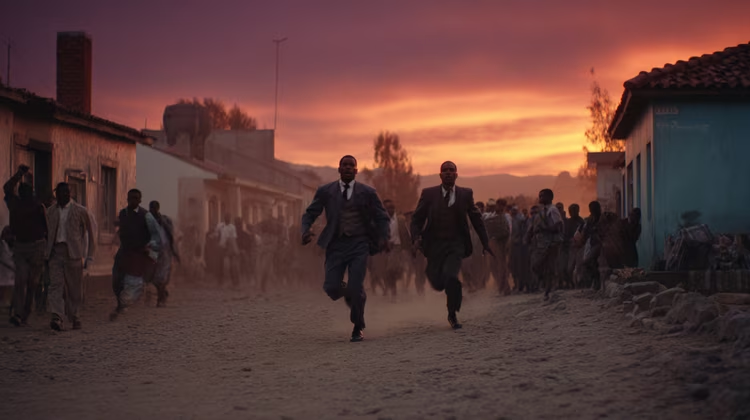
Each version of the story mapped onto a different wound, class resentment here, ethnic suspicion there, distrust of hospitals and government offices everywhere.
What the Bamunyama Legend Still Tells Us Today
When you strip away the vampire imagery and what you have is a society in distress, the myth can be read as a form of social commentary. It voiced fears about disappearing people in growing towns, about the opaque workings of hospitals and administrative offices, and about Africans who seemed to straddle two worlds.
It also revealed how gossip, steeped in witchcraft imagery and mystery, could thrive where transparency and trust were scarce.
Today, the Bamunyama stories linger as urban legends, occasionally resurfacing in times of uncertainty.
Misinformation didn't start with Facebook, but with people, fear, and too many unanswered questions. Long before the digital age, rumours could grip entire communities and shape behaviour with deadly consequences.
The Bamunyama was never real. But the fear that conjured it was, and in many ways, so was the danger. Just not the kind anyone expected.