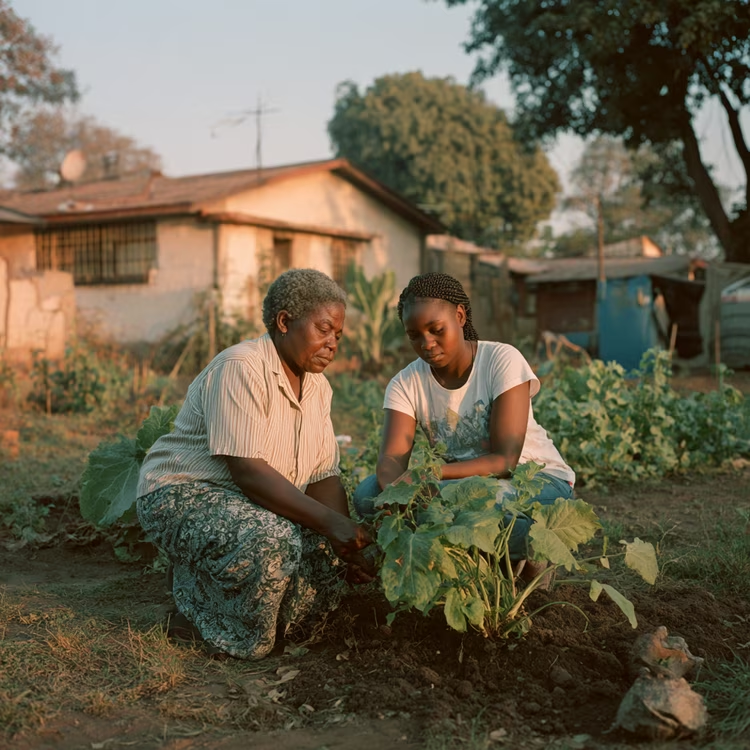
She learned it by watching, by doing, by being trusted with something that had already been tested across generations. This is ethnobotany as it actually lives: in kitchens, in fields, in the hands of women who were never given a title for what they know.
Everybody has a story to tell when it comes to herbal medication. It usually starts with a woman in your life, an aunt insisting you rub Aloe vera on your face for acne, a grandmother who swore that blackjack could ease menstrual pain, or even during the COVID era, when someone would boil eucalyptus leaves and ask you to inhale the steam like your life depended on it. These weren’t rare or unusual experiences; they were part of everyday life, repeated across generations until they became something we didn’t question.
That familiarity is where many of our relationships with plant-based healing begin, not in clinics or textbooks, but in homes, carried in memory, passed down through practice, shaped by people who knew what to use and when without needing to explain it in scientific terms.
Looking back now, with clinical training and a different kind of exposure, those moments feel less like fragments of childhood and more like an entry point into something much larger than we first understood, because what we were witnessing had structure, consistency, and even without formal language, it had been tried, tested, and refined over time.
The Plant Knowledge Passed Down by Women Across Generations
Across rural Zambia, this knowledge lives in practice. Women move through their environments with a familiarity that resists easy explanation; it is neither mystical nor reducible to a checklist. They know which plants reduce inflammation, which ones help a wound close, which ones are used when labour needs to progress, and which ones are avoided because their effects are too strong or unpredictable. This is expertise built over time. When something worked, it was remembered and passed down to the next woman in the house. When it did not, it was adjusted or abandoned.
From a clinical standpoint, some of these practices align with what we now understand through pharmacology. Moringa oleifera contains micronutrients and antioxidant compounds that support nutritional status, especially in low-resource settings. Aloe vera has documented anti-inflammatory and wound-healing properties. Bidens pilosa (blackjack) has been studied for antimicrobial and anti-inflammatory effects.
Why Healing and Conservation Are the Same Thing
It is tempting to separate healing from conservation, to think of one as medical and the other as environmental, though in practice they exist in the same moment. The woman who prepares something for a wound is often the same person who knows that the plant she is using has become harder to find over the years.
She has seen where it used to grow and notices when it no longer appears after the rains, guiding how she uses it. This is where ethnobotany becomes less about plants in isolation and more about relationships. It is about the relationship between use and restraint, between need and sustainability. When a plant is overharvested, it becomes a health issue. Herbal remedies disappear, and a cascade of effects follows.
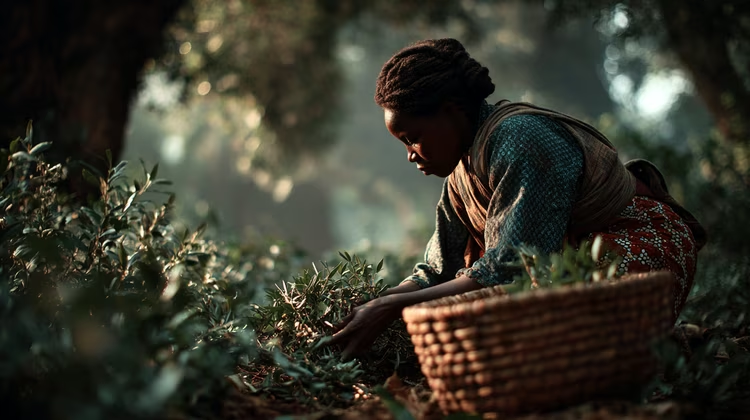
As formal health systems expanded, much of this knowledge was moved out of focus. Some of it was questioned, dismissed, or labelled superstition, in some communities, attributed to witchcraft, and over time, what was once shared freely began to sit more quietly in the background.
At the same time, the environments that sustain these plants are changing. Access to land shifts, climate patterns become less predictable, and younger generations are less exposed to the practices that once passed this knowledge along naturally. What starts to fade is the understanding of how to interact with these plants sustainably.
From a clinical perspective, this creates a gap that shows up in subtle ways. Patients still use plant-based remedies, though the knowledge behind them may be less complete, less consistent. At the same time, clinicians are often not trained to engage with this history in a meaningful way, which makes it easier to dismiss than to understand.
Who Benefits When Indigenous Knowledge Gets Packaged and Sold?
What makes it more concerning is that foreign investors appreciate their value and package it at prices that the indigenous owners cannot afford. It is a pattern that has played out with rooibos, marula, and countless other African plants, valued internationally, but rarely in ways that return anything to the communities that preserved them.
The role women play here comes from where they are positioned within both the household and the community. They manage food, care, and in many settings, move between the home and the land, daily, practically, without ceremony. That position places them in constant interaction with plant resources on a daily basis. Over time, that interaction builds a depth of knowledge that is both practical and adaptive. It changes with the environment and responds to what is available. It is tested continuously through use.
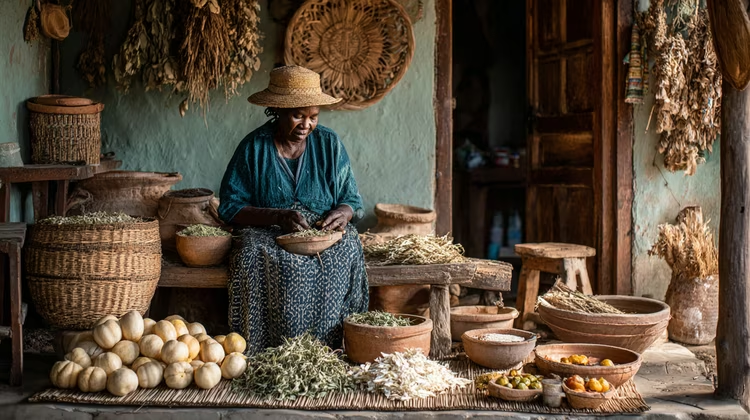
Yet the people making decisions about conservation, land use, and environmental policy are rarely the women who hold this knowledge. The result is a disconnect between what is known on the ground and what is decided at a higher level. Where women are included and participate in decision-making, the outcomes tend to reflect a more sustainable approach. Resources are used in ways that align with how they have been maintained over time.
A Living Knowledge That Cannot Afford to Be Overlooked
What many indigenous women hold in their hands is a lived understanding of health and the environment that has endured for generations. The risk now is that it is overlooked while still in active use or taken, repackaged, and sold back without the people who built it seeing a single kwacha. Paying attention to it as it exists, in its original context, may be one of the simplest and most practical ways to protect both knowledge and the environments it depends on.