The Kulamba ceremony is an experience that begins long before you arrive at Mkaika. As you make your way to Katete, the landscape of Eastern Province stretches around you. Long, winding roads intertwine through rocky hills and farming settlements scattered across the plateau. Katete is about 90 kilometres from Chipata, but during Kulamba, every kilometre seems to anticipate what lies ahead. Traders and craftsmen display handmade woven baskets, wood-carved artefacts, fabrics and other pieces unique to Chewa craftsmanship. Food vendors lure travelers with luscious fresh fruit and roasted bottlenose fish, just caught from the Luangwa River.
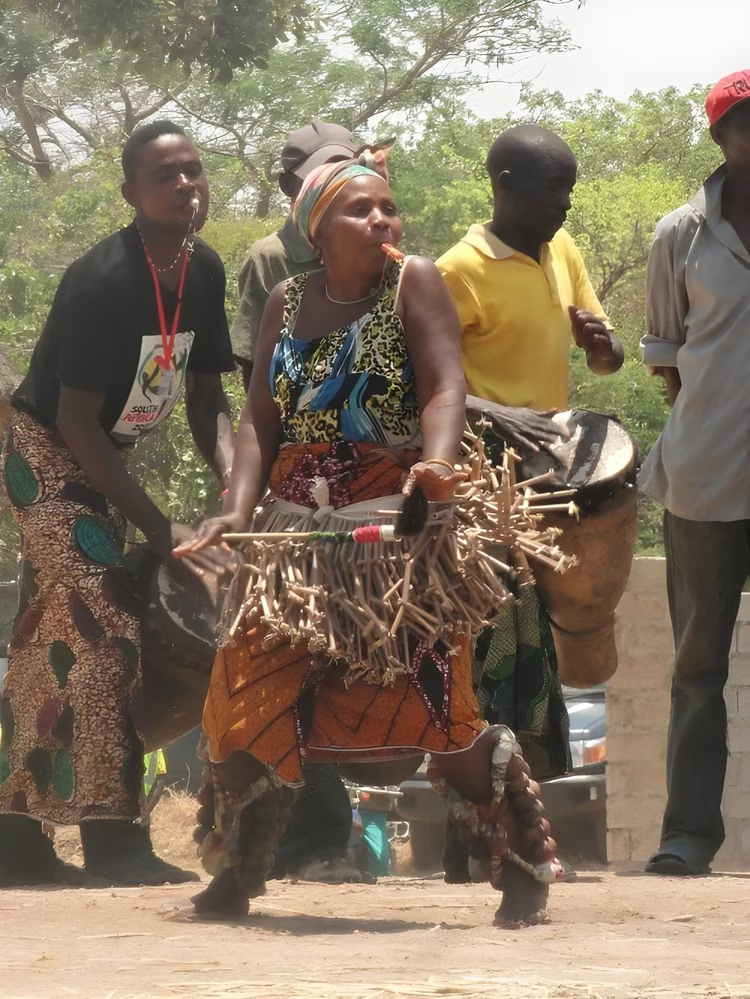
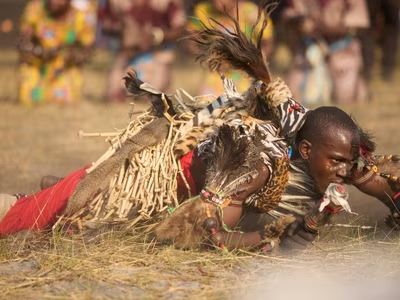
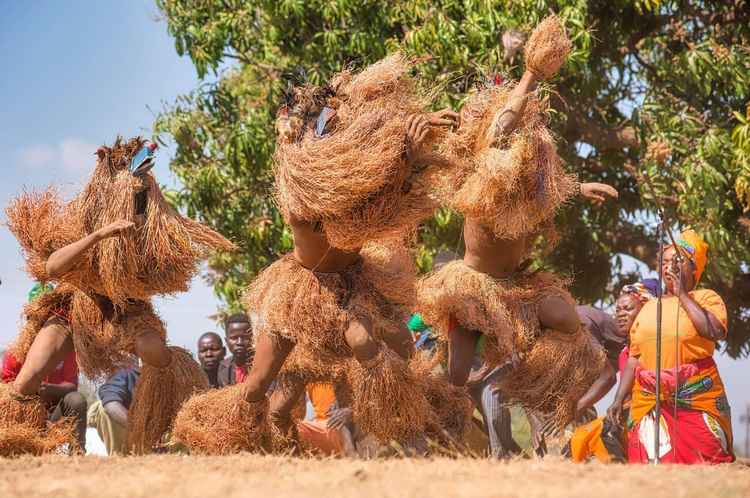
As you draw closer to the Mkaika area, you hear it. A steady rhythm rolls across the landscape, the steady vibration of drums growing louder as you approach the arena. It settles into your body through your chest and beneath your feet. A flash of colour quickly moves through the crowd, and you spot a figure entirely in costume dancing to the rhythm of the drums, concealed by a mask. Other figures appear, dancing in unison until the arena disappears behind a cloud of dust.
The Nyau introduce themselves with no words. To be honest, there is something quite disorienting about seeing them for the first time. Human faces disappear behind elaborate masks, their bodies concealed beneath layers of cloth and animal hide, transforming them into figures you would think are from another world. Some take the form of familiar animals. Others appear exaggerated, almost grotesque. Gulugufe, the restless butterfly, moves among the other figures, while towering above them are the Makanja, balanced on impossibly high stilts. In the distance, women sing and dance clad in matching chitenges, evidently brand new for the occasion, ushering in the convoys of chiefs as they arrive.
All this, and you have only just arrived. This is the Kulamba ceremony of the Chewa People.
The word Kulamba comes from Chichewa and means "to pay homage", "to show respect", or "to present oneself before a superior". Under the spectacle of music and masquerade lies a ceremony of governance. Each year, chiefs from Zambia, Malawi and Mozambique gather before their paramount ruler, His Majesty Kalonga Gawa Undi, to reaffirm a political tradition that defies the borders separating the three nations. Unlike the monarchies of the West, where subjects traditionally approach a king one by one, Kulamba brings together an entire hierarchy of traditional leadership. Chiefs arrive bearing gifts and tribute, presenting reports from their chiefdoms, raising matters affecting their communities and reaffirming their allegiance to the Kalonga. It is part royal audience, part council of chiefs, and part celebration of a shared Chewa identity.
To understand why this gathering is still significant today, it helps to go back to its origins. Around the fifteenth century, the ancestors of today's Chewa established one of Central Africa's largest states, the Maravi Empire. Stretching across present-day Malawi, eastern Zambia and northern Mozambique, the kingdom prospered through agriculture, iron production and the ivory trade. Portuguese travellers documented the Maravi in the sixteenth century, while archaeological evidence and oral tradition identify the Kalonga as the empire's supreme political authority. Although colonial borders later divided the kingdom, the institution of the Kalonga endured, and Kulamba remains one of the few traditional ceremonies in Africa that continues to unite communities across three sovereign states.
The formal proceedings begin with the arrival of chiefs, each accompanied by dancers, drummers, attendants and gifts from their chiefdoms. For some delegations, the journey to Mkaika takes several days. One by one, the chiefs are received before Kalonga Gawa Undi, where they pay homage, present tribute and offer reports on the welfare of their people. In the distance, an elderly chief pauses before the Kalonga, bowing solemnly before presenting his tribute. Behind him, young boys stretch their necks for a better view. Maybe one day, they too will inherit this history. Only after these formalities does the celebration unfold in full. The Kalonga addresses the gathering, often speaking on peace, agriculture, education, development and the well-being of the Chewa people. The arena then erupts into song, dance and the unmistakable rhythm of the Nyau drums. The ceremony also provides an opportunity for the transmission of cultural knowledge between generations, with teachings, performances and community gatherings reinforcing customs that continue to shape Chewa identity.
For many visitors, Kulamba is remembered for its colour and spectacle. Yet that is only a small part. It is an expression of history, governance and identity, bringing together a people whose shared heritage extends far beyond the borders of Zambia, Malawi and Mozambique. In a region shaped by colonial frontiers, Kulamba remains a reminder that some traditions have always belonged to something much larger than the lines drawn on a map. It is also a beckoning moment of pride for the Chewa people. A moment to showcase their culture and continuous evolution.
As the drums begin to fade and the convoys slowly depart Mkaika, Kulamba leaves behind more than memories of colour and spectacle. It leaves the lasting impression of a people gathering, as they have for centuries, to honour a shared history that continues to transcend modern borders.