About 18 kilometres north of Lusaka, in the Ngwerere area, sits an unusual yellow-and-red Chinese Buddhist complex with sweeping pagoda-style roofs and Chinese-inspired details.
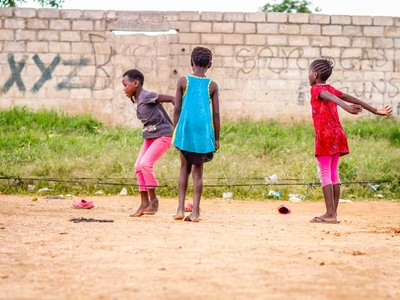
Inside the complex, very young African children in bright yellow and red traditional Shaolin monastic clothing practise, among other demanding Shaolin movements, sitting low with their legs spread wide, holding the position for strength and endurance in a stance known as Mǎbù. For many first-time visitors, the sight can prompt an unexpected question: are these children from China?
Opened in 2021 and officially known as the Zambia Shaolin Cultural Centre (ZSCC), the complex is Africa’s first Shaolin temple, bringing Chinese culture to life in the Zambian landscape. Its location on the outskirts of Lusaka also gives the centre the space needed for its original purpose. Built on a 20,000-square-metre site donated by Chinese businessman Jiang Qingde, Ngwerere affords the Shaolin complex space for training yards, buildings, gardens, accommodation and performance areas, while serving young people from disadvantaged communities. From inception, the centre was presented as providing education, food, shelter, martial-arts training and skills to young people who lack opportunities.
As a result, the centre has attracted many Zambian children and young people, including many from disadvantaged backgrounds. Today, more than 30 young people live, study and train at the centre.
Inside the temple, students who participate in Buddhist activities may bow before Buddhist altars and take part in chanting and other religious practices.
Up to now, the temple remains the most visible symbol of Africa-China cultural exchange headquartered in Zambia, where China’s presence is already visible through investment in mining, roads, manufacturing and infrastructure. And just 18 kilometres away from Lusaka, the temple still retains substantial interaction with the capital’s communities and institutions.
How Are Zambian Students Trained at the Shaolin Temple?
The Zambian centre isn’t exclusively a meditation retreat. It offers its students training in martial-arts forms, techniques, conditioning and discipline, flexibility, balance, jumps and physical conditioning, dragon dance and other Chinese cultural performances under the able hands of both Zambian and Chinese Shaolin-trained instructors.
With students mainly Zambian children and young people, and the Temple registered for a primary-school licence, the training includes formal education in Zambia’s syllabus for the residential students so they don’t simply spend the whole day throwing rapid punches and coordinated kicks, and hitting Mǎbù stances.
The programme combines physical training with formal education, ensuring that residential students continue with their schoolwork alongside their martial-arts training.
This simultaneous education ensures the children keep up with their schoolwork whilst exploring, learning and appreciating wider culture.
Are Students at Zambia’s Shaolin Temple Becoming Buddhists?
According to Master Yanlun, headmaster of the Zambia Shaolin Cultural Centre, the centre does not impose Buddhism on its students.
The centre’s position, as described by Yanlun, is that students are not required to adopt Buddhism and may continue practising their own faiths.
The Shaolin tradition is rooted in the Chinese Buddhist monastery of Shaolin and encompasses religious, cultural and martial-arts practices. For visitors, it is useful to distinguish between learning about Shaolin’s Buddhist heritage and adopting Buddhism as a religion.
Why the Shaolin Temple Matters to Zambia
The temple stands as a place of cultural adaptation and exchange, rather than simply a Chinese institution residing in Zambia.
Its presence has also created a distinctly Zambian setting in which Shaolin traditions are being practised and experienced. Shaolin is often associated internationally with kung fu, but its heritage extends beyond martial arts. The Shaolin tradition is rooted in the Chinese Buddhist monastery of Shaolin and encompasses religious, cultural and martial-arts practices. It is a discipline that teaches patience, repetition, bodily control and self-discipline. And when Zambian students practise it, Chinese culture becomes tangible in Zambia instead of being encountered only through television, products, food and Chinese-built infrastructure.
At the same time, interactions between Chinese instructors and Zambian students create opportunities for cultural exchange in the other direction, allowing both groups to encounter aspects of each other’s traditions.
In essence, the Temple embodies what happens when a tradition thousands of kilometres away takes root in an African community, gets adopted, and acquires a new context without necessarily losing its original identity.
Visiting the Zambia Shaolin Cultural Centre
It is important to note the following before visiting the Temple to witness self-disciplined kids in colours that don’t always read as a spiritual hierarchy hold incredibly uncomfortable-looking positions for long periods.
- Location and Getting There: The temple is in the suburban Ngwerere, some 50 minutes’ drive from Lusaka’s CBD on mostly paved roads.
- Opening Hours: The Temple operates from 08:00 to 17:30 on working days.
- Surroundings: The Temple is just a stone’s throw from the Ngwerere compound, with shops and businesses in the broader Ngwerere area.
- What to Know Before Visiting: It is important to contact the management if the purpose is more than sightseeing.