When Community Shows Up Without Being Asked
The passing of Mapalo’s father did not remain confined to their home. The news spread quickly, from one person to the next, until the whole community knew. Throughout the day, people kept arriving, one by one, each bringing something unrequested with them.
Someone brought a tent for the men to sit outside. Another arrived with firewood. Someone else came with a bag of mealie meal.
Inside the house, meals were prepared without instruction, while babies were passed from one set of arms to another, and no one needed to ask where they were needed. By the end of the day, the space was filled with a particular kind of presence. Everyone had taken on a role, and together they carried the weight of that loss, not as one family, but as a community moving through grief together.
This is a familiar scene across many African settings. What happens to one person does not remain with them. Life is experienced as something shared. That instinct, the expectation that we do not stand alone in our hardest or best moments, sits at the centre of what has long been described as Ubuntu.
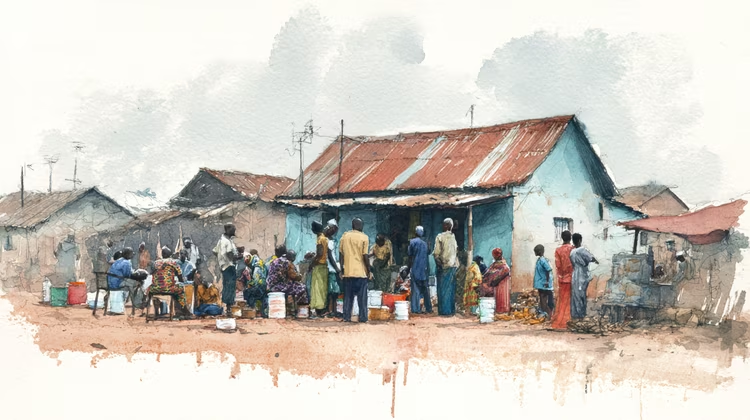
I have had the privilege of being in places where that sense of closeness feels almost automatic, and others where it has slowly faded, where people live side by side but remain largely isolated, almost lonely together.
In some spaces, help comes almost instinctively. In others, there is a calculation about whether it is appropriate to get involved. That difference reflects a deeper understanding of what it means to live among others and what we expect from one another.
What Does Ubuntu Mean?
Across much of southern Africa, that understanding has long been expressed through the idea of Ubuntu. The phrase most often used to explain it is, "umuntu ngumuntu ngabantu", which is usually translated as “a person is a person through other persons.” It is a simple line, but it carries a depth that has occupied philosophers for decades.
Zambia’s first president, Kenneth Kaunda, echoed this sentiment in his well-known expression, “Tiyende pamodzi ndi mtima umo,” often translated as “let us go as one, with one heart.”
Writers such as Mogobe Ramose and Michael Eze have described Ubuntu as a way of thinking about personhood itself, one that places relationship and shared responsibility at its centre.
Archbishop Desmond Tutu spoke of it as the essence of being human, suggesting that one’s humanity is shaped, and in some ways completed, through others.

Why Ubuntu Feels Stronger in High-Density Communities
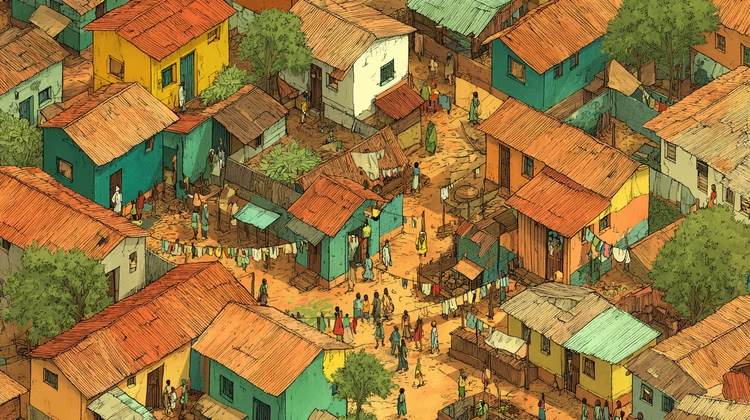
There is a common perception that Ubuntu is more visible in high-density areas than in more dispersed ones, and there are reasons for this. Density creates proximity, and proximity tends to build familiarity. When people share physical space closely, they encounter one another repeatedly. Over time, these repeated interactions can build a sense of accountability and mutual awareness.
In densely populated urban settlements, daily life unfolds in shared spaces such as flats, public transport, and communal sanitation areas where privacy is limited. Under these conditions, it becomes difficult to remain entirely detached from those around you. Social ties, even if informal, tend to form more quickly. Studies of urban communities in southern Africa have shown how these environments can support collective responses to challenges, even in the absence of strong formal institutions.
By contrast, low-density environments often prioritise distance. Homes are separated by large concrete walls, and movement is structured around private transport. Interaction becomes more intentional and less frequent. In such settings, it becomes possible to live alongside others without developing meaningful social ties. Research on suburban and gated communities has pointed to reduced everyday interaction as a recurring feature, which can limit the kinds of informal support systems associated with Ubuntu.
The Limits of Proximity
That said, density alone does not produce community, nor does distance eliminate it. Crowded environments can also create social fatigue. Living in proximity does not automatically translate into trust.
Survey data across several African countries suggests that while many people express a willingness to coexist with others, interpersonal trust often remains cautious. At the same time, low-density settings, particularly in rural areas, often sustain strong forms of social obligation through longstanding community ties. Support may not always be visible in public spaces, but it is deeply embedded in family structures and cultural expectations.
What this suggests is that Ubuntu is not tied to a single type of environment. It adapts and shifts in response to how people live, how often they encounter one another, and how much they rely on shared systems of support.
Ubuntu in Modern Zambia
What stands out now is how Ubuntu has adapted under the pressures of modern life. It is now visible in digital spaces, in WhatsApp groups that function as informal support networks, in professional circles where opportunities are shared through personal connections, and in online discussions where people try to make sense of what community still means in an increasingly individualised world.
The language has also evolved. Terms like “networking” or “social capital” are now more common, particularly in professional contexts. The phrase “your network is your net worth” is often used to describe the same phenomenon in more transactional terms.

In many African contexts, the understanding that a person exists through others has not
been erased by modern life. It still shapes how people respond to loss, opportunity, and
responsibility. Not because Africans are inherently more communal, but because this way of
living has been preserved in practice. A recognition that no life is built alone, and no one is
expected to pretend otherwise.