One Monday evening, I was on my way home on a minibus en route to Chelston. I was feeling pretty lucky that day. Work hadn't been too busy for a Monday, and I had scored a front seat, which meant I had only one other person sitting next to me. I was by the window, taking in the warm October air. What a day.
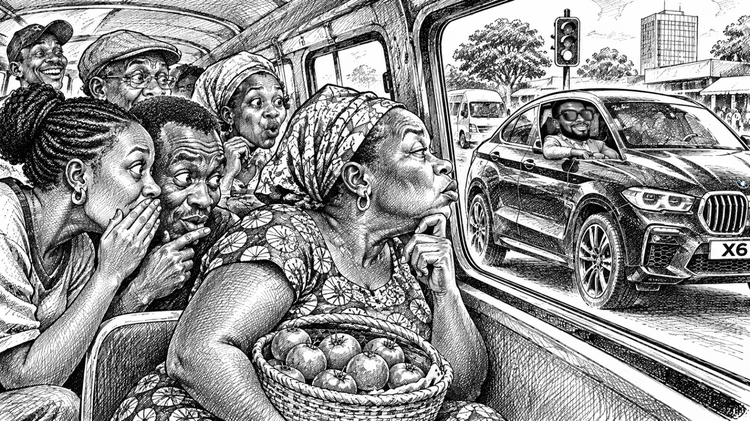
At the traffic lights at Manda Hill, I looked outside and spotted a BMW X6. I recognised the vehicle immediately. A Black man in the driver's seat, wearing Ray-Ban sunglasses, revved the engine, and when the lights turned green, he sped off, which immediately sparked a conversation among the passengers. One lady behind me, who had a basket of tomatoes resting on her lap, remarked, "If I too were a Satanist, I would be equally rich. Perhaps I should go to the Chongwe shrines as well." And just like that, the passengers broke into discussion. Everyone seemed to have something to say about the car, the driver and, of course, how someone could afford such a vehicle in this economy.
And in that very moment, I became acutely aware of just how hot, loud and cramped the minibus was.
There is an old Bemba proverb, “Umwana ashenda atasha nyina ukunaya”, which loosely translates to, “A child who doesn't travel thinks their mother's food is the best”. I have always found this proverb quite interesting because I think it speaks to something crucial about how we experience life. Your reality is only as big as the world you have been exposed to. This has been a thought, perhaps a maxim, that I have carried with me since my days in private school. I wouldn't necessarily say the school itself taught me this, but it allowed me to interact with people from very different socioeconomic backgrounds. From children of prominent figures in society to children who were on scholarships. I was exposed quite early on to the fact that people could experience vastly different realities, even within the same environment. That exposure continued when I went to university, only this time it was on an international front. I got to interact with people from different countries, cultures and backgrounds, and I became increasingly aware of just how differently people live. Sometimes, the only thing separating these realities is the environment you happen to be born into and the opportunities you have been exposed to.
This brings me to some of the recent conversations and social media discourse around wealth in Zambia. There seems to be a growing realisation that there are people among us who are extraordinarily wealthy. Fellow Zambians with millions, perhaps even billions, at their disposal. And I think it is perfectly reasonable to ask how someone accumulates that kind of wealth. What exactly is it that they do? It is a valid question, especially when the source of someone's wealth is unclear. But I also think something is interesting about how we, as a society, respond to wealth that exists beyond what we are accustomed to seeing, especially in people who look like us. Why is it that we rarely seem to find it strange when our Western counterparts accumulate extraordinary wealth, yet can become considerably more suspicious when that same wealth belongs to fellow Zambians? There’s something worth reflecting on. Maybe it has something to do with the fact that we have grown accustomed to seeing certain forms of wealth from a distance, through interactional celebrities, business moguls and global corporations. When it comes closer to home, in someone’s circumstances we don’t understand, we seem to demand a different explanation.
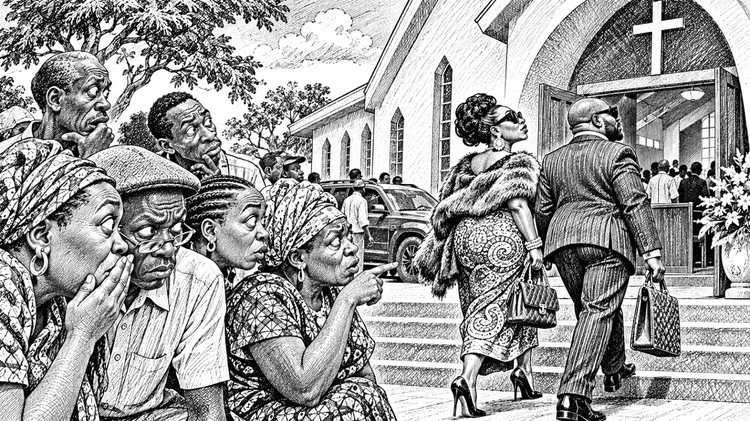
In Zambia, becoming exceptionally wealthy can sometimes attract a rather interesting kind of suspicion. People may go as far as avoiding certain churches because the congregants are perceived to be extremely wealthy. Somehow, their financial standing becomes a reason to question the legitimacy of their faith. This - coming from the very community that endorses Christianity coexisting with excellence.
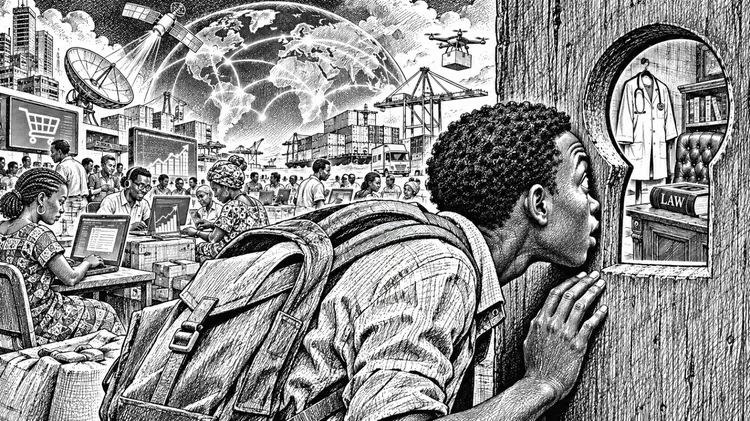
Perhaps part of this has to do with the narrow picture we have historically held of what financial success looks like. For a long time, our understanding of how one becomes wealthy was mostly conventional. A good white-collar job, a successful career in medicine, law, or engineering, or maybe proximity to those in the proverbial “some of us” circles. These were the professions and associations we accepted as financial success. Today, however, the avenues through which people make money have expanded considerably. Artists and creatives, entrepreneurs, people in blue-collar professions and social media personalities are building businesses and earning incomes that would probably surprise many of us. Entire industries have emerged around digital content, entertainment, technology, and services that previous generations might never have considered viable sources of considerable wealth. Some of these people are operating in markets that go beyond Zambia’s borders.
There is also the question of how we understand money itself. We sometimes make assumptions about someone’s financial standing based on what we consider to be substantial amounts of money. But how far, for example, can K100,000 actually stretch? What does that figure mean to someone earning in kwacha, compared with someone whose business transactions, savings or investments are largely denominated in US dollars? Two people can occupy entirely different financial realities while living in the same city. Our understanding of what constitutes considerable wealth can be limited when measured exclusively against the financial environments we know.
Of course, none of this is to suggest that every fortune is legitimate or that questions about how people acquire their wealth should be discouraged. Zambia has legitimate concerns around corruption, tax evasion and other questionable means of accumulating money. Extraordinary wealth, particularly when accompanied by an absence of any discernible source of income, warrants scrutiny. There is a difference, however, between asking reasonable questions about the origins of someone’s wealth and treating the mere possession of it as evidence of wrongdoing. We should be capable of doing both things: questioning unexplained wealth while recognising that legitimate avenues for extraordinary financial success exist.
I also think there is a question of social imagination here. The world we grow up in inevitably shapes what we believe is attainable. If the only successful people we have encountered are those who followed a particular professional route, we may struggle to imagine someone building wealth through an entirely different one. If the only businesses we recognise as profitable are those we see operating along Cairo Road or in the shopping malls, we might overlook the possibilities in industries that exist largely outside our immediate field of vision. Our expectations are often built from what we have seen, rather than everything that is actually possible.
This is why exposure matters. It introduces us to possibilities we might never have considered and challenges assumptions we may not even realise we hold. Life deals people different cards, and some are afforded privileges and opportunities that others aren’t. But even within the circumstances we find ourselves in, there are possibilities we may not have encountered. Sometimes, seeing what another person has built is enough to expand our understanding of what can be done.
Maybe this is what the proverb is getting at. A child who has never travelled might genuinely believe their mother’s food is the best in the world. And maybe it is. But there is a whole world of food they haven’t tasted yet. Our understanding of wealth and success can be much the same. Sometimes, we make conclusions about the world based on the small portion of it we have experienced. And there is a great deal beyond it.