The Sacred Cave Behind the Waterfall
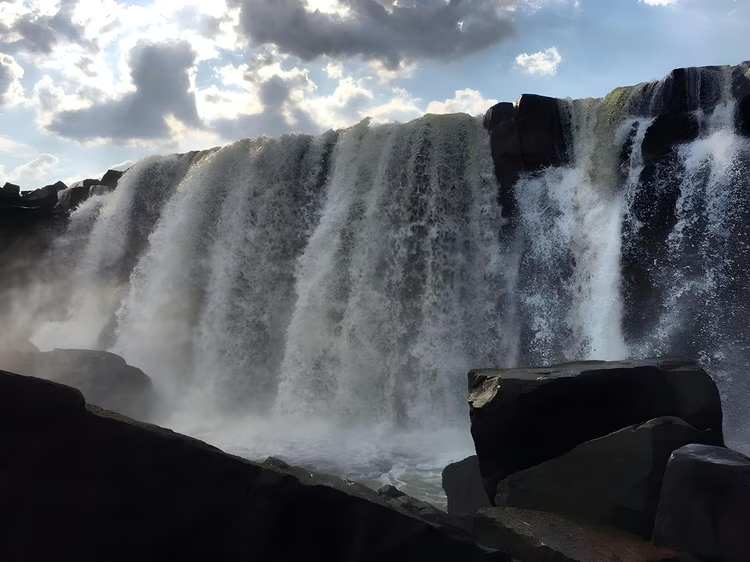
You hear the water at Chishimba before you see it. The Luombe River drops through red quartzite for the better part of a hundred feet, and its thunder reaches your chest long before the cave behind the spray comes into view. Many people familiar with the stories surrounding the site lower their voices as they approach the entrance, often without realising it.
"You don't say bad things here," one local guide warns with a sombre face. "Not even as a joke."
The warning refers to Chishimba, a spirit many local traditions associate with the cave behind the falls.
"Not in thought or word," elders and guides alike will tell visitors. What's unusual isn't the prohibition itself but how openly it's spoken about and how little that openness has worn down the seriousness with which it's kept.
Mwela Rock Paintings
Travel three hundred kilometres north to Kasama, and the shape repeats, though the details change. At Mwela, a sprawl of rock outcrops holding some seven hundred paintings among the largest concentrations of documented rock art in Zambia and southern Africa, attributed mostly to Batwa hunter-gatherers and dated to perhaps two or three thousand years old, a formal taboo system once governed entry.
Local researchers documenting Bemba testimony around the site recorded restrictions known as imichiliko and imipamba, which entirely closed the caves to ordinary people. By several elders' accounts, only a herbalist under spiritual possession was permitted inside to gather medicine believed to grow nowhere else with the same potency.
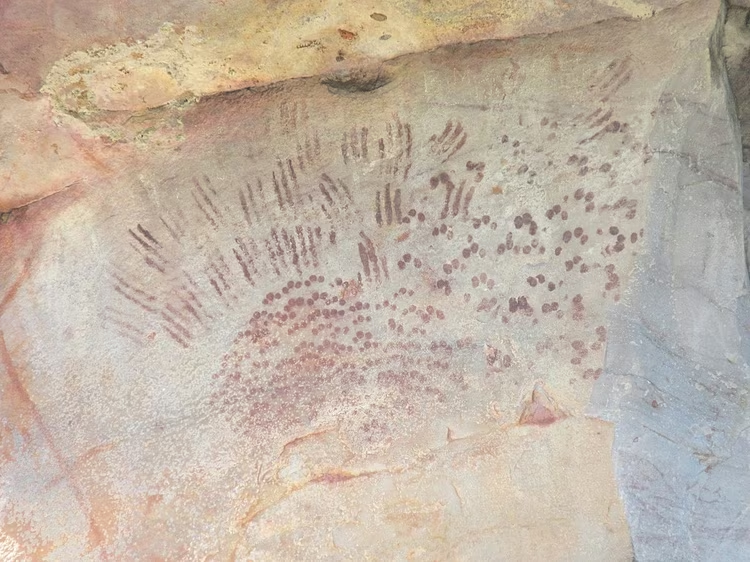
The Batwa who painted those panels were not, genealogically, ancestors of the Bemba who later came to regard the site as ancestral ground. Its significance appears to have outlasted the people who first painted the shelters, becoming incorporated into later Bemba understandings of ancestry and sacred places.
Kapembwa Shrine and the Spirit Traditions of Lake Tanganyika
Further north, along the southwestern shore of Lake Tanganyika, the Lungu speak of Kapembwa, a water spirit residing on the escarpment above the village that bears his name. Prayers are still made there for safe passage across a lake that has drowned careless fishermen for as long as anyone can recall.
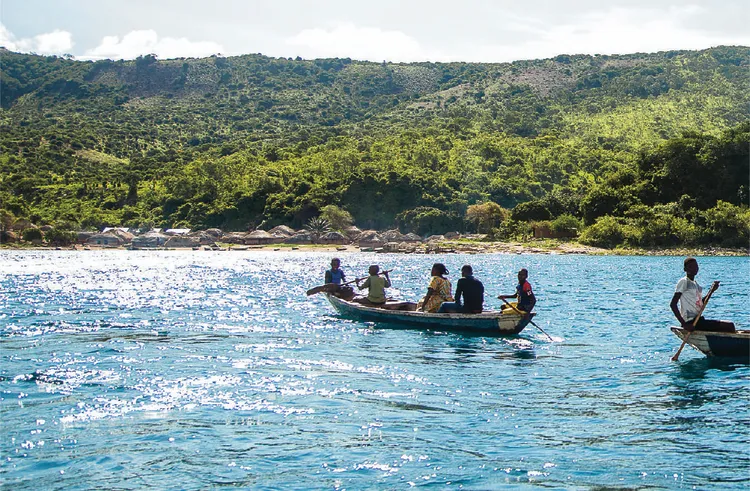
Oral tradition describes two shrines: one built by human hands, round, with two doors, and a second said to be made by the spirit itself, visible only to those considered pure, a structure that reflects every colour of the rainbow. Some oral accounts along the lakeshore also speak of older sacrificial practices associated with the shrine.
Kalambo Falls and One of Humanity's Oldest Wooden Structures
None of these stories exists in isolation from what's actually in the ground. At Kalambo Falls, where the Kalambo River drops 235 meters into a gorge on the Tanzanian border, archaeologists from the University of Liverpool and Aberystwyth University announced in 2023 that they had dated a wooden structure, two logs deliberately notched to interlock, to at least 476,000 years old, older than Homo sapiens itself.
It is among the oldest known evidence of humans shaping wood into something built, and the site has sat on UNESCO's tentative World Heritage list since 2009, still waiting. No one is claiming this particular find was a shrine. Some local traditions also regard the wider Kalambo landscape as spiritually significant. The archaeology doesn't validate those beliefs. It just makes the persistence of human attention to this place across immense stretches of time harder to dismiss as a coincidence.
How Sacred Sites Preserve Memory Across Generations
This is the pattern across the region once you've seen it at three or four sites rather than one: not folklore layered over otherwise empty ground but something closer to a parallel record-keeping system, run on different rules of evidence, that has nonetheless tracked, across centuries, which places matter and why.
What Traditions Teach About Sacred Places
Audrey Richards, the British anthropologist who lived among the Bemba in the 1930s, documented a cosmology centred on imipashi, the spirits of the dead, and ngulu, spirits associated with particular places, including waterfalls, springs, and stretches of bush thought to influence harvests and uncultivated land.
The Bemba, Lungu, and Tabwa are related but distinct peoples, each with its own chiefly lineages and migration histories, many tracing their origins to the old Luba kingdoms across what is now the Democratic Republic of the Congo.
Their traditions are not identical, but they often arrive at a similar conclusion: some places demand a different kind of conduct. A cave or waterfall may be approached with lowered voices. An offering may be left where an outsider sees only rock. The place itself is treated as though it remembers, carrying obligations that survive the people who first observed them.
Christianity and Traditional Beliefs
More than nine in ten Zambians today identify as Christian. The country declared itself, by constitutional amendment in 1996, a Christian nation. Missionaries reached this region in the 1880s and 1890s. However, with the arrival of Christianity, the shrines were not simply abandoned. What happened, more often, was layering rather than replacement. Among the Bemba, the word for the Christian God, Lesa, wasn't imported.
It was the existing name for a remote creator figure, repurposed to carry the new theology in an act of integration rather than replacement. People who attend church on Sunday may still decline to raise their voice near Chishimba Falls on Monday, and most who hold both convictions don't seem to find them contradictory at all.
Why These Sacred Sites Still Matter Today
It would be convenient to say the archaeology validates the oral tradition, that science has caught up with what the elders always knew. That isn't quite true, and claiming it would shortchange both. What the evidence actually shows is that these places have drawn human attention across spans of time the mind struggles to hold concretely, and that their significance has persisted across total discontinuities of population, language, and belief.
Perhaps that is why people still lower their voices at Chishimba.
The cave has survived changing kingdoms, colonial rule, missionary expansion, and independence without surrendering its claim on the imagination. Whether approached as a shrine, a historical site, or simply a hollow in the rock behind a waterfall, it continues to suggest that memory can inhabit a landscape as surely as it inhabits a book.