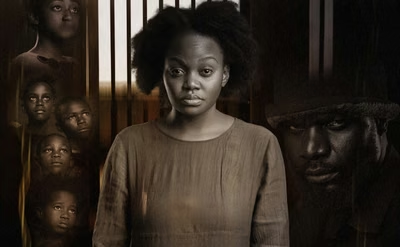
Ruth is heavy.
If you have milled around Zambia’s art and history circles, you may know of her. She is a repository of art and the history of everyday Zambian life, documenting for years through books and her blog.
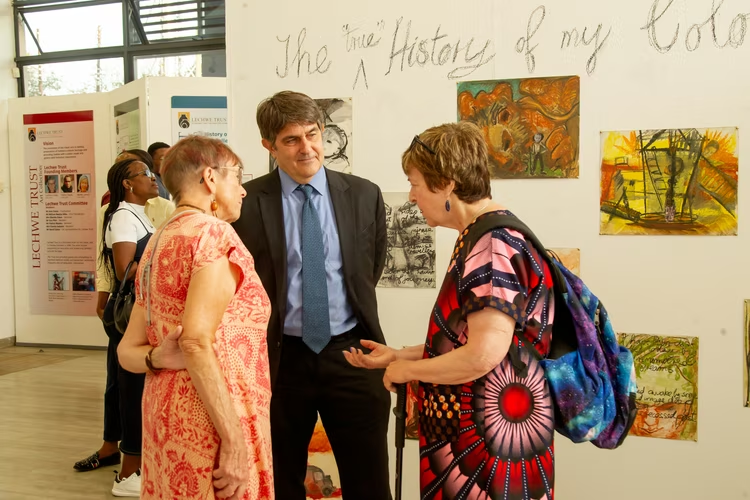
I first encountered Ruth as I was researching a project. I find I often come across her archive of written musings whenever I do some in-depth research on Zambian art. Frankly, I was surprised to learn that she was alive.
An Exhibition That Challenges Expectations
Her latest show, the first in twenty-five is vulnerable and raw, and not for the faint of heart. ‘Unravelling’ skips over the niceties and goes straight for the jugular, disrupting and upending what Zambian art could be on its head as she returns to where art really began for her. Gone are the vibrant colours reminiscent of chitenge fabric and colourful representations of tradition. Amid a sea of black, white and grey, colour shines through, but the perfunctory introduction of colour to this exhibition is not without intention; there is a formula to it. None of Ruth’s work made me happy, and therein lay my own contradiction in my own slanted perceptions of art. While I know that the art we view is often informed by the times, I often find that I engage with art on a superficial, aesthetics-first level.
Who Is Ruth Hartley?
Ruth Hartley has been part of Southern Africa’s fabric since her birth in Harare, Zimbabwe, in 1943; she has lived and created art between Zambia, Zimbabwe, South Africa and Europe. She studied art at the Michaelis School of Fine Art in Cape Town and later received her MA in Women’s Studies from Anglia Ruskin University in 1999, and a PhD in Creative and Cultural Innovation and Management. She moved to Zambia in 1972 and ran Mpapa Gallery alongside Lechwe Trust Gallery founder Cynthia Zukas for ten years, from 1984 to 1994. These years, often considered the golden age of Zambian art, were instrumental in helping to direct the future of Ruth’s approach to her art practice.
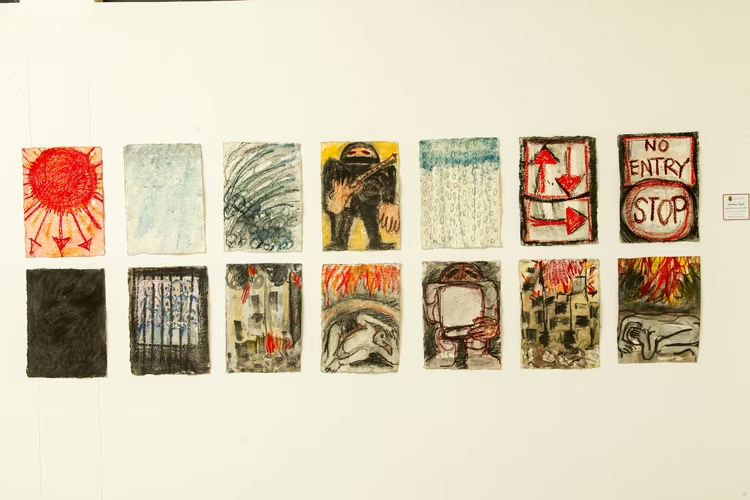
As with most artists, Ruth’s works are informed by the times, except Ruth has always gravitated to the political, vulnerable and unvoiced. One of her earlier works, ‘Chikumbi Bombings, 1979’, depicts the bombing of Chikumbi in the late 1970s, during Zimbabwe’s liberation struggle, when Ian Smith deployed Rhodesian forces near Chisamba. At first glance, the colours are bright and vibrant. Crimson red, velvet greens and deep yellows create an orderly, almost practised composition. On closer inspection, these are bodies in various positions of prostration and despair beneath the shade of a tree crowned with red and gold flowers. The flowers are flaming tongues of fire. There are buildings aflame. The bodies are not lounging; they are those of the deceased and those who mourn them, caught in the crossfire. Despite its raw messaging, the image fulfils the criterion of an aesthetic image. Neatly ‘coloured within the lines’, a dirge disguised as a tableau. In this image, is Ruth still finding her way? Not yet vulnerable, not yet come to meet herself?
Inside Unravelling
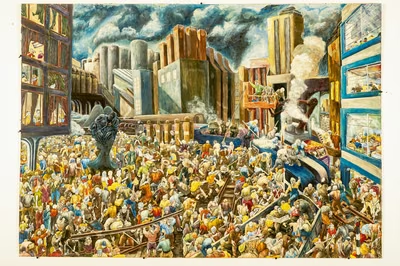
The ‘Unravelling’ brings 150 out of 245 pieces, sketches and installations out of hiding. Sana Ginwalla, curator, archivist and founder of the Everyday Lusaka Gallery in Lusaka, Zambia, curates what we see, and how and when we see it. We approach ‘Chikumbi Bombings’ before the abrupt steeliness of the ‘Migration Series’ enters our periphery and keeps our attention. Ginwalla’s choice of juxtaposition is not without intention. The spectrum of colours flows throughout the exhibition. The first series, ‘The “True” History of My Colonial Childhood ’, is drenched in vibrant colour, a collection of whimsical, almost crude sketches, to stark black-and-white sketches depicting the realities of Zambia’s ongoing relationship with drought and climate change, before turning a corner to a piece from her ‘Apartheid Series’, drenched in blood-red and created in the Mbile International Artist’s workshop addressing apartheid and its conclusion in South Africa. The coffins at the bottom of the painting are a precursor to the cold, dark, grey steel of iron, metal and war, shot with red for blood, fire and restriction in the ‘Migration Series’, chronicling the plights of Syrian refugees. These later works, in contrast to ‘Chikumbi Bombings’, reveal a more honest stroke that demonstrates Ruth’s anguish, loneliness, pent-up emotion and empathy for human life.
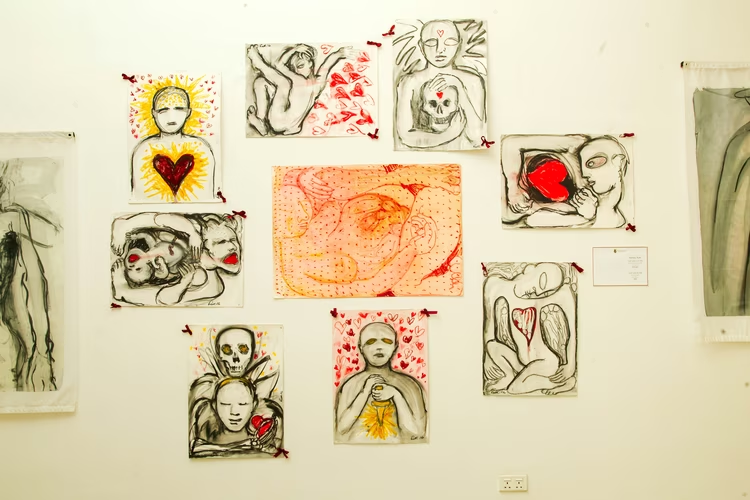
What strikes me about ‘Unravelling’ is the linework. It is bold, intimidating and purposeful. Her strokes remind me of the pains of labour. This work is birthed through the pain and adversity of her life, and this form of pain is raw and visible in nearly every piece. Forced into political exile after fleeing apartheid South Africa for being pregnant with an interracial child, and subsequently experiencing financial and emotional abuse in her first marriage, followed by a divorce that disrupted her family life and that of her children, Ruth bears down in ‘Unravelling’ and enters the second stage of labour.
Artist Skinned
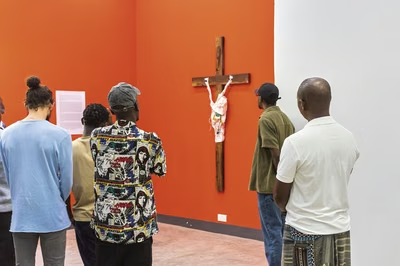
From here, the curation draws into the ‘heart’ of the exhibition, Ruth’s heart, where we meet her most intimate and vulnerable self. So far we have experienced her from the outside, as ‘WWW Woman’, spun out of hessian and unravelling over the years, and we have experienced her depictions of the struggles of others, Syrian refugees losing their lives escaping wars in tube boats and the effects of drought. In the heart, Ruth depicts herself in ‘Artist Skinned’. We find her body discarded on the floor, her skin flayed and spread out like a cattle hide drying, to reveal…nothing. We walk all over and past her body like she means nothing, just a discarded object of no importance. She is unsettling.
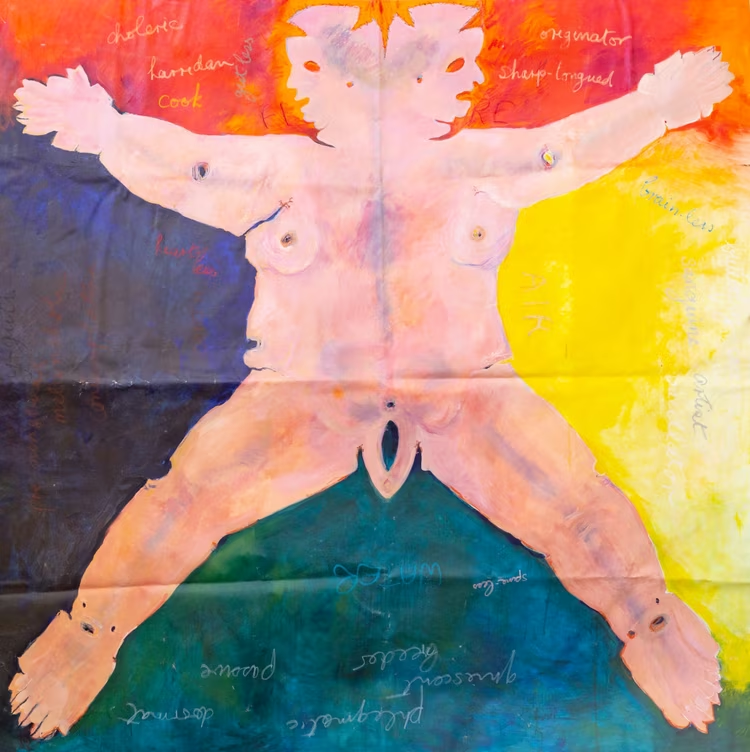
Motherhood, Memory and Loss in The True History of My Body
Above her discarded remains, a mythical creature, ‘The “True” History of My Body’, with multiple eyes escaping its head and five arms, clutches various objects associated with her life, travel, motherhood, relationships, art, an impaled ankle from many years ago and a hole in her belly: a miscarried pregnancy. Her heart is arranged with what she loves and what she has lost. Pieces of a disintegrating door in ‘The Past Future Tree’ bear the disintegrating portraits of her family tree, as her ancestors fade away; so do the photographs, so do the salvaged remains of a discarded door. An untitled installation piece hangs in a corner. It is a collection of debris collected with her husband during a long road trip, depicting the things we pick up along the way that become a part of us. In the ‘Love’ series, Ruth also confronts heartbreak, grief and those she holds dear with a sobering collection of sketches titled ‘Love’. There is not much to love as the collection is unsettling, not at all betraying the imagery we have come to associate with the verb. In ‘Love’, the artist appears haunted and in anguish, mirroring our own struggles with the implications of loving, being in love and receiving love.
RaItz: Art, 9/11 and the Weight of Human Suffering
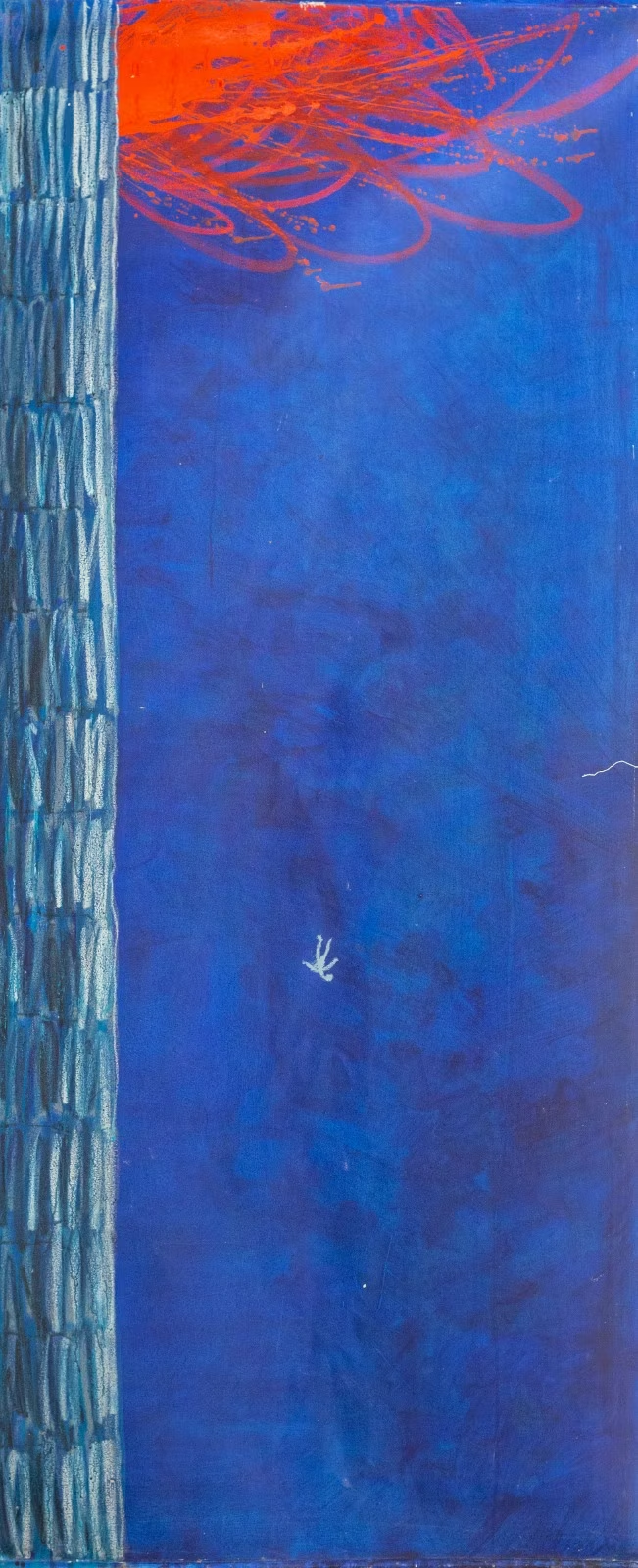
The walkthrough ends with a 5-panel display titled ‘raItz’. It depicts a recreation of one of the world’s most chilling images, a man falling from the World Trade Centre during its collapse on 9/11. ‘Unravelling’ leaves behind a bitter taste. It steps outside the boundaries of what art should be or could be. Viewing the exhibition is not a pleasant experience; Ruth takes the worst of society and holds a mirror up to it: war, violence, geopolitics, death. Herself an advocate for political and social change, she once considered herself a Marxist and has been involved in the Vietnam War protests, the Women’s Rights Movement, and was a member of the ANC Youth Wing during her time in South Africa.