Traditional Healers and Doctors
A child falls ill in a rural village. The family takes him to the clinic for treatment, but they also consult a Ng'anga afterwards, to understand why the illness happened in the first place. To many outsiders, this looks contradictory. To millions of Africans, it simply makes sense.
The assumption is that traditional healing and modern medicine are worlds apart. In practice, they are far more connected than people assume.
Ng'angas and Sangomas: What's the difference?
The terms get used interchangeably, but they refer to different things. A Sangoma's focus is primarily on communicating with ancestors and spiritual divination. A Ng'anga, also called an Inyanga, works with an extensive knowledge of indigenous flora and fauna, using roots, leaves, bark and sap to heal. In Zambia, the line between the two can blur, but the distinction matters if you want to understand what you're actually dealing with.
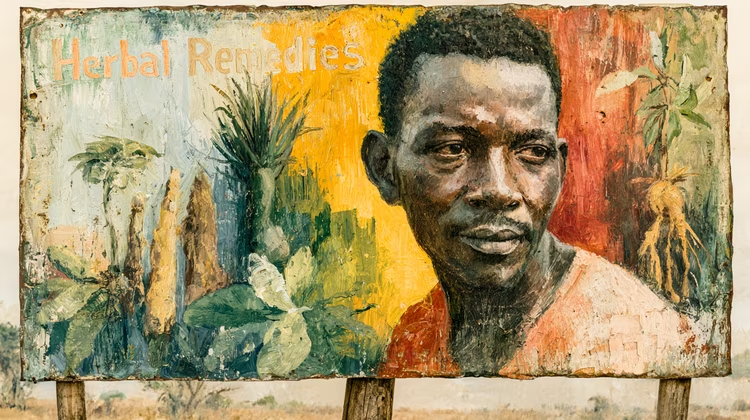
Ng'angas, Inyangas, Sangomas, whatever you call them, are not diminished by labels. Language shapes how we relate to these practices, and dismissive terminology cuts people off from their cultural significance before the conversation even starts.
In rural areas, and increasingly in urban ones, traditional healers are often the first point of contact for primary healthcare. Sometimes, the only point of contact. They operate alongside clinics and hospitals, not instead of them.
How the two systems actually work together
Back to that sick child. The family takes him to the clinic for testing and treatment of diarrhoea. At the same time, they consult a Ng'anga because biomedical treatment addresses the cause of the illness. The Ng'anga is trying to answer why this child, and why now.
The Ng'anga may interpret the illness through a spiritual or ancestral framework and suggest ritual action alongside the clinic-prescribed medication. A ceremony, an offering, and herbal medicine. Advising the family to continue with treatment at the same time. It is two systems addressing the same problem through different dimensions.
That distinction, the what versus the why, is probably the clearest way to understand the division of labour between biomedicine and traditional healing. Biomedicine asks: Is it a pathogen? A systemic failure? Traditional healing asks: what in the person's social or spiritual life made them vulnerable to this in the first place? Unresolved grief. A broken relationship. Ancestral disruption.
The role of the Ng'anga beyond medicine
Ng'angas take on roles that extend well beyond physical ailments. They arbitrate disputes. They sit with people in conflict and help work through solutions. They navigate across belief systems and address a surprisingly diverse range of social expectations, not unlike what is asked of clinical doctors.
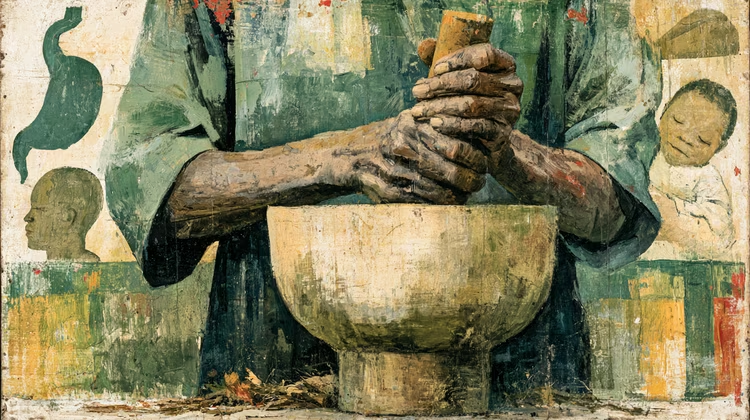
The etiquette involved in consulting a Ng'anga is also worth understanding. Respect and open disclosure are expected, as they would be with any doctor. You do not hold back information when seeking help. You are transparent about what is wrong. In some cases, you arrive with an offering: cloth, beads, specific food, part of the process of healing or of appeasing ancestral spirits. You may kneel and clap your hands as you approach, which is customary. You would not do that at a hospital, but the principle of showing up with humility and honesty is shared.
The Ng'anga is not an all-knowing sage. They are practitioners with specific expertise. Using that expertise requires your cooperation.
Legitimacy, regulation and religion
The growth of scam operations has created real problems for traditional healing. Self-proclaimed healers offering quick fixes to common problems exploit people who are genuinely seeking help. In response, legal bodies and associations have been established to register and license practitioners, balancing customary practices with statutory regulation.
This is complicated further by religious institutions, particularly mainstream churches, that denounce traditional healing as divination or witchcraft. Not everyone agrees. Many who sit outside mainstream Christianity see ancestral communication as a spiritual gift, not a threat, and incorporate it into their worldview accordingly. Some scholars have drawn parallels between the veneration of ancestors in African belief systems and the veneration of saints in certain Christian traditions. Whether those parallels hold up is a separate conversation, but the point is that the conflict between traditional practice and religion is rarely as clear-cut as its loudest voices suggest.
Where things stand
Traditional healers do refer patients to hospitals when a more pharmacological solution is needed. Hospitals do not typically return the favour. That asymmetry is worth noting because it suggests that the integration is already partly functional, just on one side.
Breaking down those remaining silos would not require either system to abandon what it does well. It would just require both to acknowledge what the other is actually doing. Most Zambians already understand this, even if the formal healthcare conversation has not quite caught up.