Part One: The Darkness
The lights died at seven forty-three, and in that instant, the house became a different place.
One moment, Chanda had been tracing the crack in the wall with his finger and the next, the crack had vanished into darkness. The refrigerator's hum stopped mid-note. The television went silent. Even the bulb in the hallway, which always flickered twice before failing, simply surrendered without warning.
For one long moment, the only sound was the clock on the wall, still ticking, indifferent to everything.
Then his mother's voice came from the kitchen, "Chanda. Bring the matches."
He knew where they were. They were always in the same place, on the shelf by the door, beside the kerosene lamp that never had enough kerosene. His fingers found them in the dark, and when he reached the kitchen, his mother had already pulled the charcoal stove from beneath the sink. She worked without light, her hands moving with a certainty that spoke of years of practice, years of darkness.
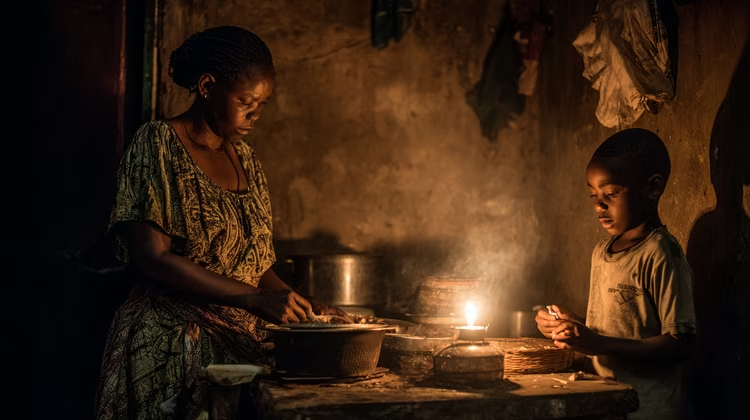
When he struck the match, the flame revealed her hands, already black. Chanda watched her arrange the coals, each piece placed with care.
Outside, voices rose and fell like waves. Mr Banda from next door called someone, asking if they'd heard anything from the electricity company. A woman laughed. The rains had failed again. Up at the dam, the water was too low to turn the turbines. And here, in kitchens across the town, women were reaching for charcoal stoves, striking matches, watching flames catch in the dark.
From somewhere beyond the houses, beyond the last streetlights, came a sound Chanda knew. The rumble of trucks, heavy and slow, returning from somewhere he couldn't see.
His mother glanced up at the sound, just for a moment. Then she returned to the stove. "The trucks," Chanda said. "Where do they go?"
She didn't answer immediately. She placed the last coal, adjusted it once, twice, until the arrangement satisfied her. Then she said, "To the forest."
"What for?"
But dinner was waiting, and the flames needed tending. His mother's silence was its own kind of answer. Chanda let the question drift into the smoke that was already beginning to curl toward the ceiling, finding its way through gaps in the roof, carrying the smell of cooking and survival into the night.
That smell would be in his hair tomorrow. In his clothes. The other children at school would know, without being told, what kind of night he had lived through. Smoke was a language everyone understood now.
Part Two: The Marks
Chanda was kicking dust with his friends when he saw a figure walking from the direction of the fields. Something about the way it moved, slow and heavy, as though carrying more than a body should, made him stop.
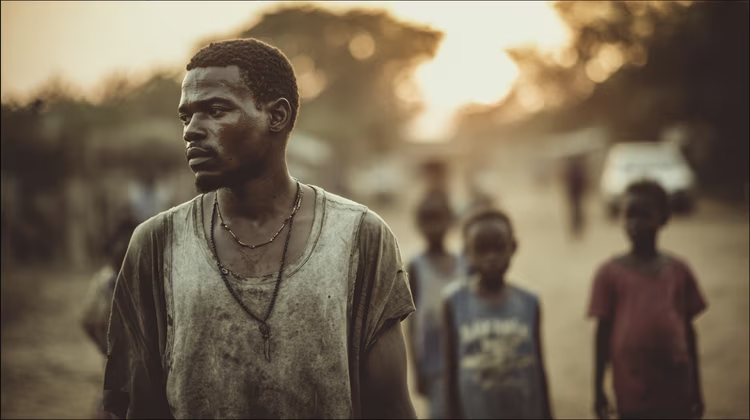
As the figure drew closer, he saw it was his uncle Joseph. But a version he barely recognised.
Joseph's shirt was dark with sweat, plastered to his chest. His face was streaked with dust. His eyes looked at Chanda without seeing him, as though still somewhere else. But his arms, his arms, Chanda would remember forever.
They were covered in scratches. Long red lines from wrist to elbow, some fresh enough that beads of blood still glistened in the sun.
"Uncle?"
Joseph stopped. The fog in his eyes cleared. He tried to smile, but failed. "Chanda." His voice was rough, as if he had not used it in days.
Chanda pointed at his arms. "What happened?"
Joseph looked down at himself as though seeing his own body for the first time. He raised one hand, touched a scratch absently, and lowered it.
"Ku mpande," he said.
The words meant nothing to Chanda. Just a name. Just a place people went when they disappeared before dawn and returned after dark weeks later. But his uncle's arms, they meant something else. They meant the place had claws.
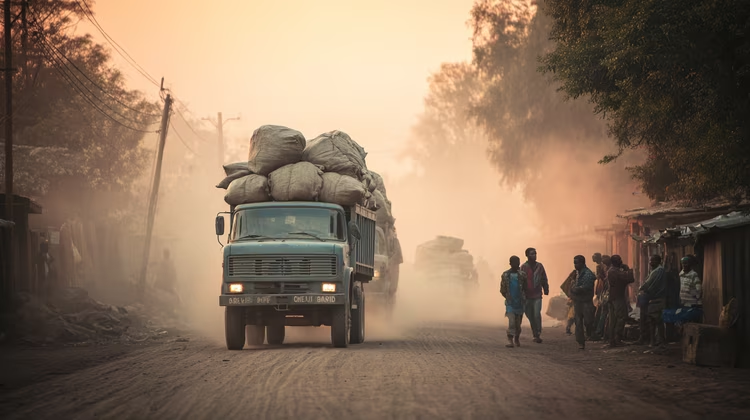
Later, after Joseph had washed and eaten and fallen asleep on a mat in the corner, Chanda stood by the road and watched the trucks pass. They came from the same direction his uncle had come, their beds stacked high with dark sacks tied with rope. The sacks sagged with weight, and the trucks seemed to move more slowly because of them.
His mother came to stand beside him. "Is that where he was? Ku mpande?" "Yes."
"What is in the sacks?"
"Charcoal. For when the power does not come back."
Chanda watched another truck rumble past. The man in the passenger seat had the same scratches on his arms. The same dust. The same eyes that looked at nothing.
"But where does it come from? The charcoal?"
His mother was quiet. The last truck disappeared around a bend, and the dust it left behind hung in the air like smoke.
"The forest," she said. "It comes from the forest."
She turned and walked back to the house. Chanda stayed by the road, watching the dust settle, trying to imagine a place so far away that people left before dawn to reach it, so rough it left marks on everyone who visited, so full of trees you could fill a thousand sacks and still have more.
He tried to imagine the forest. But he could not. He had never seen it.
Part Three: The Journey
Chanda decided to see for himself on a Saturday morning, when the house was still asleep, and the only sound was his mother's soft breathing from the other room.
He left before the sun was fully up, walking past the last houses at the edge of town, past the place where the paved road turned to dirt, past the fields where women would soon arrive to work, bent over their hoes. He kept walking until the houses disappeared and the fields disappeared, and there was only the path ahead, winding into trees.
At first, it was beautiful.
The light fell in patches through the leaves, dappling the ground in ways Chanda had never seen. The air was cooler than in town, and it smelled different. Green, damp and alive. Birds called to each other in languages he didn't understand, their voices bouncing off invisible branches. He thought: This is where Uncle Joseph goes. This is where the sacks come from. This is the forest.
He walked deeper, following the path as it curved and climbed. The trees grew thicker, their trunks wide and old, their branches reaching toward each other overhead. Chanda felt small among them, but not in a bad way. In a way that made him feel like he belonged to something larger than himself.
Then the path opened up, and he stopped walking.
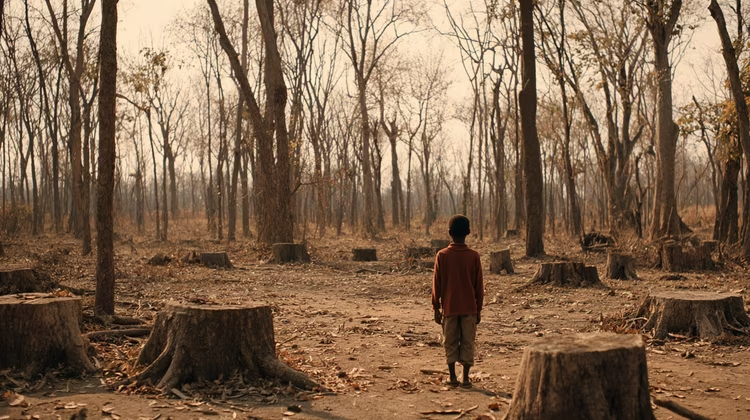
The trees were still there, but wrong. Thin. Sparse. Like someone had come through and taken only the biggest ones, leaving the rest to hold up the sky alone. The ground was bare in places, hard-packed where trucks had driven over it. Stumps dotted the earth like graves, some fresh-cut, some already weathered grey.
The birds were still there, but their calls came from deeper in now, from places Chanda couldn't see. The closer parts of the forest were quiet, except for the wind moving through empty spaces.
Chanda kept walking. He didn't know why. Maybe he wanted to find something that was still whole.
He found a stump instead. Fresh cut. The wood inside was pale, almost white, and it smelled sharp and green and sad all at once. Chanda touched it. It was still damp.
From somewhere ahead, beyond a rise in the land, he heard a sound. A ring of metal against wood. Then another. Then a pause, and then a crack that seemed to travel through the ground and up into his feet. The sound of something large giving way, surrendering to the weight it had carried for decades.
Chanda stood very still. The crack echoed through the trees, bounced off hills he couldn't see, and slowly faded into silence.
Then the axes started again.
He didn't go further. He stood there, in the heat that now reached places it never used to reach, and listened to the forest falling somewhere ahead. And he thought of his uncle's arms. The scratches. The way he hadn't answered when Chanda asked what happened.
He had thought the forest had claws. But the axes were in his uncle's hands.
Part Four: The Smoke
The walk home was longer.
Chanda's legs ached. His feet were sore. The path offered less shade than it had in the morning, or maybe he noticed it more now. Every stump by the trail seemed to speak to him as he passed.
When he reached the edge of town, he stopped and looked back. The forest was still there, a dark line on the horizon. But it seemed smaller than it had that morning. More fragile.
He walked through streets where women were lighting evening stoves, where children played in the dust, and where men rested in doorways after their own journeys. Smoke rose from a hundred braziers, carrying the smell of cooking and survival, and something else now.
Something he had not noticed before.
It smelled like the stump. Like the sound of axes.
When he reached home, his mother was preparing the evening meal. She looked up when he entered, and for a moment her face showed something, worry perhaps, or relief, but she said nothing. Just returned to the stove.
Chanda sat on the floor and watched her hands, black with charcoal dust, arranging the coals. He watched the flames catch. He watched the smoke rise toward the ceiling, finding its way through gaps in the roof.
"I went to the forest," he said.
His mother's hands paused. Then they continued. "I saw the stumps. I heard the axes."
She was quiet. When she spoke, her voice was soft, almost a whisper. "What did you expect to find?"
Chanda thought. Beauty, maybe. Peace. A place untouched by what made life difficult. Instead, he had found the same struggle, the same survival, the same marks on the land that he saw on the people he loved.
"I don't know," he said.
His mother nodded, as though that was the right answer.
That evening, Uncle Joseph sat beside Chanda on the step outside.
They watched the sky darken. Watched the first stars appear. Watched smoke from a dozen braziers rise and blur the line between earth and sky.
"You went," Joseph said. Chanda nodded.
Joseph looked at his hands. The scratches were healing, but the lines would remain, marks that would tell their own story to anyone who knew how to read them.
"I was your age the first time," Joseph said. "My father took me. Showed me how to cut, how to burn. Told me the forest would always be there."
He paused. In the silence, Chanda could hear the trucks in the distance, still running. "He was wrong."
They sat together in the growing dark, uncle and nephew, thinking their own thoughts.
When the candle went out that night, Chanda did not reach for the matches. He lay in the dark, listening. The trucks were still running. The trees were still falling somewhere beyond the edge of town. The birds that remained called to each other in a language he would never understand.
He thought about what his uncle said. About the forest always being there. About how it was not. About the stump he had touched, still damp, still warm from the sun that now reached places it never used to reach.
He thought about his mother's hands and how the black never fully washed out.
He would never hear an axe the same way again. He would never see smoke without remembering. He would never look at his mother's hands or his uncle's arms without seeing the marks of a place he had finally visited and would never truly leave.
The End.