Restless, simple, and at times incredibly introspective, Copperbelt, a play by playwright and actress Natasha Mumba, invites audiences to engage with issues of class, race, and geopolitics through the multifaceted relationships between the central protagonist, Eden, and other characters. The play oscillates between Canada and Zambia, relaying the urgency of the concerns plaguing Zambia’s contemporary mining industry. Characters in the play include Eden Chileshe, her partner, Peter Kund; her parents, Mr Chimfwembe Kasuba and Mrs Harriet Kasuba; her brother, Musulo Kasuba; her sister, Lombe Kasuba; and Dalitso Moyo, Lombe’s husband. Most notable is the ensemble cast, which includes homegrown Zambian actors catapulted onto an international stage, including Kondwani Elliott Zulu (Black Dollar, Can You See Us) as Dalitso and Kapembwa Wanjelani (Mpali) as the formidable Chimfwembe.
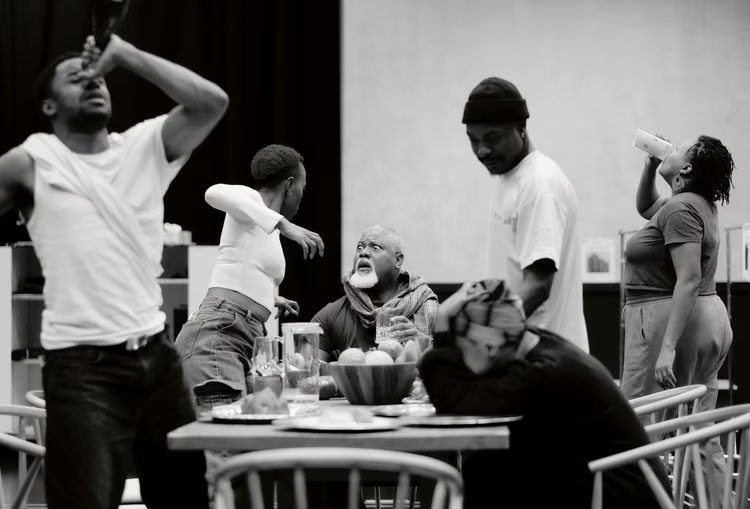
The production, which premiered in early 2026, is a critique of the Zambian mining industry that feels both incredibly holistic and timely. Devoid of clear protagonists and antagonists, Copperbelt’s characters exist on a spectrum of greyness, with each possessing varying levels of resilience and greed. Eden embodies this duality quite well, motivated by the desire to succeed beyond her father’s expectations and prove him wrong, while driven to acquire large sums of money for herself. At times, her grit, wit and charm shine through, encouraging audiences to root for her.

In the play's opening scene, we are introduced to Eden and Peter, an interracial couple living in Canada. It is through their relationship that some of Mumba's most compelling socio-political commentary can be gleaned. Both are employees of Maverick Gold, where Eden is an operations manager and Peter is the head of exploration. This is also where the two met, and their relationship began with controversy. Mumba's decision to name the company Maverick Gold is a hilariously cheeky allusion to a similarly named mining company. In the scene, Eden scolds Peter for not taking her frustrations from their dinner with Maverick Gold’s CEO seriously. I read Peter’s disregard as a failure to understand the racial and power dynamics at play within their relationship and in their wider society.

Although Peter is her romantic partner, the exchange in the play's opening scene suggests they cannot be equals in any meaningful sense. Furthermore, Eden and Peter’s relationship could be regarded as symbolic of the relationship between mineral-rich countries in the Global South and investors from the Global North. Despite being competent, Eden does not have the level of power that Peter has at Maverick Gold, and her attempts to close this gap are met with a dismissive attitude from Peter. The same could be said of the relationship between the Global North and Global South.
Eden’s experience of subjugation in Canada is contrasted by her socio-economic background, personality and motivations. She is confident and ambitious, taking on a dominant role in her relationship with Peter. This is apparent from the first time they meet, when Eden cleverly goads Peter into buying her and her friend drinks at a bar. Peter is taken aback by Eden’s brashness and confidence. She is also very upfront about her ambition, as evidenced by her telling Peter she knows his position at their company and by her giving him intel on his competitors.

If we speculate, Peter and Eden’s relationship draws a parallel between the Global South (represented by Zambia) and the Global North (represented by the West), with Eden’s ambitions mirroring Zambia's. The copper industry represents the lion's share of Zambia’s income-generating activities and, as such, is the lifeline of many livelihoods in the country. This raises the stakes of Eden’s relentless pursuit of success: she has to work hard and assert herself among her Canadian colleagues just as Zambians seek to assert themselves as equal partners with foreign investors. However, Eden’s dishonesty and greed complicate what would otherwise be a ‘good versus evil’ narrative.
For all her candour and confidence, Eden is simultaneously secretive and detached. Later, we learn that her last name is Kasuba and that she is the daughter of Mr Chimfwembe Kasuba, who owns the Zambian mining company, Rising Sun Investment Group, with which Maverick Gold is in partnership. Eden would benefit from the partnership between the two companies, and her failure to disclose this information to both Peter and her company suggests that she is just as cunning as she is ambitious. Furthermore, her behaviour aligns with her father’s, despite his representation as the cut-throat antagonist in her life. This is one of Mumba’s strongest creative choices. By aligning Eden’s actions with her father's, Mumba unsettles the notion that Zambians are helpless bystanders as foreign investors pillage the country’s natural resources.
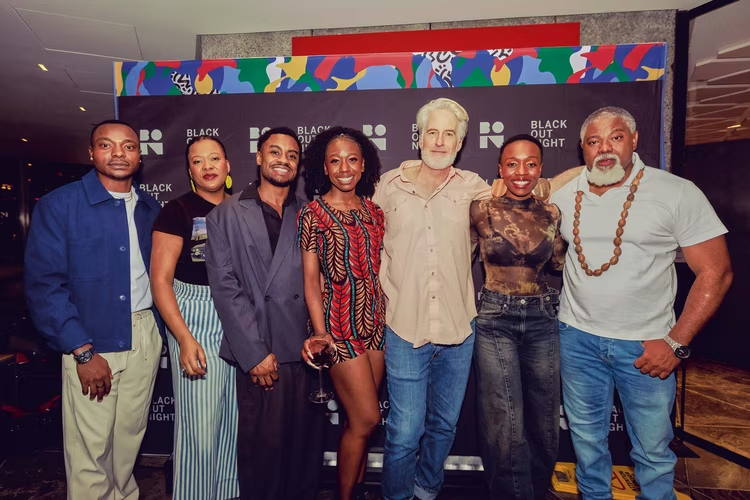
Adding to the strength of Mumba’s social commentary is her decision to cast the Kasuba family as wealthy, highlighting corruption within the Zambian mining industry. Mr Kasuba’s rags-to-riches story is striking in that it draws attention to Zambia’s colonial legacy. His purchase of the home once owned by his father’s European boss is a reclamation of power, signalling the emergence of a new class of Zambian elites and the economic opportunities that existed in post-independence Zambia. However, his continued greed and that of his family suggest that this new class of elites replicated the machinations of power once wielded by a colonial ruling class, which makes Mumba's critique lucid.
Whether oblivious to their privilege or not, the Kasuba children take advantage of their positions to gain wealth (Eden), fame (Lombe), or a comfortable lifestyle (Musulo). As a foil to the family’s greed, Dalitso's humble background and character represent the interests of ordinary Zambians. He works hard to be close to the Kasubas, particularly his wife, Lombe, whose carefree lifestyle he has to maintain.
I view their relationship as symbolising the dichotomy between the elite and middle- and lower-income people in Zambia. Lombe is carefree about generational wealth, whereas Dalitso is keenly aware of the work he has to do to achieve what the Kasubas have. Mumba invites audiences to engage with the power imbalances that mar Zambian society through this powerful portrayal.

Where the play falls short is in its presentation of auxiliary characters. Musulo and Dalitso's characters, for example, were robbed of the exploration they deserved. Perhaps Mumba was attempting to comment on various topics, but her choice not to explore wonderfully complex characters like Musulo made important social commentary fall flat.
By the end of the play, Peter has attempted to outmanoeuvre Eden, but she outsmarts him and secures a deal with the Zambian government. Eden comes out on top at the end, although she has still bent the knee to a foreign investor, albeit one of her choosing. Ideally, audiences should root for her triumph. However, I find myself wondering whether she will truly be on equal terms with the new investors and thinking about the magnitude of her greed, which might be the point of Copperbelt as a production.
Mumba's latest theatrical entry shows the importance of art that speaks to contemporary Zambian and global issues. Her inclusion of Bemba dialogue and indigenous Zambian actors in the cast is powerful and necessary, centring Zambian audiences and asserting her cultural identity. I look forward to what’s next for the playwright and hope this signals a much-needed renaissance of Zambian theatre.