The numbers don't lie: raising a child today costs far more than most salaries account for, and more Zambian couples are doing the uncomfortable maths before deciding how many children to have.
In Zambia, the idea of a large family did not emerge from sentiment alone; it was shaped by conditions that made having many children both rational and necessary within the realities of the time. Child survival was uncertain well into the late twentieth century, with higher rates of infant and under-five mortality driven by infectious disease, limited access to healthcare, and gaps in maternal services, particularly in rural areas. In that context, having more children increased the likelihood that some would survive into adulthood, while those who did became part of the household economy, contributing labour in agrarian settings and gradually sustaining the family structure over time. This expectation extended into old age, where children were relied upon for care, continuity, and the management of family land and resources.

Alongside these practical considerations sat a strong social meaning attached to family size, where larger households were often associated with stability, capacity, and social standing. That perception has not entirely disappeared.
Data from the Zambia Statistics Agency and ICF International show that while Zambia’s total fertility rate has declined from above six children per woman in the 1990s to around four in more recent estimates, desired family size remains relatively high, particularly outside urban centres. Education, urbanisation, and improved access to reproductive health services have contributed to this decline, yet the cultural valuation of larger families continues to shape how people imagine what a household should look like.
How Much Does It Cost to Raise a Child in Zambia?
What has shifted is not the value placed on children, but the conditions required to raise them well. The financial demands of a household have expanded in ways that are difficult to ignore and now shape daily decision-making at a very practical level.
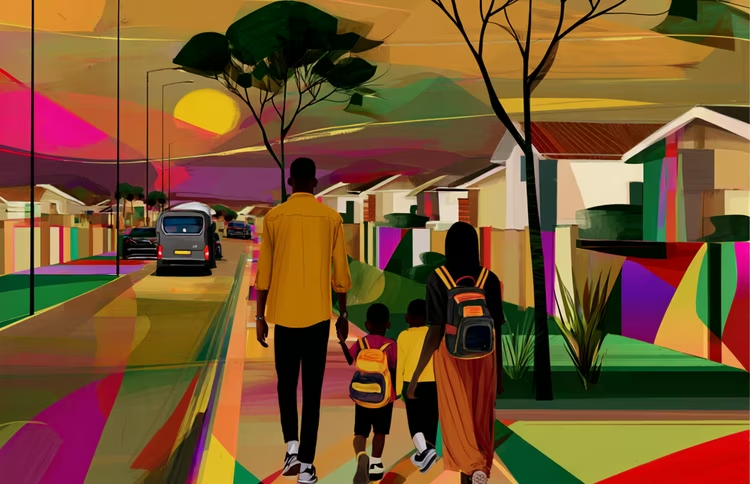
Data from the Jesuit Centre for Theological Reflection, which tracks the Basic Needs and Nutrition Basket, indicates that a family of five requires approximately K11,844.63 per month to meet basic needs and maintain a minimally adequate diet, particularly in urban areas like Lusaka.
But that figure realistically covers food alone. The full picture is considerably heavier. Rent for a modest three-bedroom house in a mid-range Lusaka neighbourhood, such as Ibex Hill or Chalala, currently ranges from K10,000 to K20,000 per month, with more central areas pushing beyond K25,000. The realistic option for many urban parents who want smaller class sizes and consistent teaching runs from around K3,500 to K8,000 per term at mid-range institutions, per child.
Government schools are technically free under the current free education policy, but transport to and from school adds a recurring cost, and minibus fares for school-age children in Lusaka average between K30 and K50 per day per child, translating to roughly K600 to K1,000 monthly. Fuel for households with a vehicle adds another K2,000 to K4,000, depending on usage. When these line items sit next to each other, the monthly cost of sustaining a family of four or five in Lusaka comfortably exceeds K30,000, and that is before medical costs, clothing, airtime, or any form of savings.

This benchmark reflects the cost of sustaining a household at a basic but acceptable standard, and its steady increase over time points to a widening gap between income levels and what it now takes to live with a degree of stability.
At the same time, the definition of provision has expanded beyond food and shelter. Education is no longer centred on access alone but on quality, early development, and long-term outcomes. Parents are expected to think about literacy before formal schooling, access to learning materials, and environments that support cognitive growth. National education priorities increasingly emphasise foundational literacy and numeracy, reinforcing the importance of early learning.
These expectations carry financial implications, from school fees to transport, materials, and additional academic support, meaning that each additional child increases not only household size but also the level of investment required to maintain a standard of care that aligns with current expectations.
The Hidden Burden on Mothers in Large Families
As the structure of raising children becomes more demanding, the weight of that shift does not fall evenly within the household. In Zambia, women’s participation in education and the workforce has increased, yet expectations around caregiving have remained largely unchanged, creating a persistent strain that becomes more pronounced in larger families.
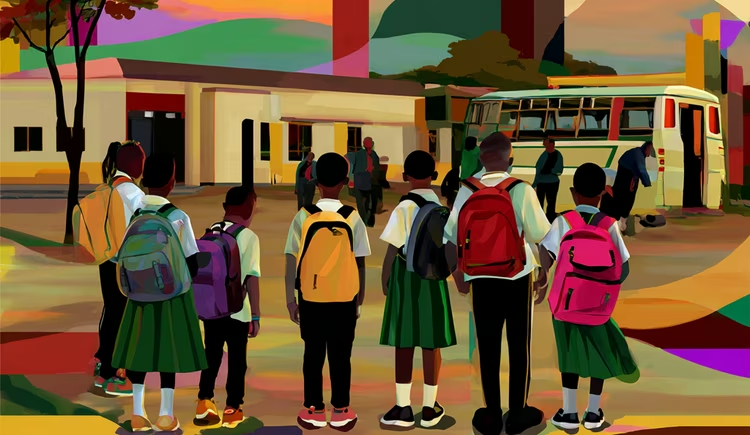
The coordination of daily life grows more complex with each additional child, from school schedules and clinic visits to meals, emotional support, and discipline, forming an ongoing system that requires active management. In most cases, that responsibility rests with the mother, regardless of her professional commitments, and each pregnancy introduces a pause in career progression that can limit advancement, delay further training, or alter long-term career trajectories.
These pressures intersect with the evolving needs of children themselves. Greater awareness of conditions such as ADHD and dyslexia has changed how learning difficulties are understood, placing new expectations on parents to recognise and support these needs, sometimes requiring specialised care or schooling. At the same time, maternal health remains a critical factor, as repeated pregnancies, particularly with short intervals, are associated with increased risks, including anaemia, hypertensive disorders, and postpartum complications, patterns reflected in both national data and clinical practice.
Why Families Are Choosing to Have Fewer Children
What sits underneath all of this is a gap that is rarely addressed directly. The idea of a large family is still encouraged socially and, in some spaces, expected, yet the conditions required to sustain one have changed in ways that demand far more planning, financial stability, and structural support than before. Families are navigating higher living costs, more demanding educational standards, and increased health considerations without a parallel shift in how support systems are built around them.

The result is that large families have not disappeared, but deliberate limits are becoming more visible. A growing number of urban couples, particularly women with secondary or higher education, are settling on one or two children as a conscious ceiling, not a fallback. The 2024 Zambia Demographic and Health Survey recorded an urban total fertility rate of 3.2, down from 3.4 in 2018, and a third of women surveyed said they want no more children. Among younger, educated urban women, the direction is sharper still.
The expectation remains visible, but the support required to meet it is less clearly defined. That tension is shaping how younger adults are beginning to think about family size as a decision that carries weight across every part of life, from health and career to the kind of upbringing each child can realistically receive.