Zambia's roads can be spectacular and punishing in equal measure. A little preparation before you leave makes the difference between a good story and a bad one. The kind of good story you tell at a braai, not the kind you tell from a hospital waiting room.
Let's say you've decided to drive to South Luangwa — arguably one of the best decisions you'll ever make. Here is what to sort out before your car (yours, rented or borrowed) even leaves the driveway.
Get Your Paperwork Together
Before anything else, make sure your paperwork is in order. Carry your driver's licence, the vehicle's registration papers, and a valid insurance certificate. Police checkpoints are frequent on intercity routes, and officers will ask for them. Having them accessible saves you the fumble and the slightly embarrassed ten-minute rummage through old receipts.
If you are crossing a border, you will also need a yellow fever certificate, a COMESA or third-party insurance card valid for the destination country, and the vehicle's carbon copy. Do not assume you can sort this at the border. You cannot.
Your Tyres Will Find Out Everything You've Been Hiding
Zambian roads will find the weakness in your tyres. Potholes, gravel shoulders, and sharp debris make a tyre failure more likely here than on a smooth urban commute, and a blowout at speed on a two-lane highway is genuinely dangerous.
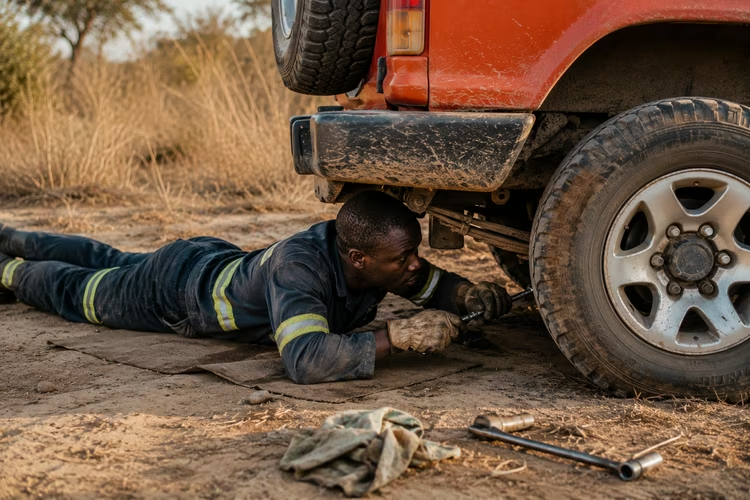
Before departure, check all four tyres for pressure and wear properly, with a gauge. If the tread is marginal, replace it before you go. Then check your spare. A flat spare discovered 80 kilometres from the nearest town is a specific kind of misery that no podcast can fix.
Carry a working jack, a wheel spanner that actually fits your nuts, and know in advance how to access your spare. Some SUVs mount it underneath and require a key or tool to release. Though finding this out for the first time at the side of a remote road is character-building.
If you are covering long distances on untarred roads, two spares are not excessive.
Fuel: Don't Play Chicken With the Gauge
On major routes, the Great North Road, the road to Livingstone, and the Copperbelt corridor, fuel is reasonably available. But "reasonably available" is not the same as guaranteed. Stations run dry, especially outside Lusaka, and the spacing between reliable stops can be longer than it looks on a map.
Fill up before you leave, and again whenever you drop half a tank in rural areas. If you are heading into genuinely remote territory, Kafue's western reaches, the roads toward Mbala or Lundazi carry a jerry can. Know your vehicle's consumption rate and do the maths before you commit to a stretch. Optimism is not a fuel type.

Bring Cash. Actual Cash.
Card machines exist, but they are unreliable. Many fuel stations, roadside restaurants, and rest stops operate on cash only. ATMs out of town can be out of service or out of notes, sometimes simultaneously. Draw sufficient kwacha before you leave the city, keep smaller denominations for tolls and roadside purchases, and do not rely on mobile money working everywhere; network gaps are real. The time to learn this is not when you are standing at a fuel pump with an empty tank and a declined card.
Slow Down. No, Slower Than That.
Hitting a pothole at 100km/h can crack a rim, damage suspension, and send you swerving into oncoming traffic. On known problem roads, slow down and mean it. Drive at a speed at which you can actually respond to what you see. At night, this becomes even more critical; your headlights give you less time to react, and many potholes are invisible until you are already in them.
Do not swerve aggressively for potholes when there is traffic behind or beside you. A controlled, reduced-speed hit is safer than a sudden lane change. The pothole wins either way; at least choose the less dramatic outcome.
Night Driving: Best Avoided
The honest advice is to be off the road by dusk if at all possible. At night, pedestrians, cyclists, and animals are on the road and largely invisible. Unlit vehicles, broken-down trucks, and slow-moving carts are a serious hazard.
If you must drive at night, drop your speed significantly, use your full beams when the road is clear, and pull over if you are tired.
Know Your Season
The rainy season, roughly November to April, changes road conditions substantially. Some untarred routes become impassable. Bridges flood. Visibility drops sharply in heavy rain. If your route includes untarred sections, check conditions before you go — local knowledge from a fuel attendant or lodge is often more current than any app, and considerably more honest.
In the dry season, dust and heat are the main concerns. Keep water in the car, ensure your cooling system is in good order, and watch your temperature gauge on long climbs.
Snacks, Water, Breaks
This sounds minor until hour five of a nine-hour drive. Carry more water than you think you need — two litres per person as a baseline, more in hot conditions. Pack food that travels well. Take breaks every two hours, not just when you feel tired, because fatigue on long drives arrives before you notice it. It is polite like that.
Rest stops along major routes vary from decent roadside restaurants to very little. Know roughly where you plan to stop, and eat something proper at least once during a long day's drive. A packet of crisps is not lunch.
Coverage on main roads between major cities is generally adequate. On remote routes, it drops off considerably. Before you leave, download offline maps for your route — Google Maps and Maps.me both work offline with pre-downloaded areas. Share your route and expected arrival time with someone who is not in the car.
Save these before you leave: the number of a breakdown service or someone who can arrange one, the nearest hospital or clinic to your destination, and a contact at your destination who knows when to expect you.
A basic roadside kit is worth carrying: a first aid box, a reflective triangle or vest, a torch, and jump leads. Most of this takes up very little space and earns its place the one time you need it. That time always comes.
It Is Worth It
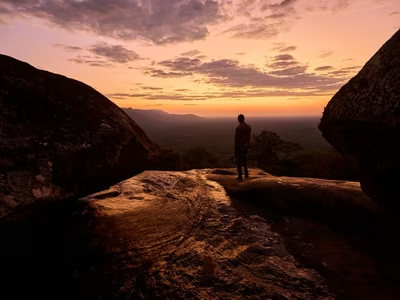
Zambia is worth the drive. The road between Lusaka and South Luangwa at sunrise, the long straight runs through miombo woodland, the moment the escarpment opens up above the Zambezi Valley — none of this is accessible any other way. Prepare properly, drive sensibly, and the road will look after you.