The body is a work of art.
I saw my first naked man when I was around four, but not yet five. He lay flat, superimposed in two positions inside a circle and a square in the middle pages of an abandoned encyclopaedia in our house. He was spread wide but not vulnerable. There were some facts about him, Leonardo da Vinci’s Vitruvian Man, on the next page, but I would only know them when I learned how to read.
Aside from being illiterate, I know I was four because my younger brothers had just learned to walk. They were in the era of cute twin-boy outfits, while I wore dresses. This early exclusion was why I later refused to carry the female signifier of my last name: Nakamba.
The Namwanga tribe is matrilineal, with surnames that carry gender and clan signifiers marking proximity to the royal line. Sons bear their father’s surname, while daughters receive a name that identifies their lineage and their proximity to the throne. As an only daughter, I didn’t understand this system. Left out of the special, matching clothes and my father’s last name, my position in the family felt weak.
I moved up to primary school, never got the matching dungarees, but when I learned to write my last name in shaky pencil, I wrote ‘Siame’.
Nobody stopped me from wandering through my father’s books, and it was only when I started asking questions that they realised I could read at age five. The naked form of the Vitruvian Man was almost sexless and presented geometric principles considered ideal standards of the human form and its relationship to space, time, art, science and nature. By learning that the standard human body is eight heads tall and its span is proportional to its height, I discovered balance, architecture and the beauty of symmetry. It was clear that man had a relationship to both the infinite divine and material existence.
Now that I am older, the naked body is more than its geometry. It is the composition of character. The naked form has no secrets. It records the history of experiences, pain, pleasure and fear.
But it does not say enough.
As soon as I understood what it meant to be naked, I wondered when humans decided to wear clothes. The Book of Genesis tells of Adam and Eve in an Eden free of mosquitoes, frolicking in nude splendour until their eyes opened. By His mercy, God slaughtered an animal and covered them in something more sustainable than fig leaves.
The discovery of clothing-lice fossils hints at the existence of attire worn by Homo sapiens in colder climates around 300,000 years ago. This is also supported by archaeological evidence of tools used to turn bark and animal skins into cold-resistant coverings.
As soon as we could hunt, we ate enough calories for brain development. With that came curiosity and wonder. That was all we needed to spark the urge to travel and the ingenuity to construct clothing from the fur we tore from our food. Without clothes, we would never have made it this far.
With travel came definitions of territory and, in true animalistic nature, we fought for it and still do today. War is demanding. With war comes the need to kill and shield. This drove the development of the textile industry to meet the demand for trade and armour. Governments contracted fashion houses to furnish the armies with appropriate garments. During World Wars I and II, European fashion houses were increasingly involved in producing military uniforms, leather goods, and protective wear, all of which necessitated industrialisation and the need to churn out as much as humans could consume. Fashion houses required cheap labour to stitch garments for every child born and every soldier sent to the battle line.
War is constantly shaping culture. The insignia, crests, chariots, knights and horses in luxury labels are scars of war, whispering the violent history of fashion.
When it was time for colonialism, it was natural that they came dressed to kill. But what did they find?
In Ghana, they found Kente. But in Zambia, as early as the Iron Age, Bantu tribes were fashioning barkcloth wraps, loincloths and animal-skin aprons to protect themselves from the Zambezi sun.
For adornment, they introduced other materials such as shells, seeds, bone, clay and copper. Clothing was organic, eco-friendly and biodegradable; therefore, most surviving examples have been lost to time and are preserved in ethnographic accounts and cultural memory. Among most tribes, the soft inner bark of trees such as Mubanga was stripped and treated with smoke, sun or natural pigments to create the desired garment.
Not all clothing was made equal. While everyday wear was made from the skins of game hunted for food, such as antelope, the skins of leopards and lions were reserved for royalty.
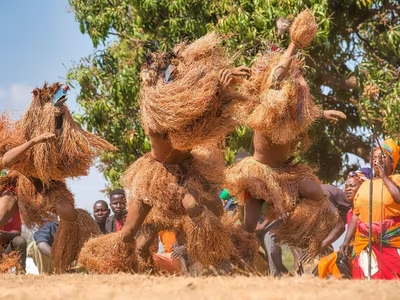
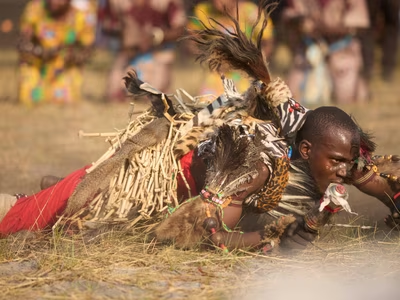
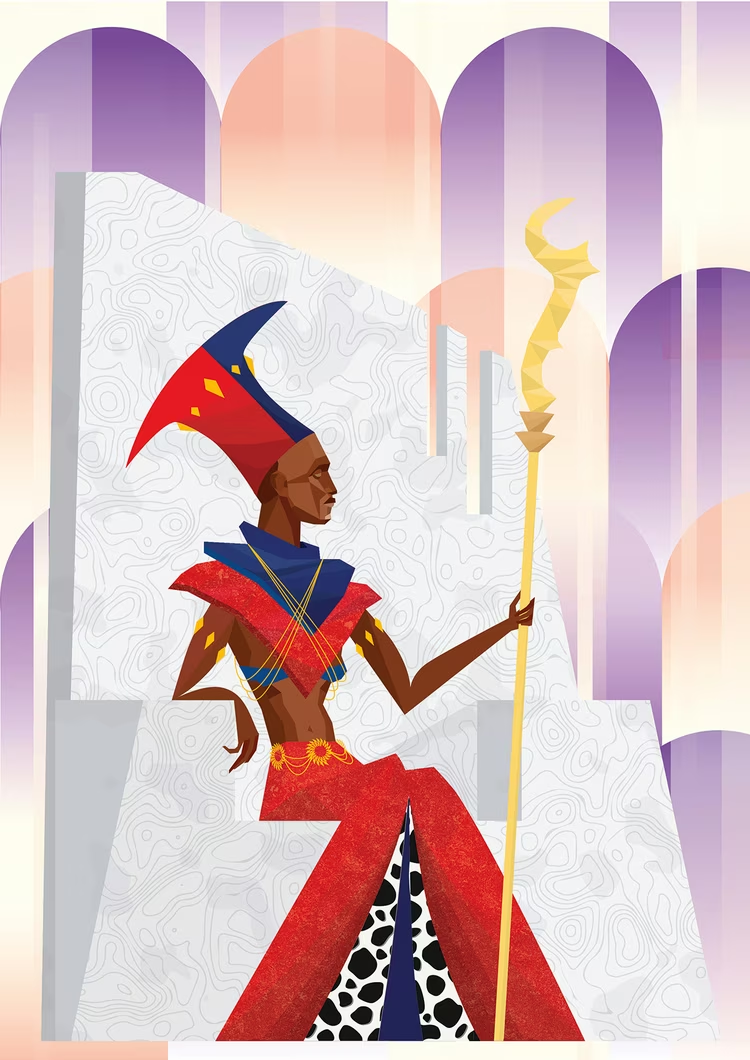
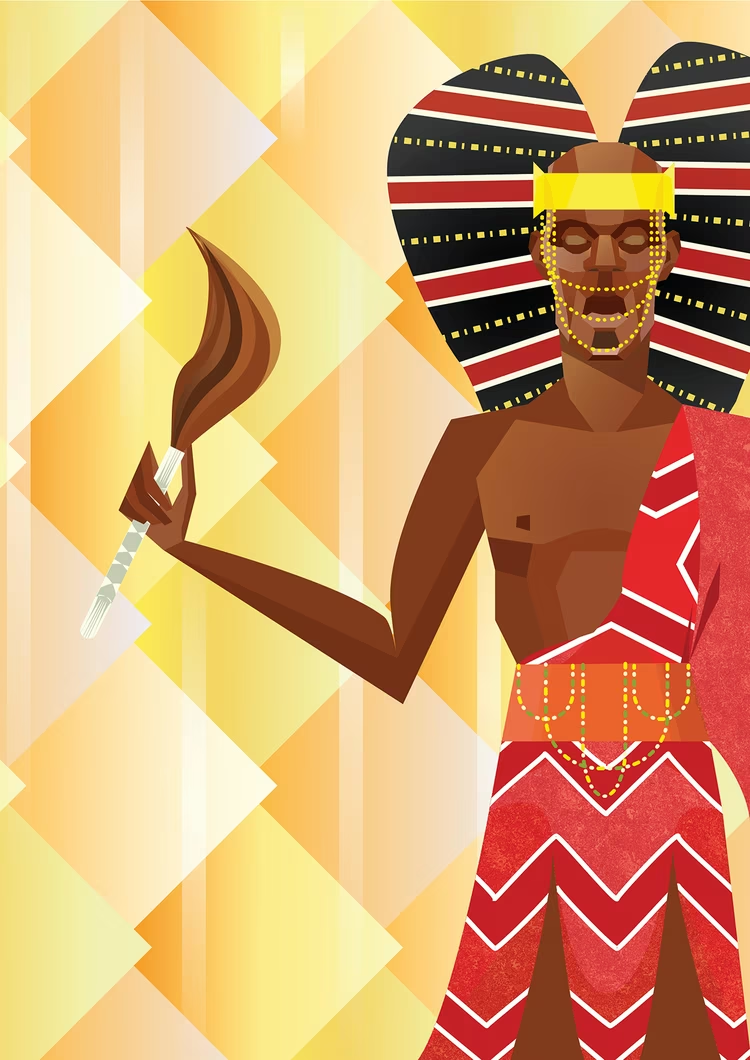
It is notable that clothing in pre-colonial Zambia consistently carried indicators of gender, class and purpose. Among the Bemba, Impapa for men were different from the animal skins worn by hunters. The Lozi in the west have always had the Musisi, but its pre-colonial iteration was built with fibre layers, skin or beads to signify femininity, social rank and wealth. The Tonga have an enduring history of elaborate adornments crafted from reeds, seeds and fibre. In the east, Nyau costumes reflect the Makishi costumes of the north-west, both indicating that indigenous Zambian tribes regarded textiles as an art of performance. Through raffia skirts, barkcloth, animal hides, wooden masks and feathers, textiles evolved into something else entirely: they became spiritual. Through the power of a garment, one became a mystical guide, an embodiment of ancestral spirits from the past with a message for the future.
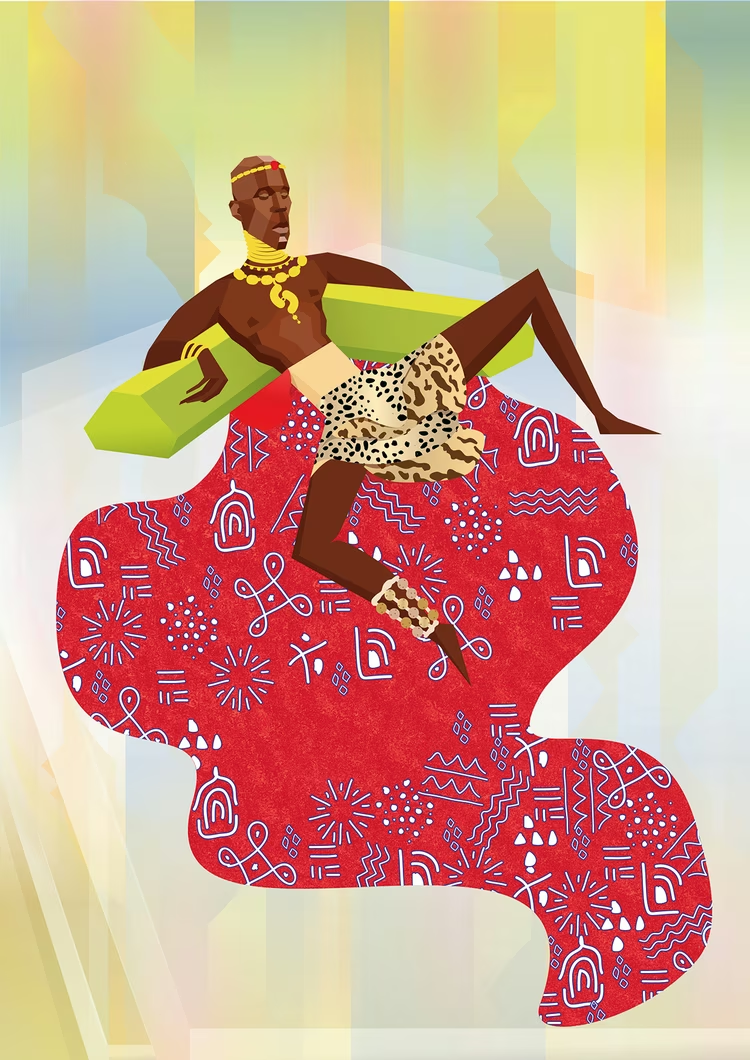
By the 1800s, glass beads from trade started blending in. Intricate leather and cowhide skirts are documented in the ethnographic record, adorned with beads for brides. Indigenous Zambian textiles were elaborate and often sacrificial. Garments came out of the risk of hunting or the sacrifice of slaughtering a prized animal raised for years on the land. This limited mass production and added a layer of rarity and reverence to clothing.
There is a layer of simplicity and innocence in the absence of cuffs, collars and trains in indigenous clothing.
The design of the textiles spoke about identity, creativity, ancestry, the marking of history and communal expression. Before the emergence of organised religion, nudity was natural, a climatic adaptation. Modesty, self-expression and respect were shown more through averted gaze, folded shoulders or clasped thumbs. There was no formal gym culture, nor was there shame. Bodily features were inherited as enduring evidence that versions of us had been loved before. Today, my siblings and I wear whatever we please, but I am still charmed that we all have our late father’s hands.
During the transitional era of colonialism, European textiles made their appearance in Africa and stayed. Missionaries transformed the landscape of religion and education, sharing new ideas of what it meant to be dressed. This reshaped concepts of dignity, modesty and influence, and brought with it textiles to match. With investments in production, the ease and abundance of European textiles made them convenient to adopt, while religion and education made them valuable to adapt to. Textile transformation had survival at its heart.
The Endangered Materials Knowledge Programme (EMKP) is funded by the Arcadia Fund and hosted by the British Museum. Its focus is on preserving and transmitting the material memory of dying cultures worldwide. The ‘Last of the Bemba Bark Cloth Makers’ is among its projects and, in recording the ancient art of barkcloth, researchers uncovered archaeological links to the lifestyles of Stone Age artisans in northern Zambia from 500,000 years ago. In observing barkcloth makers, archaeological objects with no known purpose were seen in a new light.
Through exploring the link between tool use and human evolution, the EMKP was drawn to the work of John Mukopa, one of the last three makers of traditional Bemba barkcloth. His work extended beyond textile production. At age 82, he was revered and called upon as an elder in the community’s spiritual life. His process started and ended with the ancestors. Working with an iron axe and blades, John would strip the bark and work the wet mass with a wooden flat-head mallet, singing songs of gratitude and praise to the tree for its sacrifice.
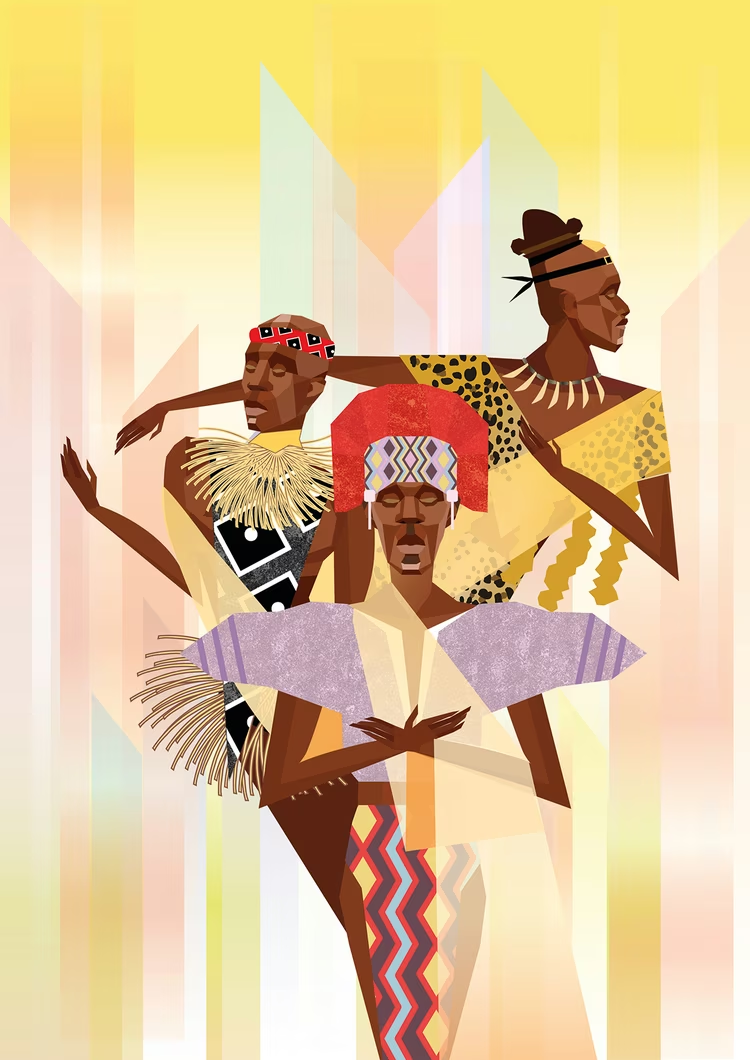
The ritual observances surrounding indigenous textile production explain why mass production is impractical and why clothing is more than an escape from nudity in most African societies. John Mukopa passed away in March 2024, leaving Simon Chileshe and Patrick Chanda as the last two to possess the ancient skill. The work of the EMKP is vital to documenting and preserving sacred knowledge in its purity before it is transmitted and integrated into modern life, thereby ensuring continuity.
I have never seen Bemba barkcloth in person, and I would like to own a piece as art more than clothing. However, as knowledge is lost, it will be harder to obtain. T-shirts, on the other hand, are easy to find and imbue with our own meanings. This perspective reveals that it is essential to consider how the culture of sacred secrecy and intimacy within our practices is slowly eroding textile preservation. It leaves the process and results to the imagination, or to those brave enough to reach back in time and bring ancient craft to the present.
One of those people is Banji Chona, who calls on ancestral knowledge as she practises her craft. As an artist, Banji’s ongoing involvement in women-focused community development projects, particularly in textile and organic gardening techniques, makes her voice relevant in discussions about making indigenous processes contemporary. In an interview with Contemporary&, Banji shares an interesting perspective:
“Through observation and research, it becomes painstakingly evident that over the years, foreign influence has altered the relationships indigenous communities have with the earth and natural ecosystems, not only in the Southern Province but in Zambia as a whole. For example, basketry has become a popular product in tourist-oriented markets, thereby affecting palm tree harvesting levels. Both practices are now disconnected from indigenous roots, fuelled by a newly forged and imposed connection to the foreign, with serious negative impacts.”
Aside from aesthetic relevance, sustainable incorporation is the only way to resist cultural amnesia.
When John Mukopa passed away, he carried centuries of embodied knowledge to the grave. The loss was more than symbolic. It was material, procedural and spiritual. Each forgotten rhythm of the mallet, each unrecorded song, narrows the future of what we can hold on to.
Textile preservation cannot survive as an archive alone. It must live through practice, adaptation and respectful incorporation into contemporary life.
Before fabric, there was skin. Before skin, there was land. The body learned its curves from hills, its endurance from seasons, its scars from survival. Clothing began as a means of survival and later became a language. Long before seams and sizes, textiles were a map of the world, our way of saying who belonged, who was protected and who carried meaning. Indigenous textiles were never separate from life. They held grief, growth and the story of community and nature in their shapes, colours, textures and patterns.
To remember how we dressed before we were taught to be ashamed is to remember that the body was never incomplete. It was enough. It was art. The naked body once held everything: history, ancestry, labour and devotion. Today, those stories are covered with garments whose origins we rarely question. To remember indigenous textile knowledge is not to reject modernity, but to resist forgetting.
I once refused a name because it made me feel small. But now that I understand, I wear it with meaning. Names, like garments, are not fixed; they are carried, altered, inherited and sometimes reclaimed. What matters is not what covers the body, but whether it tells the truth of where we come from and where we are going.