“I am going to town.” In Lusaka, this statement is never only a statement of direction. It is a small announcement of intention. It means errands, traffic, queues, banks, government offices, bargaining, impatience. It means the day has business to attend to with you.
For many people, town is Cairo Road.
Even before arrival, the road begins to assemble itself in the mind: towers, pavements filled with dashing feet, men manoeuvring modified wheelbarrows through traffic and throngs of pedestrians. It seems a new delivery economy has emerged alongside offices housing bureaucracy and old buildings still standing with the stubbornness of memory.
Cairo Road is busy and practical; it is interrupted by commerce and urgency. It has the cadence of a place that has been used. A place that has witnessed. A place that has absorbed the footsteps of a country.
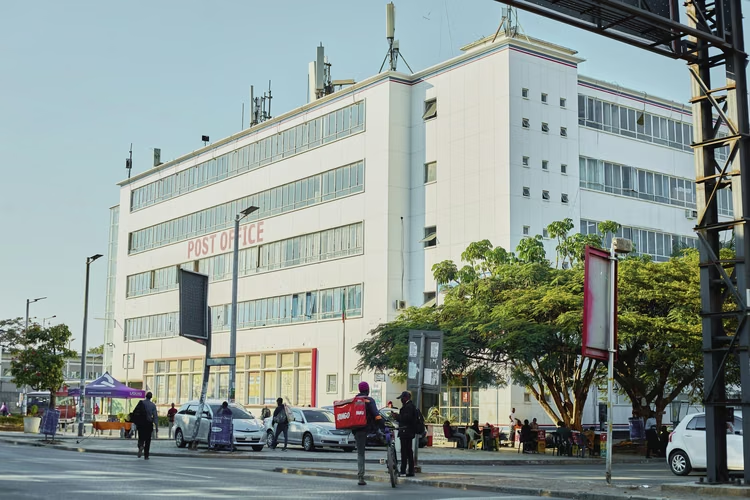
To journey along Cairo Road is to walk through one of Zambia’s memory corridors.
It stretches about 1.8 kilometres, from Kafue Roundabout to Kabwe Roundabout, but its historical distance is much longer. Before we named her Zambia, the road was already taking on the habits of a future nation.
The road was once known simply as Front Street: a place of arrival, trade, display and encounter.
At some point in 1924, the name Cairo Road was officially approved. The name carried a long shadow of colonial geography and the Cape-to-Cairo imagination, but cities have a way of refusing to remain inside the meanings first assigned to them.
“I am going to town.” The phrase belongs to everyone. The student looking for photocopies. The father depositing money for school fees. The clerk on lunch break. The tourist trying to navigate Lusaka.
Cairo Road began with commerce, with the first store established in 1908, when the road was still Front Street. The street slowly became a spine, function by function, errand by errand, until the city began to rely on it.
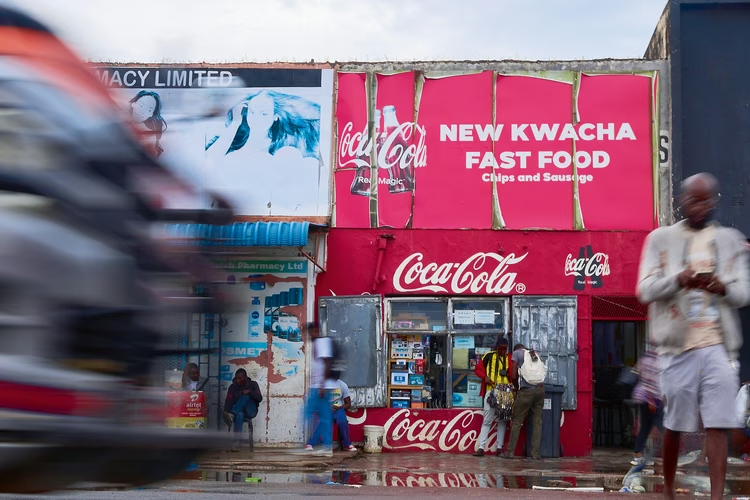
We can look at Cairo Road as a commercial space, but what better way is there to understand a society than through its public stage, a canvas that holds an ongoing work of art: everyday Lusaka life?
In the 1950s, the African National Congress in Northern Rhodesia organised walk-ins at the Post Office and shops along Cairo Road to protest racial segregation in the city. Such details change the way one walks through town. Before independence became a date on a calendar, it was also a body entering a space from which it had been excluded.
Place as Protest
The Post Office and its counters were not neutral spaces. Instead, they formed part of the architecture of belonging. To walk into them was to ask a political question with one’s body: who is allowed to stand here? Who is allowed to be served? Who belongs to the city? But the act did more than ask a question; it also offered an answer. A post office is an architecture of trust. You give it a message and believe it will travel. You stand in line and believe your turn will come. You write an address and believe someone is waiting somewhere to receive what you have sent. If Findeco House speaks of ambition, the Post Office speaks of connection. It speaks to a part of being Zambian: the faith that something can move from one hand to another, from one town to another, from one generation to another.
And Cairo Road remembers that.
Not only does it remember the grand things, but it also remembers the ordinary ones.
Another Word for Dawn
A short walk away, on Freedom Way, Kwacha Fish and Chips has been frying its own version of Lusaka’s memory for more than half a century. Even though not technically on Cairo Road, it belongs to the same emotional geography of town.
Freedom Way and Cairo Road run parallel through the heart of the CBD, separated by a single city block. Lusaka is best experienced by routes: the corner you turn, the shop you know, the shortcut you take, the food you buy before catching a bus back home.
Kwacha Fish and Chips is one of those ‘if you know, you know’ spots. Except everyone knows!
Parboiled, then fried chips, Hungarian sausage, fish, vinegar, newspaper and brown paper wraps. A certificate hanging on the wall, dated 1968, places the shop’s life in the years immediately after Independence.
Certain places become landmarks because people keep returning to them. Not all heritage is monumental. Some of it is served hot. Some of it smells of vinegar and oil.
Kwacha is a word of dawn. It is the name of our currency, the sound of a new morning, a word tied to national becoming. A city’s memory is kept in such spaces. In the streets where a boarding school child got his first trunk, on the sidewalk where two friends met after years apart.
Further along the road, Lusaka offers another kind of pause.
A Meeting Place for Business
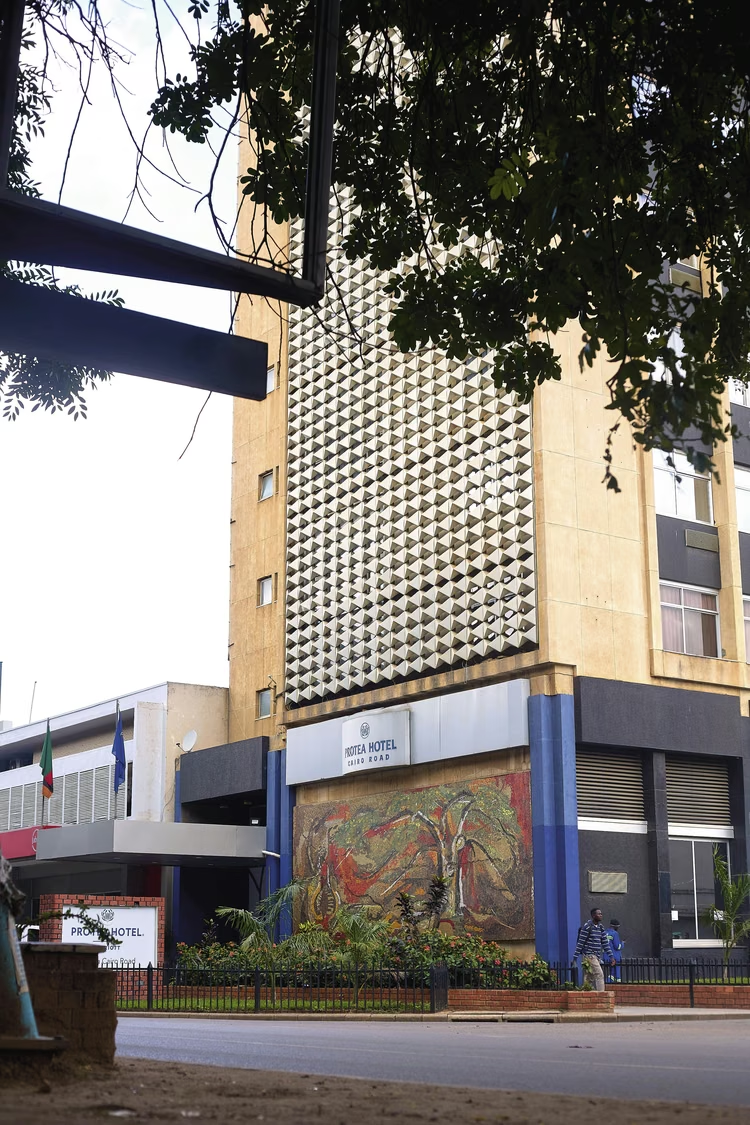
At Protea Hotel Lusaka Cairo Road, housed in Mutaba House, whose name refers to a fig tree traditionally associated with meeting and doing business, the mosaic mural adds a moment of colour, texture and imagery to the CBD. Made from many small pieces gathered into a larger whole, the work feels almost like the city itself: fragmented, layered, busy but somehow held together. Its reds, greens, ochres and dark lines create a wall of movement.
Designed by celebrated Zambian artist Gabriel Ellison, the mural is part of a larger truth. Art in Zambia hangs in galleries, lives in homes, on fabric, in hairstyles, in ceremony and in the streets of Lusaka, each form symbolic in its own right.
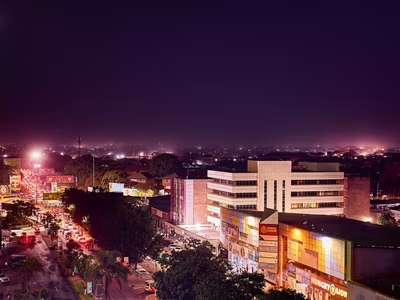
From the hotel’s elevated dining spaces, Cairo Road can be seen differently. Below, the road is noise and hurry. From above, it becomes composition. Concrete towers, shop signs, moving cars, pavements. The city becomes less of a problem to move through and more of a thing to behold.
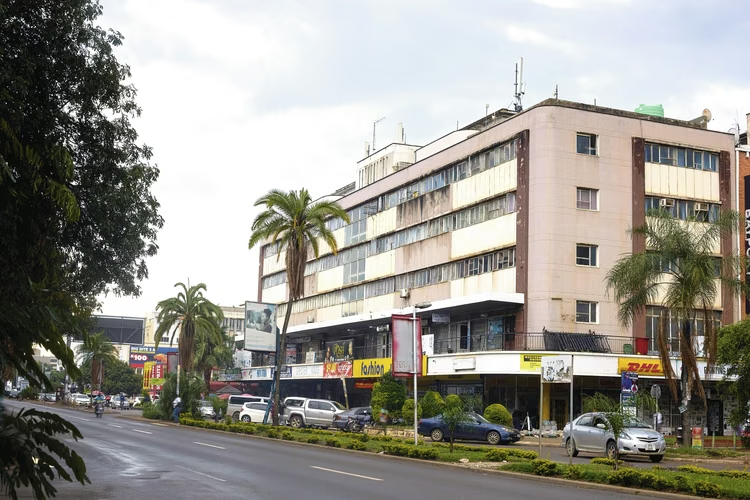
Architecture changes depending on where one stands. At street level, Cairo Road is pressure. From above, it is pattern. From memory, it is inheritance.
Architecture of Meaning
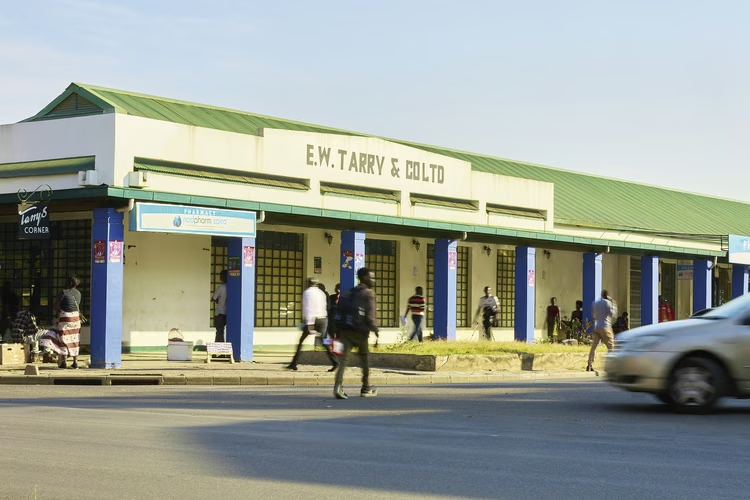
At the northern end, the E.W. Tarry Building carries the memory of another Lusaka. It belongs to the older commercial city: colonial-era business and the early grammar of urban life. Interestingly enough, the building has not remained solely in the past. Part of it now houses Everyday Lusaka Gallery, a contemporary space for photography, visual culture and urban memory.
A building once associated with early commerce now facilitates conversations and exhibitions about how Lusaka sees itself. This is one of the quiet victories of independence: that it not only removes old meanings but also writes new ones within inherited structures.
The rest of the building continues as part of the city’s commercial fabric, and perhaps that is fitting. Cairo Road does not separate memory from use. Its buildings are rarely allowed the luxury of becoming pure monuments. They must still work and remain inside the life of the city.
An Ascent
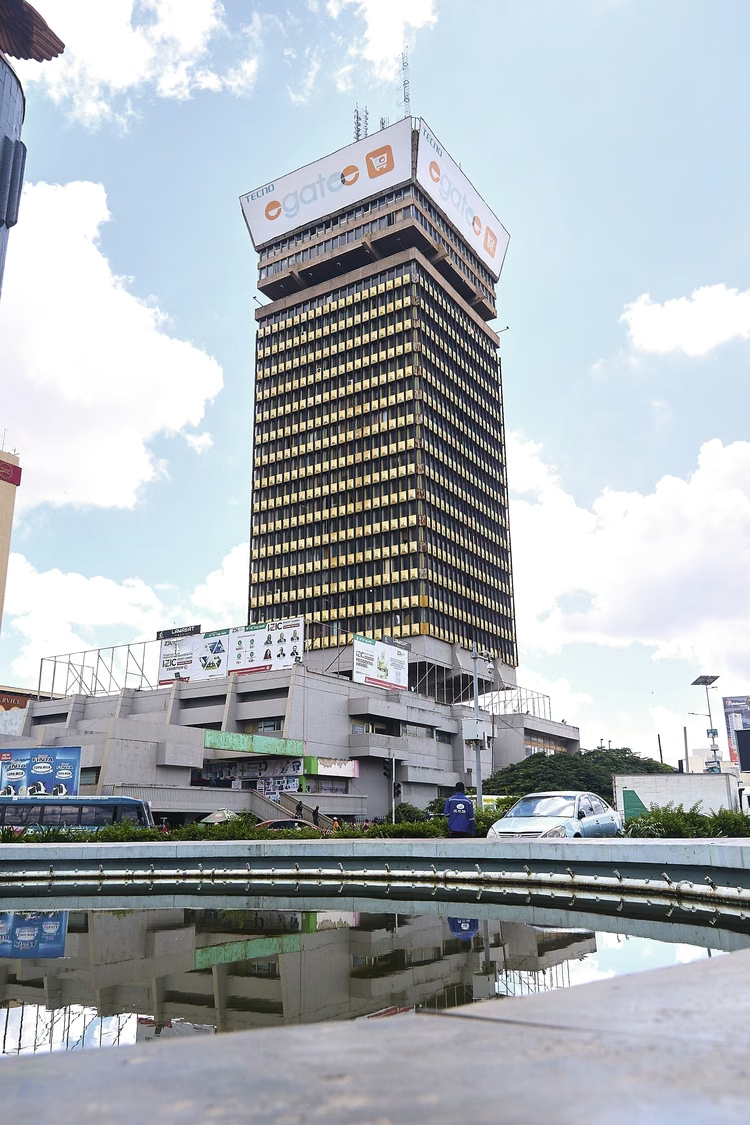
At the road’s other end, where Cairo Road meets Independence Avenue, Findeco House stands with a different kind of authority. Built during the 1970s, it rises with the confidence of a young republic imagining itself upward. It is not a shy building. Its concrete form belongs to an era when architecture was asked to express ambition: height, permanence, modernity and economic belief. The tower’s floors are cantilevered from a central pillar, giving it a gravity-defying appearance. There is something almost symbolic in that: a building that seems to test the courage of concrete.
Today, it continues to operate largely as office and retail space, altered by time, signage and the practical life of the city. But it still holds the drama of its original intention. It still asks us to look up!
Cairo Road is not polished heritage. It is noisy, crowded, layered, impatient and alive. That is what makes it honest. It holds the colonial city and the independent republic, the old shop and the modern tower, the mural and the monument, the meal and the memory.
It reminds us that Zambia was not only declared into being. It was built, walked, argued over and loved.
So when someone says, “I am going to town,” perhaps they are saying more than they know.
They are returning, even briefly, to one of the places where Zambia first learned how to see itself.