At almost every Zambian funeral, a collection goes around. Someone from the family stands at the gate or moves through the mourners with an envelope or a tin, collecting whatever people can spare, because the burial has to happen and there is rarely enough money set aside for it. It is such a familiar ritual that most of us have never thought to question it. Maunga Kwenda has, and the comparison he keeps coming back to is uncomfortable. Whatever gets collected in that one desperate afternoon, he says, would often have covered a full year's premium for everyone who gave.

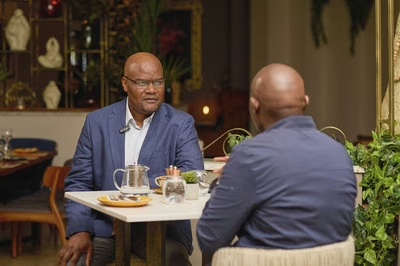
The tension between what a proper safety net could do and what Zambians actually reach for in a crisis sits at the centre of Maunga's life and work. He is the Chief Executive Officer of Sanlam Life Insurance Zambia, and I met him for lunch at The Royal Dil, a restaurant tucked inside Acacia Park that has hosted many a private event and still manages to feel like the best-kept secret in Lusaka. Over fried rice and kadai chicken (no chilli, at his insistence), we talked about why an entire country still treats life insurance as something closer to a curse than a plan.
The resistance, in his telling, isn't really about money. It's about what asking for a policy implies. Ask a relative for their ID number so you can put funeral cover on them, and the answer is rarely gratitude. “Why are you putting a policy on me? You want me to die?” Maunga says, recalling a conversation he's had more times than he can count. We have come to believe that planning for death is what invites it.

He has an answer he often reaches for, one that has stayed with me since the interview. In Maunga’s reading of the story, Joseph of Arimathea had prepared a tomb for his family years earlier, before Jesus was buried there. “There's nothing wrong with planning ahead,” Maunga says, “because in life, there are two certain things. One is born, and one will die.” It is a case for insurance built on theology, and it lands somewhere a sales pitch never could.
Maunga did not arrive at this argument from the outside. Insurance is the family trade. His father built one of Zambia's major insurance brokerages and still chairs it, and university came with a condition attached: "study whatever you like, but work for me while you do it." Two of Maunga's brothers went into the industry too. One now runs a competing insurance company; the other runs the brokerage their father founded. Three companies, one family, occasionally on opposite sides of the same tender. "We are in fierce competition, but we don't talk about work at family dinners anymore," Maunga chuckles.
He tried to leave the industry once, training as an accountant and doing a year in banking, before insurance pulled him back in. He credits a second influential mentor, Florence Kazhanje, a CEO who inherited him as a young finance manager and refused to let him hide in spreadsheets, pushing him into client presentations before he felt ready. He called it being pulled out of his ‘accounting shell’.
What fascinated me most is how Maunga thinks about life insurance, less as a hedge against disaster, more as a wealth tool. He describes a ‘Rockefeller method’, in which a policy pays into a family trust rather than directly to individual heirs, so the trust keeps insuring each generation that follows, in perpetuity. “It's one thing to create wealth,” he says. “It's another to be able to preserve it. You need a different set of skills.”

He is equally candid about how far the industry has to go. Insurance penetration in Zambia sits below 2 per cent of GDP, well behind Botswana and Namibia, where not carrying funeral cover is seen as irresponsible. Sanlam is piloting a mobile-money product that would bring cover down to roughly K10 a week, and Maunga is advocating for compulsory group life assurance for any employer in Zambia with ten or more staff, pointing to Malawi’s employer life cover requirement.
Away from the office, Maunga is harder to pin down than his job title suggests. He describes himself as a reader who has slipped into being more of a book collector. The title he keeps returning to is Dale Carnegie's How to Win Friends and Influence People, picked up during a difficult stretch in his twenties; he still lends it out to colleagues on the condition that they return it. His leadership style borrows from Formula One: a driver on the podium has really only contributed about 10 per cent of the result, he says; the rest comes from the crew that changes tyres in under three seconds. “I may stand on the podium on behalf of the company, but ninety per cent of the work is done by the team.”
The Sanlam Group sponsors the Cape Town Marathon, and Maunga takes part most years, though he draws a firm line at how far he will run, leaving the full 42 kilometres to colleagues he calls ‘running junkies’. Given the choice, he would rather walk than run. When it comes to personal goal-setting, he prefers smaller, yearly targets that he can track and comfortably abandon if one turns out to be unrealistic, a habit he picked up from a former boss who reviewed family goals with his children twice a year.

Some of that discipline traces back to his childhood dinner table, where his father insisted on proper manners and sitting up straight. “The world is not for humble people,” his father used to tell him, a line that made little sense to Maunga as a boy and has only settled into meaning as he has grown older. He now passes that same insistence on discipline to his own son, a two-year-old who inspires him daily.
When I ask what he wants to have achieved the next time we sit down together, he doesn't reach for a growth figure. He talks about simply wanting to be, in his own words, “a good example to my son,” and about an agent on his sales team who flew for the first time this year on an incentive trip to South Africa and texted him afterwards to say the experience had changed how he saw his own work. “More than hitting certain numbers,” Maunga says, “being able to make a difference in the life of fellow Zambians will really, really be something impactful.”