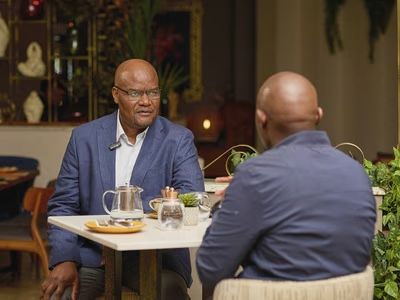
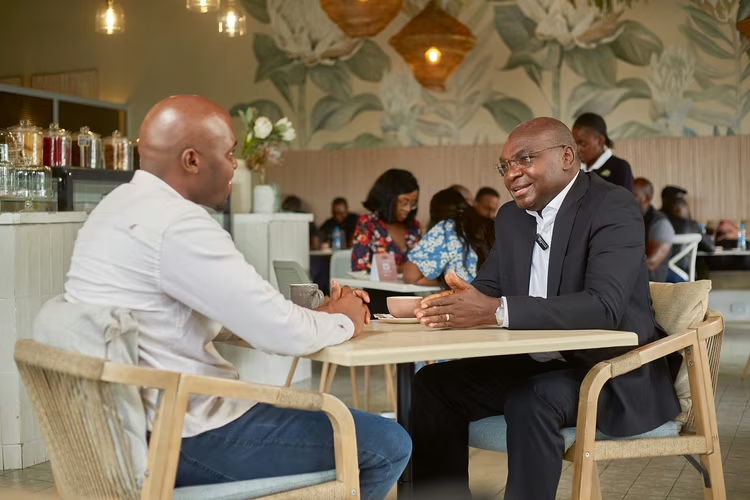
Mint Restaurant at Agora Village has a way of making conversations feel intentional. Perhaps it is the calm atmosphere or the fresh flavours, but it consistently creates the right environment for meaningful dialogue. It was here that I met Kakenenwa Muyangwa, Chief Executive Officer of Zambia Consolidated Copper Mines Investments Holdings Plc (ZCCM-IH). From the first few minutes, it was clear that this would not be a conversation about mining alone.
There is an unmistakable quality about Kakenenwa. He belongs to what I describe as Zambia’s iron generation, the cohort born in the 1950s and early 1960s, who were among the first to access international education and return to build the country’s core industries. They were the engineers and executives who shaped the nation’s mining houses and infrastructure networks. As he speaks, there is a steady groundedness. “We were given opportunities our parents never had,” he tells me. “When you come from that background, you can’t take it lightly. You have a responsibility to use them well.”
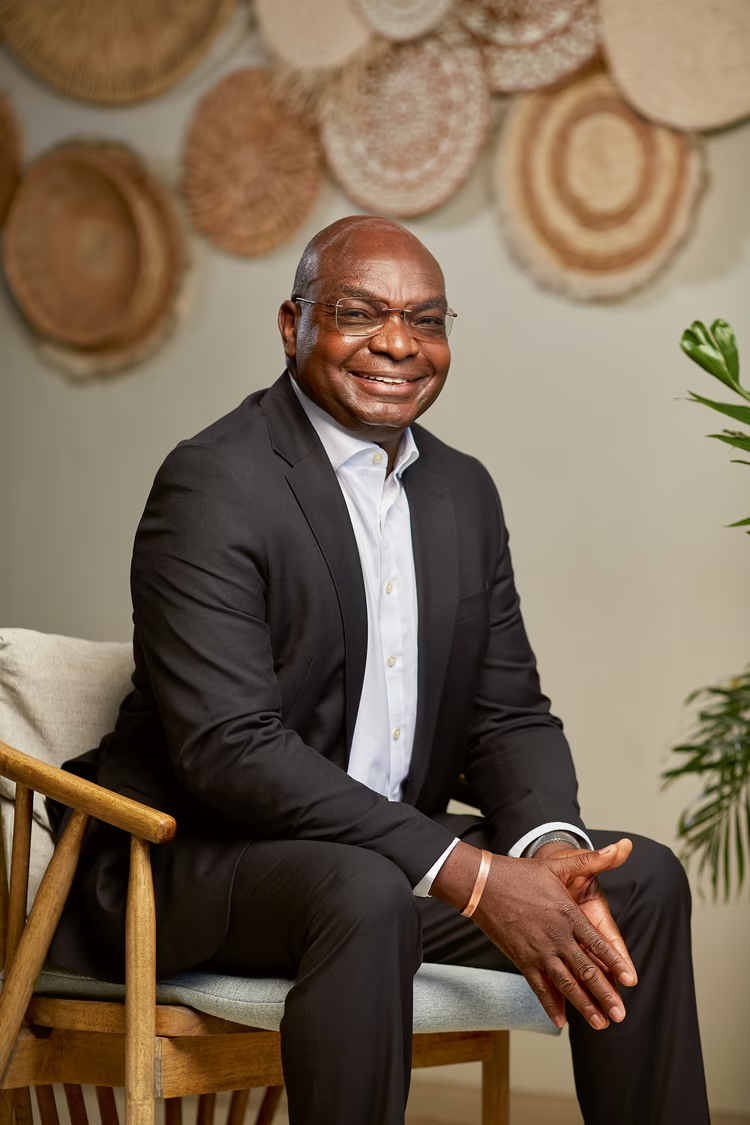
His story begins far from the boardroom. Raised by a single mother in Mongu, Western Province, his parents divorced when he was still a baby. Village life influenced him in ways that no formal education ever could. “Growing up in the village, my mother taught me the value of self-sufficiency,” he says. “She used to tell me a saying in Lozi, ‘A cow does not fail to carry its own horns’.” It was her way of teaching him that responsibility is not optional but a means of survival. This ethos continues to guide him to this day.
From a young age, work was simply part of life. Helping in the fields, tending to chores and understanding where food comes from all formed his relationship with effort and time. “It wasn’t child labour,” he explains, smiling. “It was learning. Learning where your food comes from and understanding the skills that are required.” He learned early that patience is not passive. “In farming communities, you learn the value of time. If you give anything enough time, it will grow.” That philosophy still shapes how he looks at career, leadership, and institutions. “Work accumulates over the years,” he says. “If you are not working, what will you be doing?”
Another powerful influence in his life was his maternal grandfather, who lived with them. “He taught me the value of reading,” Kakenenwa recalls. “He would make me read the newspaper for him.” That simple habit opened a new world. Stories from across the country, politics, business, and social issues, all poured into his young mind. “All these stories were jumping out at me. That curiosity has stayed with me.” Even now, he admits, he learns things for no reason other than interest. “Some time back, I started learning calligraphy and have also attempted to learn French, just for the sake of it,” he laughs.
Interestingly, mining was not part of his childhood dreams. “I actually wanted to pursue medicine or aeronautical engineering,” he tells me. “I wanted to be challenged.” It was a presentation at his school by ZCCM that shifted his thinking. “I knew nothing about mining, but I was intrigued by how central mining engineering was to operations.” That fascination led him to pursue the opportunity, and he was awarded a scholarship to study mining engineering at the Royal School of Mines in the United Kingdom.
Returning to Zambia as a young engineer, he noticed an unusual trend. Many engineers were moving into financial roles and earning significantly more. “I knew these guys,” he says, shaking his head. “They knew nothing about accounting; they were technical like me.” On closer investigation, he made a discovery: “Engineering requires precision, mathematical thinking and logic,” he explains. “That made mining engineers attractive in finance. Our UK-based training gave us exemptions, and we could progress faster.” So he made the shift, joining the then Pricewaterhouse (now PricewaterhouseCoopers) in Lusaka. It was the first major reinvention in a career that would later be defined by adaptability.
After many years in finance, he returned to mining at Konkola Copper Mines (KCM), where he established the marketing unit. At the time, Zambia was exporting copper almost exclusively to Japan. “We needed to open new markets,” he says. Under his leadership, KCM began exporting to Egypt, Thailand, Malaysia and China. It was a strategic move that broadened Zambia’s commercial footprint and reduced dependency on a single market.
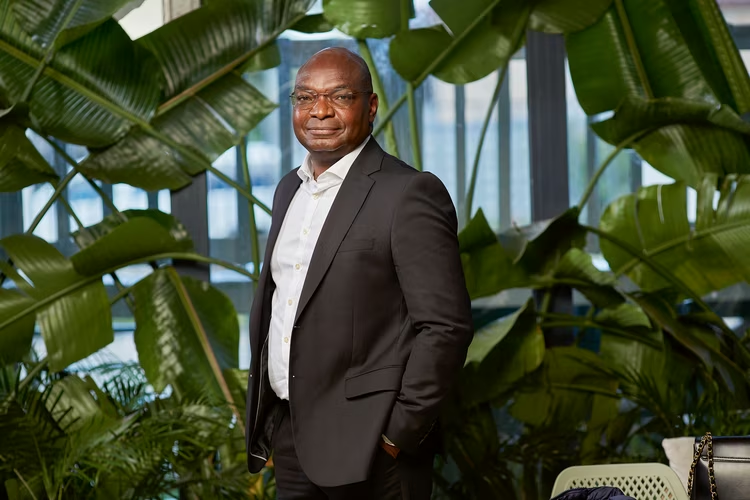
Following a diverse career in various industries, he joined the ZCCM-IH board as Board Chair in 2023 before being appointed CEO. It is a role that places him at the heart of Zambia’s economic future. Zambia has set an ambitious target to mine three million tonnes of copper by 2031, aiming to rival the DRC, and ZCCM-IH is a key part of that mission. “We [ZCCM-IH] should take our rightful place in the mining and energy sector,” he says. “We should show what we can do on the national stage.”
He is acutely aware of the weight ZCCM-IH carries in the national psyche. The old ZCCM was not just a mining company. It ran schools, hospitals and entire townships. “It was an all-encompassing company,” he reflects. Its collapse during the privatisation era was a huge blow, but he is clear-eyed about the lessons. “You cannot be an island of success in a sea of poverty,” he says. “We work with the companies we have stakes in to ensure communities are not forgotten.”
Under his leadership, ZCCM-IH is positioning itself as a strategic investor rather than a mine operator. The company holds significant stakes in Mopani Copper Mines, Konkola Copper Mines, Maamba Collieries and Copperbelt Energy, and is also making an aggressive move into renewable energy. “We have 2,000 hectares in Lufwanyama,” he tells me. “We decided we are going to use it for farming, just a different kind,” he jokes, referring to solar farming.
One of the most complex challenges on his desk is the surge in artisanal mining across the country. “Zambia is copper-centric,” he explains. “Our focus has always been on copper, but we have known we have other minerals.” The explosion of gold activity has exposed gaps in regulation and structure. “Mining has to be safe, it has to be formal, it must be secure, and there has to be formal trade so that what belongs to the fiscus is captured.”
Despite the weight of his role, he remains deeply grounded. For relaxation, he enjoys walking in the early mornings. “It allows me to start thinking,” he says. It is a small habit, but with exponential results on his life and work. He also enjoys reading, learning, and, most importantly, spending time with family.
As our conversation draws to a close, he reflects on his generation. “We are the generation that didn’t have direct experience of colonialism,” he says. “We had free education. In my case, I received a scholarship to the UK straight from the village. We had incredible opportunities.” While he is not nostalgic, he remains hopeful of the next generation. “I think there is another generation coming that will do the same.” I joke that it must be those of us born in the 1990s. He laughs and nods.
As we part ways, it is clear that Kakenenwa Muyangwa is not driven by legacy for its own sake. He is driven by work, responsibility, curiosity, and the discipline he learned in a village in Mongu many years ago. In a country searching for steady hands and long vision, his current positioning feels both grounding and timely.
About Mint Agora
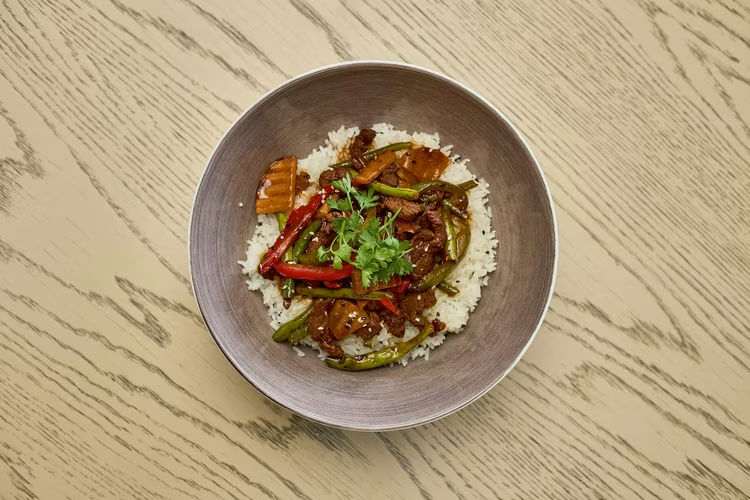
Mint Agora is yet another twist on the Mint family of restaurants. Located inside Agora Village, it is the earthy, nature-inspired sister to Siesta Mint. It is the perfect location for dinner, all-day brunch, good food, good vibes and cocktails around the clock.