This year, First Quantum Minerals marks 30 years in Zambia. The company began in 1996 with a modest ambition, producing about 10,000 tonnes of copper a year, and has since grown into one of the largest copper and nickel producers on the continent.
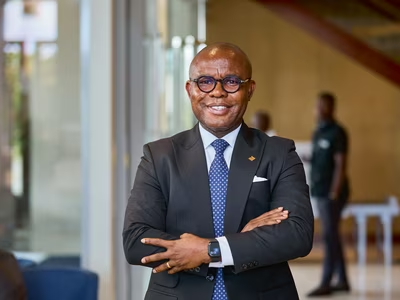
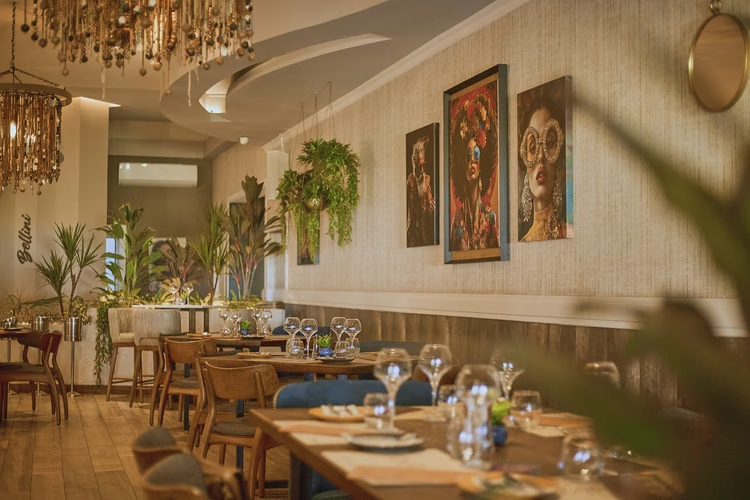
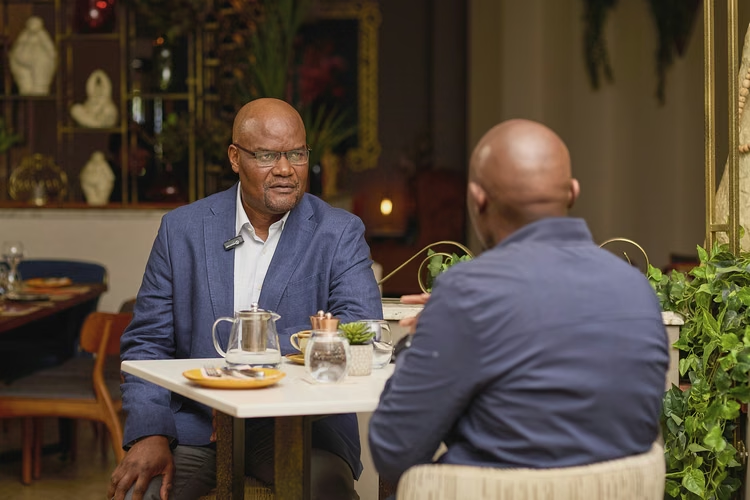
I met Anthony Mukutuma, Country Director of First Quantum Minerals Zambia, for lunch at Bellini, one of Lusaka’s finest dining rooms, tucked away in the Showgrounds and overlooking the polo fields. Anthony carries the easy-going confidence of a man who has spent thirty years moving between mine sites, countries and boardrooms. We settled in and went straight into it.
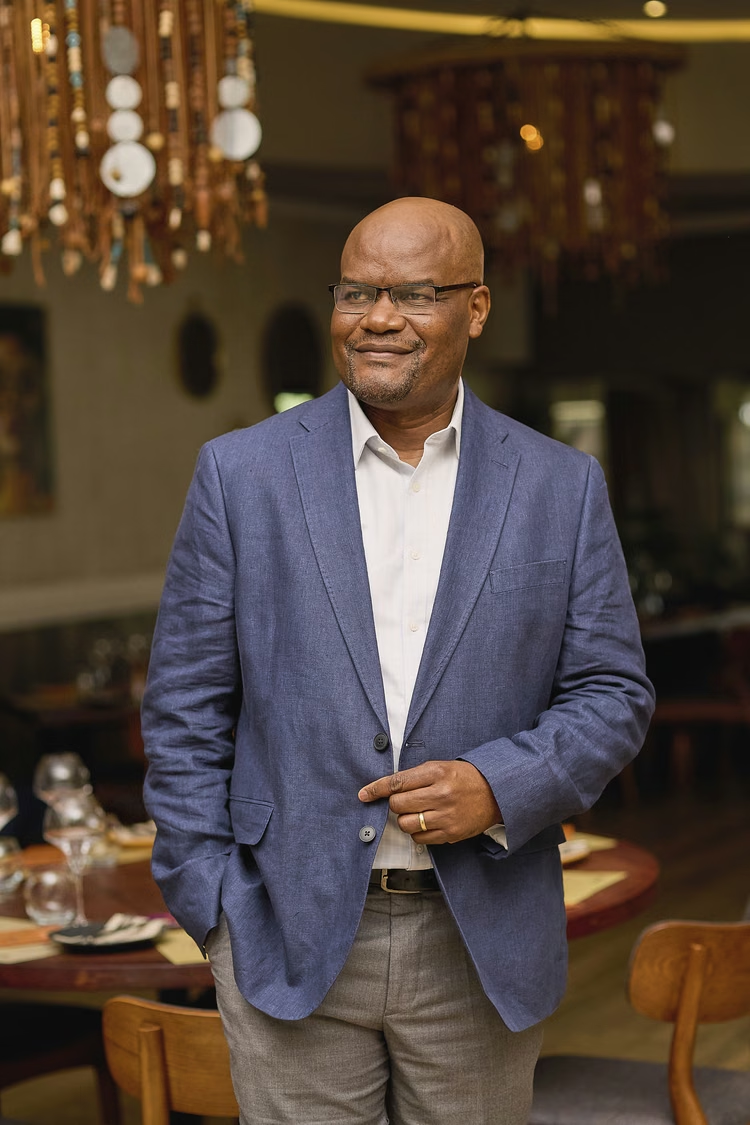
Anthony is a chemical engineer by training, and for the better part of his career, he was a metallurgist, a man of pipes, pumps, slurry and microscopes. Today, he sits atop First Quantum's entire Zambian operation, a role far removed from the technical world he cut his teeth in. "I like to see it as coming from the metallurgy side into the more strategic," he tells me. "That journey started at 22. Thirty years on, I'm still at it."
Anthony grew up in Kabwe, on the main street in the middle of town, the son of a civil servant, in the shadow of the old zinc and lead mine. He left for Kitwe at 18 to complete his A-levels at Mpelembe, studied chemical engineering with a focus on minerals, and briefly worked in the water industry in the UK before deciding, within a few months, that it was not for him. He returned to Zambia and joined Zambia Consolidated Copper Mines in Chililabombwe, where he says he "cut his teeth" in the industry. He credits two early mentors, Mr Abraham Musonda and Mr David Ng’andu, with reshaping how he saw himself. "I thought I was a superstar," he laughs. "They told me, yes, your skills are good, but you are far more impactful working in a team." He joined First Quantum in 2002, where he spent over a decade working under a notable mentor, the late Philip Pascall, the company's former chairman and CEO, a man Anthony remembers for his uncanny ability to remember the names of ordinary workers across a mine site and details about their families. "It's all about the people," Anthony says. "If you want to build a great business, you need a team connected at a much deeper level than just producing copper."
The shift from technical work to people management, he admits, was the harder of the two transitions. Somewhere around 2010 or 2011, he moved from designing process plants into operational management, trading machines for people. "Machines are easy. If I draw a line, it's from there to there," he says. "If this was people, that line is all over the place." He spent seven years being mentored and coached by various organisations in London to make that shift, learning to listen rather than to dictate. That grounding carried him through general manager roles in Mauritania, Finland and Australia, before delivering him back to Zambia. He has now been in the country director role for a year and nine months. "The only certainty I have," he tells me, "is that I'm still learning."
To understand the scale of First Quantum’s operation in Zambia, Anthony walks me through the business: Kansanshi, the flagship mine near Solwezi, is a complex operation that combines oxide and sulphide processing, a concentrator, a smelter, a leach plant and a gold circuit, and is home to the US$1.25 billion S3 expansion project. About 150 kilometres away sits Kalumbila, home to the Trident operation, which houses Sentinel, one of the continent's largest copper mines, and Enterprise, one of Africa’s largest operating nickel mines, which is projected to produce between 30,000 and 40,000 tonnes of nickel this year.
For Anthony, though, the mine cannot be the whole story. "Our business in Zambia is not only about the technical output of copper," he says. "It's about the value that our business brings to the country, and to the communities." That philosophy shows up in the company's sponsorship of sporting events across the North-Western Province, as well as a conservation farming programme, the newly commissioned Wumi Mini Hospital in Kalumbila, alongside various educational programmes at Sentinel Kabitaka School, Trident College, Frontier Nkisu School and Kwambula Training Institute, which focuses on vocational skills. It also funds scholarships for more than 40 students at the University of Zambia and the Copperbelt University, largely in geology, metallurgy and surveying. "We're setting the map to make sure our employees of the future come from the local areas," he says. "There's a pipeline."
Where Anthony gets most animated, though, is on the question of local content. First Quantum spent US$2.1 billion with Zambian-registered suppliers and contractors last year alone, a figure he is visibly proud of, but one he believes could be dramatically higher. To this end, First Quantum has successfully negotiated with banks across Zambia, offering the certainty of a signed order as security. "For the first time, suppliers in Zambia will have access to finance to become suppliers and contractors to the mines," he says. "And because there are several banks, suppliers can make the banks compete for their business, rather than take whatever is offered."

Our conversation turns to the artisanal mining boom that has gripped the country in the last three years. Anthony is quick to correct a common misconception. "Let me be clear to anyone who reads this: artisanal mining is not illegal," he says. What is missing, in his view, is not legislation but education on licensing requirements for artisanal, small-scale and large-scale mining in Zambia, as well as financing opportunities for aspiring miners. He points to Morocco, where family-run copper mines producing 30 tonnes a year have operated for over a century under a proper licensing regime.
Outside of work, Anthony is, somewhat unexpectedly, a musician, having played the keyboard and drums in bands since university and, more recently, the bass guitar, a habit he picked up while working in Australia. Kenny G is his favourite artist, and he tells me about seeing him perform in Cape Town last October. He is also a keen runner, logging short weekday runs and a long Saturday run of 21 kilometres with his wife and friends near his home in State Lodge. "Where else would you want to be," he asks, "than early in the morning with friends and family?"
As our lunch wound down, I asked him where he saw himself in five years. He turned the question back towards the country. "I would like us to be debating mining companies we can't count on one hand anymore," he said. It is, in its way, the same conviction that runs through everything else he told me over that meal: that Zambia's copper story is still, after more than a century, largely unwritten, and that the work ahead is not to protect what has already been found but to go looking for what has not.
ABOUT BELLINI
Bellini Restaurant occupies a corner of the Lusaka Showgrounds, off Nangwenya Road; its dining room is framed by views across the polo fields. Copper and wood chandeliers, greenery and low lighting define the room. Open Tuesday to Sunday for lunch and dinner from 11:30; reservations are recommended.