
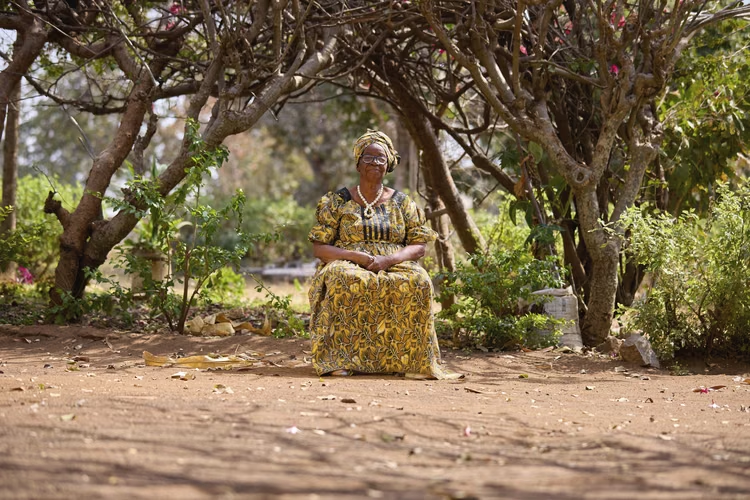
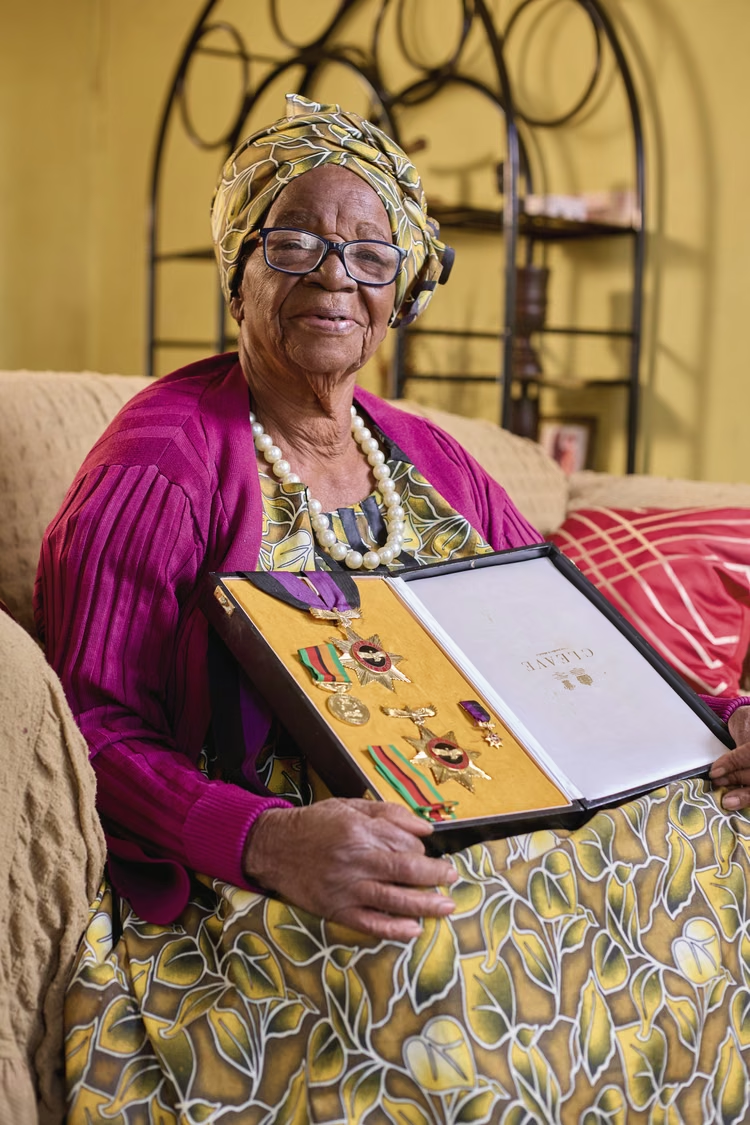
The first thing you notice is not the medals. It is the land: green and sprawling, lush with flowers and stretching wide to touch the blue sky. Mama Betty Chilombo Chilunga walks slowly now, but with the firm dignity of a woman who has lived through history.
She eats from this land. She raised her family on this land. And decades ago, she fought for this land. Today, when she looks at the Zambian flag, she does not simply see colours. She sees something else.
Every Zambian child learns the meaning of the national flag. Green stands for rich natural resources and fertile land, black for its people, orange for its mineral wealth and abundant copper, and red for the struggle and sacrifices made for independence. The fish eagle soars above the stripes, symbolising Zambia’s ability to rise above its challenges. It is one of the first civic lessons children are taught in school.
Before there was a flag to learn about, there was Northern Rhodesia, a British protectorate initially administered under Royal Charter by the British South Africa Company, with responsibility passing to the British Colonial Office in 1924. From 1953 to 1963, Northern Rhodesia was part of the Federation of Rhodesia and Nyasaland, an arrangement fiercely opposed by African nationalists who believed it delayed majority rule.
From this colonial period, a generation of extraordinary Zambians emerged: Kaunda, Kapwepwe, Nkumbula, Chona and Betty Chilombo Chilunga.
Born on 1 January 1938, Betty entered a world where opportunity depended largely on race.
As a young woman, Betty attended the renowned Chipembi Girls' School in 1957, one of the country's earliest schools for African girls. There, she was placed in House 13 and was surrounded by classmates whose families were already involved in nationalist politics, including Lily Monze and the daughters of Harry Mwaanga Nkumbula. Dialogue opened her world to questions: what were they learning, who was teaching them, and why were all their teachers white?
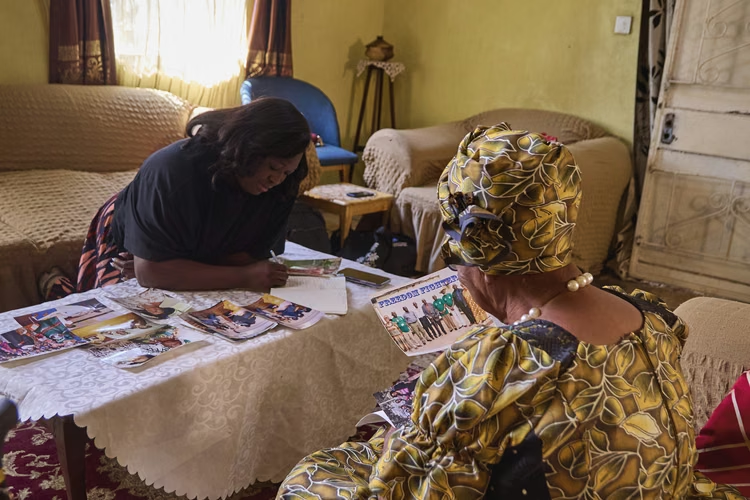
In the rising of questions, they learned. They began to understand that their education could also become an instrument of liberation.
She later trained as a teacher, even as another calling developed.
“I did not plan to become a freedom fighter,” she recalls. “But we saw how things were going. Enough was enough. We had no choice but to play our role.”
Dialogue became a tool for liberation and survival, and though the flag bears red for struggle, Zambia’s freedom was won through the force of unity rather than sustained armed conflict.
Betty and Harrison Chilunga met and grew up two villages apart. While he trained to become an African Clinical Officer, his mind stayed on Betty. The pair fell in love, married on 17 July 1958 and started a family in what is now North-Western Province.
He worked at Queen Elizabeth Hospital, and she taught at Balovale Government School, but over time, the questions arose again. No matter how hard they worked, the opportunities were never equal. Women gave up their jobs to give birth and nurture their babies because there was no maternity leave, and nobody asked why.
This inequality drew the Chilungas towards the liberation struggle. Their home in Zambezi became a refuge for freedom fighters travelling across Northern Rhodesia to organise communities. Meetings took place in their home, and cryptic messages were relayed. Under the constant threat of colonial surveillance, freedom called for self-restraint, sacrifice and trust.
“There would be a meeting inside the house at night, and my husband would take the minutes. I would be outside, with our baby on my back. I would stand guard and knock once if there was danger, and they would blow out the candle and hide. When it was clear, I would knock twice, and the meeting would continue.”
To anyone passing, she looked like an ordinary young mother watching over her household. She was a teacher by day and a key part of politics by night.
She also remembers an unlikely ally. “We were not alone in the struggle. We had a very good neighbour, Sam Snaper, who was a mixed-race man. He drove a grader, and we trusted him to move supplies to freedom fighters in other locations because we knew no one would suspect him.”
Betty devoted herself to organising women in her community. Through the Balovale Welfare Society, she encouraged women to develop practical skills to support the movement. Under her leadership, the Kapwepwe Women’s Club became the Kaunda Women’s Club, with each member recruiting 30 other women. Literacy classes, baking, hospitality and food preparation became acts of empowerment as much as domestic training.
As branches multiplied, so did confidence. The women became organisers, educators and mobilisers, proving that the struggle belonged as much to mothers and teachers as it did to politicians.
Then came Cha-Cha-Cha. As national frustration intensified, civil disobedience peaked. Mama Betty remembers one act above all others.
“Marriage certificates were the only acceptable documents for a woman travelling. Single girls could not travel. Even the men needed colonial passes, vitupa. These documents were very important and served as passports that white soldiers and district commissioners would inspect. It was an offence to tamper with them.”
“One of the master plans of UNIP was to burn those documents. I organised the women to take their marriage certificates and steal their husbands’ vitupa as we prepared to burn them. UNIP members made a small timber coffin, and we gathered at the Welfare office, poured paraffin and lit the fire. There was jubilation! We danced. That day felt good!”
To destroy the pass was to reject a system that controlled where Africans could live, work and travel. The coffin symbolised the political death of the Federation and their songs summoned a liberated era.
As a veteran, Mama Betty has spoken publicly on constitutional reform, advocating recognition and support for liberation veterans, as well as constituency delimitation.
She has not forgotten the joy of seeing Northern Rhodesia disappear and Zambia take its place on the world map on 24 October 1964.
When independence arrived, it arrived everywhere. The struggle had been fought village by village, district by district, town by town. In Zambezi, where Betty lived, the celebrations carried their own rhythm.
“It was a jubilation! People gathered at the Boma in Zambezi. There was plenty to eat, chicken, munkoyo, brewed beer... everyone brought what they had, and there was more than enough. We drummed, danced and sang from 23 October until the next day. There were Makishi dances, football matches and a full day of celebration.”
Independence was not the end of Betty Chilunga's public service. She continues to serve her church, her community and her country.
Today, she lives on her farm and eats from the land she fought for. She is proud of how far we have come, and of the Zambia we have.