Why Work-Life Balance Feels Impossible
The phrase "work-life balance” feels like a foreign concept to many people. Between juggling a high-demand job, self-development, and making time for the people and things that matter, everyone wishes for a 25th hour. The idea that work ends the moment someone leaves the office at 17:00, or that your personal responsibilities will wait until after then, is flawed. That is far from what we have on the ground.

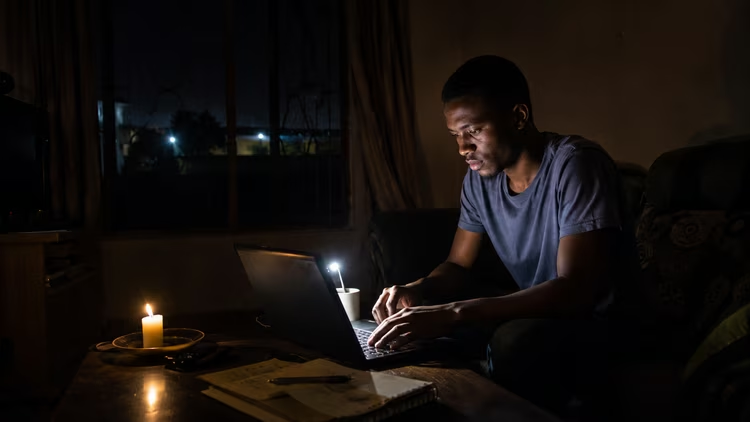
For most employees, especially in fast-moving sectors such as banking, healthcare, retail, media, and corporate administration, work is part of daily life. A manager joins a conference call in traffic, an intern responds to emails during load shedding, lit by a phone torch. Someone takes a call outside at night because the house is too noisy. It is often an adaptation to economic and practical realities. The challenge is learning how to manage that integration without allowing work to consume every available hour.
Zambia’s Employment Code Act No. 3 of 2019 provides clear minimum standards for employee welfare and leave entitlements. After completing 12 consecutive months of service, an employee is entitled to at least 24 working days of paid annual leave. Employees are also entitled to paid sick leave, with up to 26 days on full pay and an additional 26 days on half pay within 12 months, provided the illness is certified by a registered medical practitioner.
Maternity leave is set at 14 weeks on full pay. In cases involving multiple births, cesarean sections, or pregnancy-related complications, an additional four weeks may be granted upon medical recommendation. Fathers are entitled to five continuous working days of paternity leave following the birth of a child. These provisions are often treated as administrative requirements, yet they serve a broader function. Rest should not be a reward after exhaustion but a requirement for maintaining a functional workforce. The World Health Organisation defines health as “a state of complete physical, mental, and social well-being and not merely the absence of disease or infirmity.” Employees should not need to fall ill to justify time off.
The Hidden Cost of Burnout
Many companies are beginning to recognise that burnout carries measurable costs. Employees experiencing chronic stress often show reduced concentration, lower productivity, increased absenteeism, and higher turnover. In customer-facing roles, burnout affects communication and decision-making. Staying online until midnight replying to WhatsApp messages or emails rarely turns a tired employee into a productive one. Chronic work-related stress activates the body’s stress response, leading to sustained release of cortisol and adrenaline. Over time, this affects cardiovascular health, immune function, and metabolic stability.
From the employer’s perspective, overwork may appear as commitment in the short term, but it rarely produces sustainable performance. Teams that are consistently exhausted become reactive rather than strategic. Often, without noticing, teams begin to resent management. A tired team can be more damaging than an absent one. Employees, however, also need practical systems that work within the realities of life. Complete separation between work and personal responsibilities is rarely realistic. Many people are balancing side businesses, caregiving responsibilities, unreliable connectivity, and extended family obligations alongside formal employment. What helps is structure.
One useful approach is time-blocking. Many employees schedule meetings down to the minute, yet leave lunch to chance. Blocking out 45 minutes for lunch and leaving the desk can improve concentration in the second half of the workday. Even stepping outside or eating away from the laptop creates a mental break. Employees who work for hours without interruption often mistake fatigue for productivity, and tired work is often substandard.

Out-of-office etiquette also matters more than many workplaces admit. If an employee is on approved leave, there should be clarity on who handles urgent matters in their absence. A proper out-of-office email is not laziness or lack of commitment. It is part of professional workflow management. Constantly contacting employees during leave defeats its purpose.
There is growing value in visibly ending the workday. Logging out, closing the laptop, and turning on Do Not Disturb sends a healthy signal that work has boundaries. Not quitting the job, but visibly ending the workday. Logging out. Closing the laptop. Turning on Do Not Disturb. Avoiding non-urgent WhatsApp replies late at night should not be limited to personal or family status.
For many younger professionals, especially entry-level staff trying to prove themselves, there is pressure to appear permanently available. The result is often early exhaustion, sometimes within months. Boundaries do not need to be dramatic to be effective. Something as simple as muting work-related WhatsApp notifications after 19:00 can create breathing room.
Building Sustainable Work Habits
Work is unlikely to slow down anytime soon. The city is growing, and technology has blurred many boundaries between office and home. The goal is not to chase a perfect balance that does not reflect reality, but to build healthier systems within the reality people already live in.