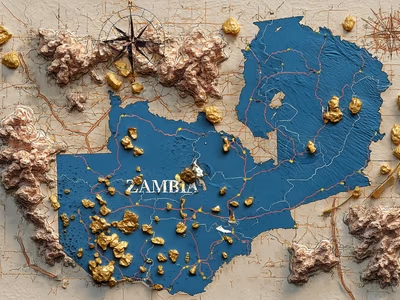
Being landlocked has often been cited as one of the most significant economic handicaps a country can face. With about 77 per cent of the globe’s 195 countries boasting a coastline and access to maritime activity, it is a relatively rare constraint. Zambia is one of 44 landlocked countries worldwide and one of 32 classified by the United Nations as landlocked developing countries.
Landlocked countries face several economic and logistical challenges. Without direct access to critical ports and harbours, participation in global trade requires relying on the ports, roads and railways of neighbouring countries. This can lead to higher transport costs, additional customs clearance fees, longer transit times and greater vulnerability to political tensions or policy changes in those countries. Imports become more expensive, and exports are less competitive. As noted at the Third United Nations Conference on Landlocked Developing Countries, held in Turkmenistan in 2025, landlocked developing countries (LLDCs) pay more than twice as much as their coastal neighbours in transport costs to move goods to and from overseas markets. These countries can also attract less foreign direct investment than coastal economies due to higher trade friction and reduced market access.

Landlocked to Land-Linked
While the challenges are undeniable, this is not the whole story. Zambia’s geographical position also presents clear advantages and opportunities, which Zambia is increasingly seeking to exploit. Over the past several years, economists, policymakers, business leaders and academics have increasingly used the term “land-linked” rather than “landlocked”. This reflects the view that Zambia’s position at the heart of south-central Africa is an economic advantage. The country has eight neighbours and is situated along multiple transport corridors leading to both the Indian and Atlantic oceans. This is a strategic position rather than an inherent disadvantage.
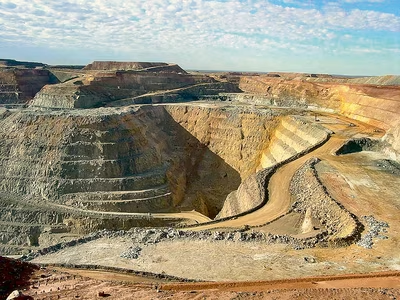
Zambia is one of the world’s largest copper producers, and its economic growth may well depend on its ability to transport this vital metal. The country produced over 890,000 metric tonnes of copper in 2025, an 8 per cent increase from the previous year, and is targeting 3 million tonnes by 2031. Meeting such ambitious goals will require substantial investment in roads, rail and border infrastructure. Zambia’s trade ambitions extend beyond copper, with an increasing focus on other minerals and non-traditional exports, reinforcing the importance of its transport corridors.
Crucial Corridors
One of Zambia’s most developed transport routes is the North-South Corridor, which links Zambia and the Democratic Republic of the Congo (DRC) and runs southwards to the Port of Durban in South Africa. It is considered the backbone of the Southern African Development Community (SADC) region and one of its busiest trade routes, facilitating the movement of minerals, fuel, agricultural products and manufactured goods.
The corridor carries over 60 per cent of SADC trade. Its wider network encompasses approximately 10,000 km of roads, while the main railway route spans over 3,000 km from Durban through Zambia to the DRC. SADC has endorsed plans to transform the route into a “smart economic corridor” that promotes industrialisation alongside transport infrastructure. Under the proposed pilot programme, economic zones, manufacturing activities and value chains could be developed along the route. SADC estimates that the initiative could generate an additional US$16.1 billion in regional GDP and create approximately 1.6 million jobs. The concept was endorsed in 2025, with the pilot programme expected to begin in 2026.
To the northeast, the Dar es Salaam Corridor provides access to the Indian Ocean through Tanzania. It includes both road and rail transport, notably the historic TAZARA railway, completed in the 1970s as a major regional infrastructure project. Stretching about 1,860 km between Dar es Salaam and Kapiri Mposhi, TAZARA remains an important link to the Indian Ocean despite ageing infrastructure. A US$1.4 billion revitalisation programme with China Civil Engineering Construction Corporation (CCECC), launched in 2025, has entered its implementation phase, with plans to rehabilitate the railway and provide new locomotives and wagons.
Another route is the Walvis Bay–Ndola–Lubumbashi Corridor, which gives Zambia access to Namibia’s Atlantic coast. Stretching more than 2,500 km, it offers transit times of three to five days to major centres such as Lusaka, Ndola and Kitwe, providing an Atlantic alternative to Zambia’s eastern and southern routes.
The Lobito Corridor and New Investment Flows
The Lobito Corridor, which currently connects the DRC to Angola’s Atlantic coast and is being extended into Zambia, has become one of Africa’s key transport and logistics projects. The planned Chingola–Luacano railway is expected to reduce export times from around 35 days to about one week. It has attracted major international backing, with the Africa Finance Corporation seeking US$3–5 billion in financing. The European Union (EU) is mobilising over €2 billion through its Global Gateway initiative, while the US International Development Finance Corporation is providing a US$553 million loan to upgrade the existing railway and mineral port infrastructure in Angola. In June 2026, Zambia and the US also agreed to expand a US$491 million programme to support infrastructure linked to critical minerals and the corridor.
Key Infrastructure and Regional Integration
Border infrastructure plays a critical role in regional trade efficiency. Zambia’s major border posts have been upgraded in recent years to reduce bottlenecks and improve clearance times.
At the Kazungula Border Post, the state-of-the-art Kazungula Bridge has replaced the former ferry crossing between Zambia and Botswana, improving connectivity along a key regional trade route and easing congestion at one of Southern Africa’s busiest crossing points.
The Chirundu Border Post remains a key gateway on the North-South Corridor, while Nakonde connects Zambia to Tanzania and East African markets. These border posts are central to reducing delays in freight movement.
Zambia’s role as a regional trade hub is reinforced by membership in the Common Market for Eastern and Southern Africa (COMESA), SADC, the Tripartite Free Trade Area and the African Continental Free Trade Area (AfCFTA). By providing frameworks to reduce trade barriers and facilitate the movement of goods, these agreements enhance the value of the transport corridors linking Zambia to regional and global markets.
The Road Ahead
Challenges remain, and delays still occur, but progress has been made through sustained investment in transport infrastructure, including upgrades to roads, rail networks and border posts, alongside deeper regional integration.
The reframing of Zambia as a land-linked country reflects the interaction between geography and economics, where connectivity shapes how geographic position can be turned into economic opportunity. Location creates the advantage, but improved connectivity and efficient systems determine how effectively it can be used.
As investment in transport infrastructure accelerates and regional transport corridors are strengthened, Zambia’s position at the crossroads of south-central Africa may be one of its most significant economic advantages.