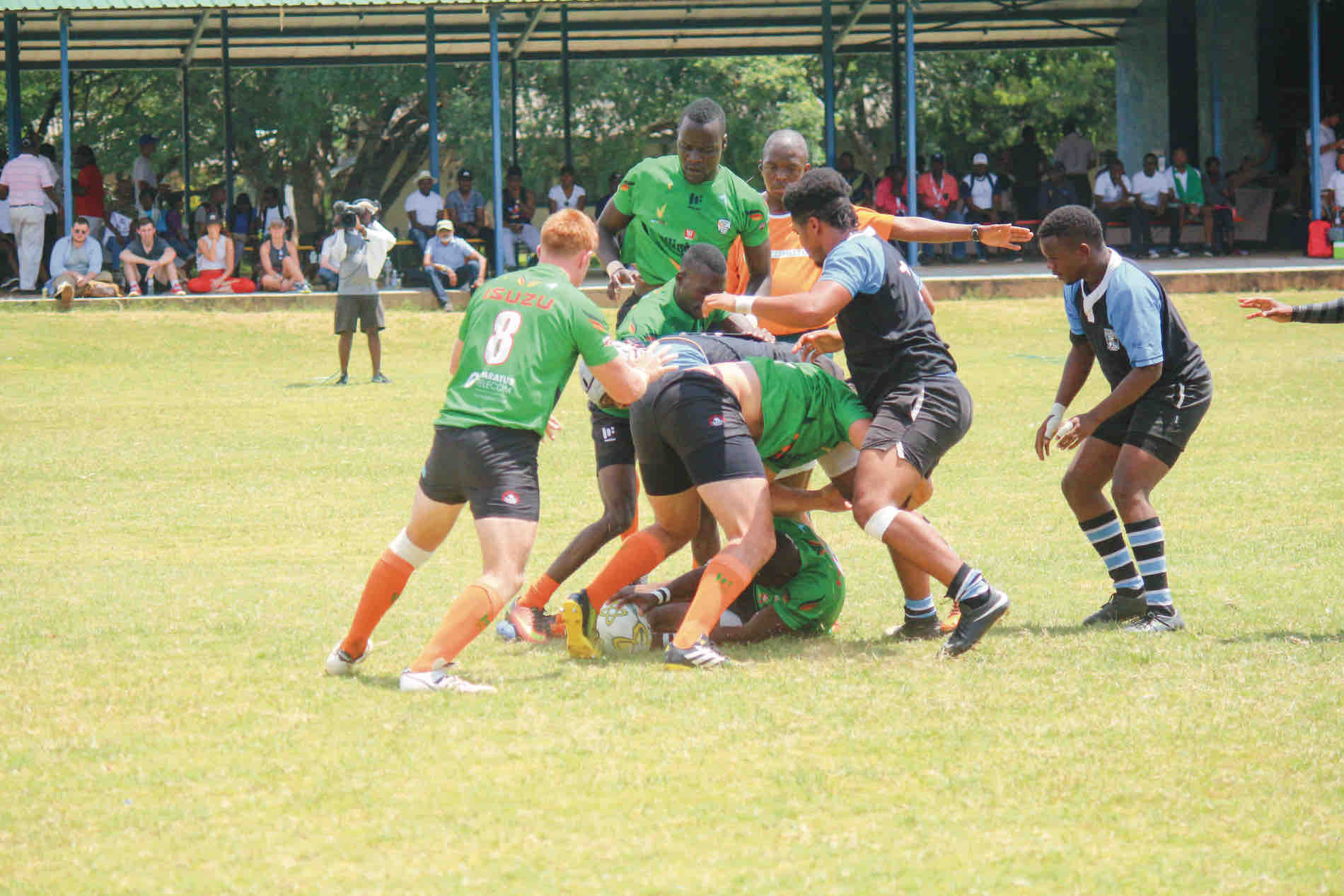
For decades, Zambia's sporting identity was carried almost entirely by football, and mostly by memory. The golden generation was lost in the Gabon air disaster of 1993, and the redemptive AFCON triumph of 2012 on that same soil. It was a story of tragedy and vindication, but for a long time, it was also the only story. That has changed. A new generation of Zambian athletes is writing a different narrative, built not on a single sport but on sustained excellence across football, mixed martial arts, and esports. Fashion Sakala, Racheal Kundananji, Miracle Chipito, and Bwalia Nkumbula have little in common on the surface. Different disciplines, different stages, different fanbases. But together they prove something Zambia hasn't had in years: talent from a landlocked, football-obsessed nation that can compete anywhere.
From Zanaco to International Success
Fashion Sakala's career reads like a map of how far Zambian football has travelled. Born in Chipata in 1997, he came up through Nchanga Rangers and Zanaco, winning the domestic league before a move to Spartak Moscow introduced him to European football, where he developed through both the reserve side and first-team opportunities. It was at Belgian club KV Oostende that his game truly sharpened, and by the time he left for Scotland's Rangers in 2021, he was a proven goalscorer on foreign soil. At Rangers, he became a Scottish Cup winner, notching 24 goals across 91 appearances.

Since 2023, Sakala has played in Saudi Arabia's rapidly rising Pro League with Al-Fayha, and his form there has strengthened the case that he belongs among the more productive wide forwards outside Europe's traditional powerhouses. His journey from the Zambian leagues, to Russia, to Belgium, to Scotland, to Saudi Arabia reflects how far the modern Zambian footballer now travels, and how comfortably they've adapted at each stop. For young players in Lusaka or the Copperbelt, his path offers something concrete: a route through unglamorous early moves that still ended in Cup medals and starring roles on world stages.
Racheal Kundananji and the Rise of Zambian Women's Football
If Sakala represents continuity in Zambia's long-standing strength in men's football, Racheal Kundananji represents change. In February 2024, Bay FC signed the Zambian forward from Spanish club Madrid CFF for a fee that made her, at the time, the most expensive player in women's football history. For a country where women's football has historically received a fraction of the investment given to the men's game, that fee alone was a statement.
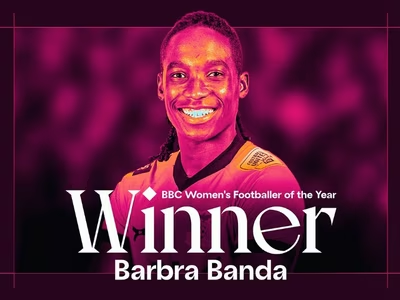
Kundananji's rise has been built on numbers that would stand out in any league. She has represented Zambia at senior level since 2018, and by late 2025 had scored more than 30 international goals, featuring at the 2023 World Cup and both the Tokyo and Paris Olympics. At club level, she quickly established herself among Bay FC's most prolific goalscorers, and her 2025 form earned her a first nomination for CAF's Women's Player of the Year, alongside fellow Zambian star Barbra Banda.
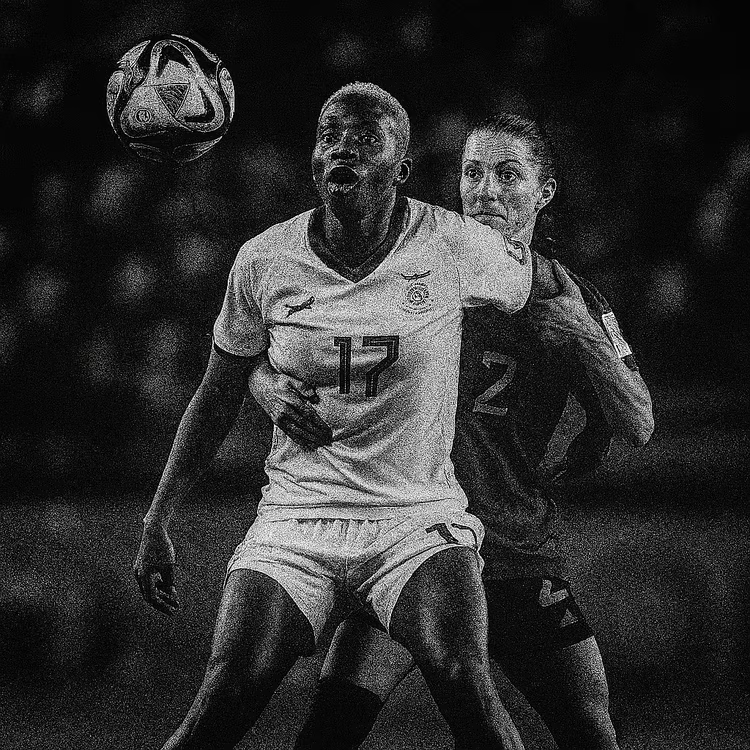
What makes Kundananji's story resonate beyond the scoresheet is where it started. She has described beginning her football journey in secret, playing in the streets after school while telling her family she was visiting a friend, unsure the sport could ever become a career. That a girl who once hid her love of football would go on to headline a professional franchise in the United States speaks directly to a generation of young Zambian girls now watching women's football not as a curiosity, but as a viable path, one with contracts, transfer fees, and Olympic stages attached to it.
Miracle Chipito's Historic Rise in Mixed Martial Arts
Mixed martial arts barely registered as a Zambian sporting pursuit a few years ago. Miracle "The Miracle" Chipito has changed that almost single-handedly. Fighting out of Lusaka's Ulemu Fight Academy, she built an amateur record of nine wins against four losses before claiming gold in the flyweight division at the 2025 Africa Championships with a first-round technical knockout. Months later, she reached the final of the International Mixed Martial Arts Federation's World Championships in Tbilisi, Georgia, taking silver and becoming one of Zambia's first athletes to win a medal at an IMMAF World Championship. An achievement recognised by President Hakainde Hichilema at a State House ceremony.
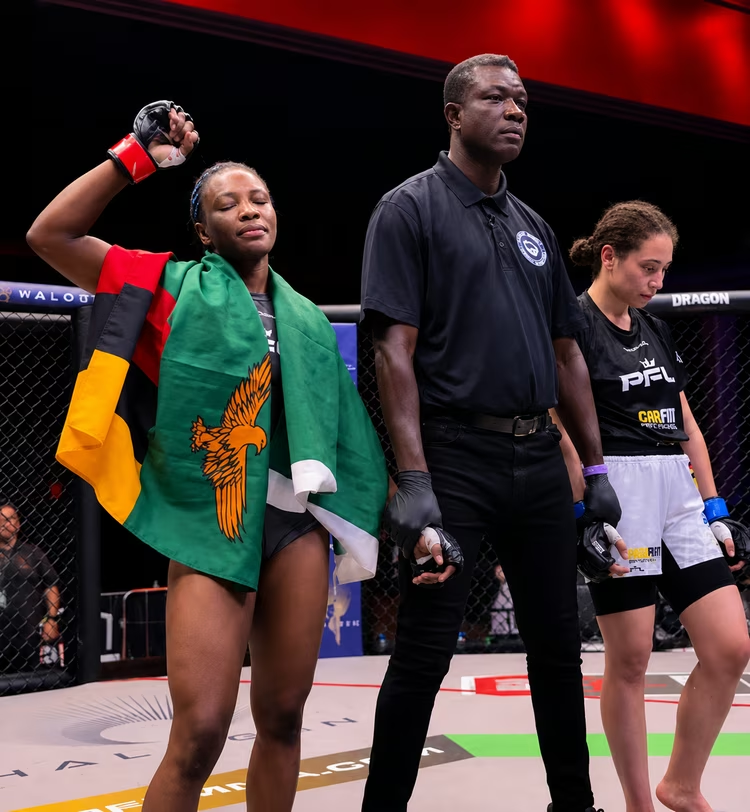
In November 2025, Chipito signed a multi-fight deal with the Professional Fighters League, becoming the first Zambian fighter to join one of the sport's major global organisations, alongside the UFC and Bellator. She turned professional weeks later, winning her debut bout at the PFL Africa Finals in Benin, and in 2026 added the AUSC Region 5 Sportswoman of the Year award to her list of honours.
What stands out in Chipito's story isn't only the medals. It's the absence of infrastructure behind them. She has spoken candidly about fighting largely without the backing of her own family, who have never watched her compete, and about the limited resources and exposure MMA athletes face in Zambia compared to football. Her coach has described her rise as a reflection of what many Zambian athletes face: talent developing despite the system rather than because of it. That she reached a PFL contract and a world championship final anyway suggests what might be possible with support at scale.
Bwalia Nkumbula Is Putting Zambian Esports on the Map
Esports is the newest frontier in this story, and Bwalia Nkumbula, known competitively as "LiaRose", has become one of its most visible Zambian faces. In late 2024, she represented Zambia at the Mzansi Esports Champions in South Africa, a tournament organised by SAGES Africa to showcase women's talent in African gaming, alongside competitors from Kenya, South Africa, Nigeria, Namibia, Malawi, Lesotho, Eswatini, and Madagascar. Competing against some of the continent's most established female gamers, Nkumbula finished among the field of eight, an experience she has called surreal and formative.
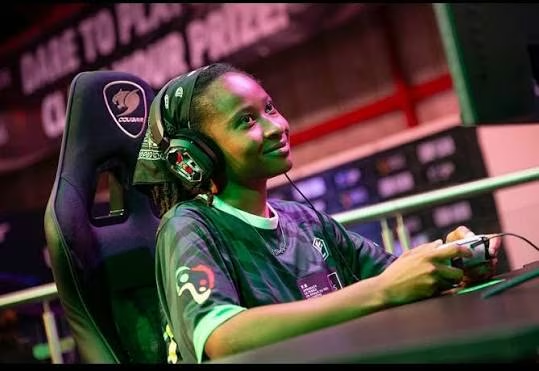
Beyond the tournament stage, her impact has extended into building the ecosystem itself. She has spoken publicly, including in a BBC Africa interview, about the state of female and African gaming, and she has been recognised with a Zambian Women of the Year Digital award for her entrepreneurial work in the space. As an executive behind a creative media venture in Lusaka, she's positioned not just as a competitor but as someone actively constructing the pathways. Sponsorships, professional teams and visibility that Zambian esports has historically lacked. In a country where gaming is often dismissed as a hobby rather than a career, her dual role as player and builder may be her most significant contribution: proof that the discipline can sustain both competition and livelihood.
Why This Is a New Golden Generation for Zambia
What ties Sakala, Kundananji, Chipito, and Nkumbula together isn't shared history but shared timing. Each is proving, in a different arena, that a Zambian athlete no longer needs football's established pipeline to reach the world stage. Even within football, that pipeline now runs through women's leagues as readily as men's. Kundananji's transfer fee, Chipito's PFL contract, Sakala's Saudi Pro League consistency, and Nkumbula's continental esports appearances are evidence that Zambian sport is no longer defined by a single sport or dependent on another AFCON-style triumph.
For the people back home watching from Lusaka, Ndola, or Chipata, the message these four people send is less about any single accolade and more about representation: that success can look like a Scottish Cup medal, an NWSL scoring record, a PFL octagon debut, or even as simple as hearing "you've done well". None of these paths was visible, in any real sense, for Zambian athletes a generation ago. They exist now because Sakala, Kundananji, Chipito, and Nkumbula redefined what success looks like. One contract, one medal, one broadcast at a time. That, more than any single accomplishment, is what makes this moment feel like a genuine new dawn.